

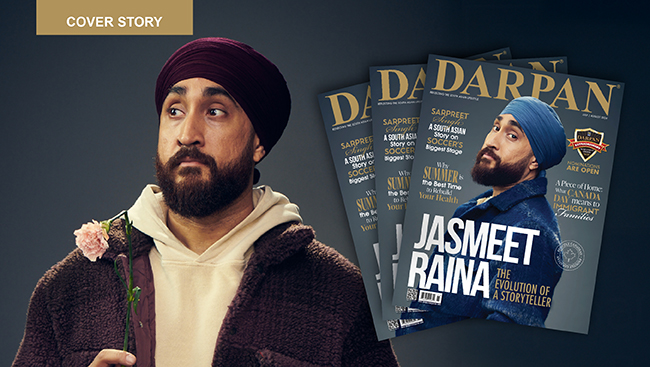
For an entire generation of South Asian youth, Jasmeet Raina arrived long before representation became a buzzword. How the creator once known as Jus Reign grew from being a YouTube sensation to one of the most prominent South Asian storytellers in the community is a story of the power of telling our stories on our own terms.
Today, nearly two decades after posting his first videos online, Raina has bloomed into a new chapter. As the creator, lead actor, and creative force behind the acclaimed television series Late Bloomer, he is no longer just making audiences laugh. He is challenging them to confront family dynamics, identity, trauma, healing, and the unspoken realities of growing up as a South Asian immigrant in North America.
The evolution feels natural now. For Raina, though, it was never part of a carefully mapped-out career plan.
The Accidental Trailblazer
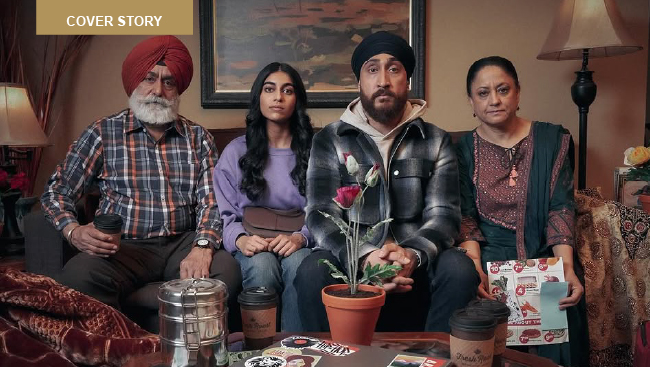
Before streaming platforms invested in diverse voices, before algorithms served up ethnic creators by the thousands, and before conversations about immigrant identity entered the mainstream, there was Jus Reign: a young Punjabi Sikh uploading comedy sketches to YouTube and making an entire community feel seen.
Born and raised in Guelph, Ontario, to an immigrant family, Raina initially followed a more conventional path. Like many South Asian children, he attended university with the expectation of likely pursuing a stable profession in the field of medicine. At the same time, he was experimenting with comedy videos online.
When he began posting YouTube videos in 2009 under the name Jus Reign, social media looked very different from what it does today. Raina recalls, "Smartphones weren't even that accessible back then. If you wanted to watch a video, you'd go to your laptop or your computer and watch it on YouTube.”
At first, he simply found his videos funny, but eventually, the meaning crystalized. "I think I came to that realization as I was doing it," he notes. "Initially, I started off with, 'Oh, this is funny. We do this in our families.' But then it was that universal experience of people having gone through the same thing that allowed us to bond."
What began as a creative outlet quickly turned into something much larger. His sketches about Punjabi parents, family expectations, racism, and cultural misunderstandings resonated with audiences around the world. In fact, Raina built a loyal following that stretched far beyond Canada.
Raina remembers one moment with his mother that perfectly captured how far his comedy had travelled beyond the screen. She was in the middle of scolding him when she suddenly paused. Mid-lecture, she realized she was repeating lines almost word-for-word from one of his sketches. “She clocked it,” he says, laughing. “She realized she was doing that, and then we just looked at each other and burst out laughing. She was like, ‘I can’t even say anything anymore because you’re just going to put it in a video.'”
Simply put, Raina’s videos were funny, chaotic, and endlessly quotable. Viewers shared them in computer labs, passed them around at family gatherings, and memorized punchlines that became part of the cultural lexicon. However, beneath the humor was something more profound. Raina was documenting a shared experience that many children of immigrants had never seen reflected back at them.
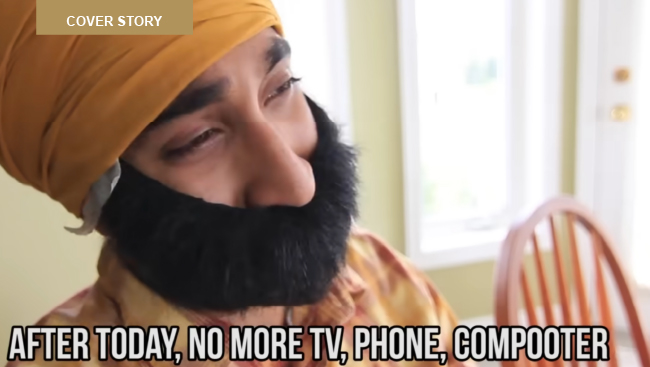
What started as comedy had become a mirror.
The Disappearance
Then, almost without warning, he was gone.
For a creator who had built an entire digital universe out of everyday South Asian life, the silence was impossible to ignore. One day, there were new sketches, characters, and punchlines circulating across group chats and classroom computers. The next, nothing. No upload schedule. No farewell video. No explanation that fans could latch onto. There was no announcement, just a gradual fading out that turned into years of speculation, echoing a growing sense of confusion. Was something wrong? Was this permanent? Was he okay?
Online, theories multiplied, but real answers were scarce.
Looking back, Raina describes that period less like a dramatic exit and more like a necessary pause in momentum that had become unsustainable. The pressure of constant output, combined with the expectations that came with being one of the most visible South Asian creators on the platform, had begun to weigh differently. The silence, in hindsight, was not empty. It was transitional.
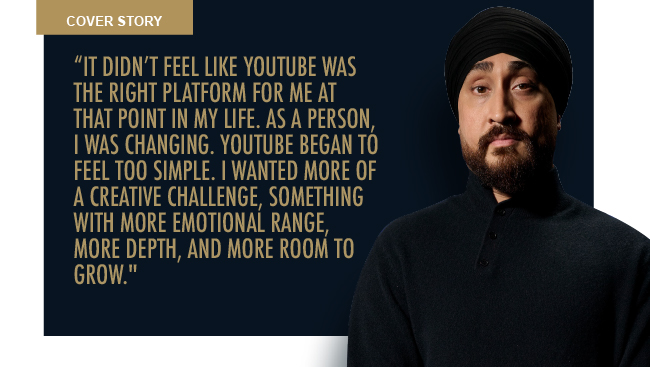
Raina remembers making one of his final videos before the hiatus and feeling something unfamiliar: the format that had once felt instinctive no longer felt creatively fulfilling. The endlessly upbeat, rapid-fire talking-head persona that defined Jus Reign no longer reflected who he was becoming off-camera. He details, “It didn’t feel like YouTube was the right platform for me at that point in my life. As a person, I was changing. YouTube began to feel too simple. I wanted more of a creative challenge, something with more emotional range, more depth, and more room to grow.”
Arguably, it wasn’t that the platform had stopped working. It was that he had outgrown the version of himself it was designed to amplify. The humor was still there, but the questions he wanted to ask were no longer the kind that could be answered in a three-minute sketch. That said, a creator who had once felt omnipresent in social media feeds suddenly vanished at the height of his cultural relevance.
It would be years before that absence would be filled again, this time not with sketches, but with something far more deliberate: a scripted world built from the same lived experiences that once shaped his humor, but now given space to breathe in a different form.
That world would become Late Bloomer.
Healing Through Storytelling
The return to storytelling almost came as a correction in direction for Raina. Where Jus Reign had once been built on speed and relatability, Late Bloomer, with Season 3 just released, moves differently. It slows everything down, sits inside moments longer, and allows silence to do some of the work.
For Raina, that shift wasn’t just creative. It was personal.
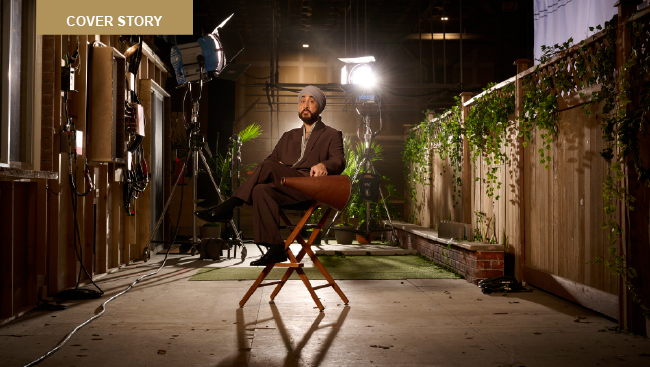
“The biggest drive behind the show was probably just having gone through changes in my personal life, and therapy, and having some form of healing,” he highlights. “I felt like wherever an artist is, the best work is produced based on where they are at that moment, and if they’re truthful about what they’re going through.”
That idea sits underneath Late Bloomer, even when the show is not explicitly about it. Family conflict is not simplified into good or bad. Conversations do not always resolve. Characters misunderstand each other not because they are written to, but because that is often how communication works in real life.
Raina is equally intentional about how that philosophy extends to casting and representation on screen. On Late Bloomer, he is clear that authenticity is not something he delegates easily, even when he is wearing multiple hats himself. “I’m always trying to cast as authentically and as real as possible,” he emphasizes. “I want the characters to feel real. For any Punjabi character you see on the show, I make sure we get that right. Even if it means street casting or bringing in people we know, I’ll push for more auditions. They have to sound, feel, and look like the characters they’re portraying.”
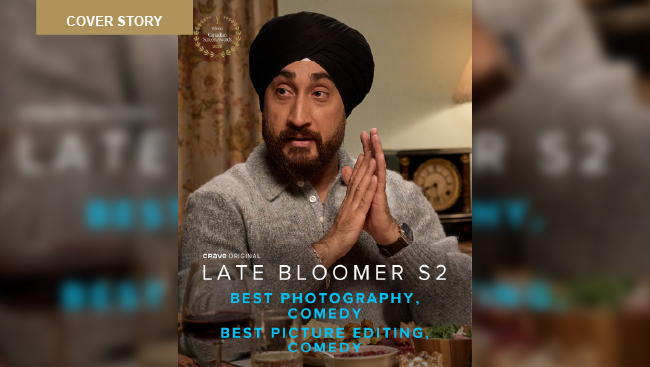
That same instinct for control and specificity extends behind the camera on Late Bloomer, where Raina recounts stepping into directing initially came with external resistance, despite feeling like a natural extension of his existing process. “When I said I wanted to direct, I got a lot of pushback,” he admits. “There aren’t that many people who write, act, direct, and produce at this level.”
Nevertheless, he just felt too strongly about taking on episodes that were especially personal, including the student storyline and the 9/11 episode. “I just felt like I had to do them,” he remarks. “There was only a certain way I saw them working.” After directing his first two episodes, his first-ever experience in the director’s chair, he says the response helped shift perception, allowing him to push his directorial talents further in the new season.
Raina states, “This is my first time acting on screen, my first time writing, my first time doing a lot of this. But I’m still doing it. There was a week I was really sick with a high fever and still had to shoot. I think people can use inexperience as an excuse, but I don’t really see it that way. You’ve got to just keep going.”
Not A Comeback, A Continuation
Even as Late Bloomer anchors this chapter of his career, Raina is already thinking beyond it. He outlines, “I’m working on and developing more, but I’m also excited about, hopefully, Late Bloomer Season 4.”
Lightheartedly, when asked to imagine an alternate reality where Late Bloomer never materialized, Raina, almost amused by how differently things could have unfolded, responds, “I don’t know what else I’d do. I don’t feel compelled to do YouTube anymore.”
He pauses, then adds with a half-smile, “I think I would’ve just become a hermit, honestly. I would’ve travelled, maybe gone to the mountains, just walking everywhere on foot. Maybe I would’ve gone to Nepal, done some hiking, spent time in a monastery, and even learned martial arts.” He laughs before continuing, “So that was kind of the split for me. I was either going to do that or do this.”
In many ways, those hypothetical crossroads was mirrored by those closest to him. Raina notes that his family’s understanding of his work has also shifted significantly over the years. As he puts it, “In the beginning, they were confused; they didn’t really understand what I was doing. But then, they truly began to believe in my creative vision. Now, they are even more supportive of me than I am of myself, and really just champion me to keep going.”
Pondering on the passage of time, Raina turns to his younger self. “I remember being a kid, I wanted to do either comedy, acting, or directing,” he shares. “Now I’m doing all of them. That part of me would probably think, whoa, you’re actually doing the thing you set out to do. And younger me would also think my Pokémon card collection is very cool, even if nobody else does.”
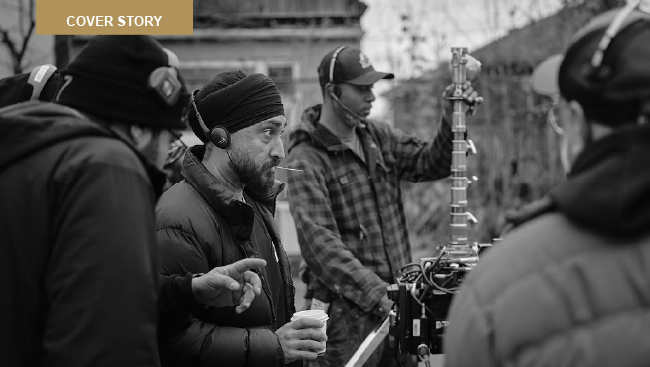
Moving forward, Raina resists the idea that his story has reached any kind of fixed point, embracing instead an ever-evolving sense of fluidity. What ties it all together is not a single breakthrough or reinvention, but a continuous return to the impulse that first pushed him to begin: storytelling. And running through it all is a sense of continuity with who he has always been, as if the different versions of himself are still in conversation, each one recognizing something familiar in what comes next.


