Friday, July 17, 2026
ADVT 
Spotlights

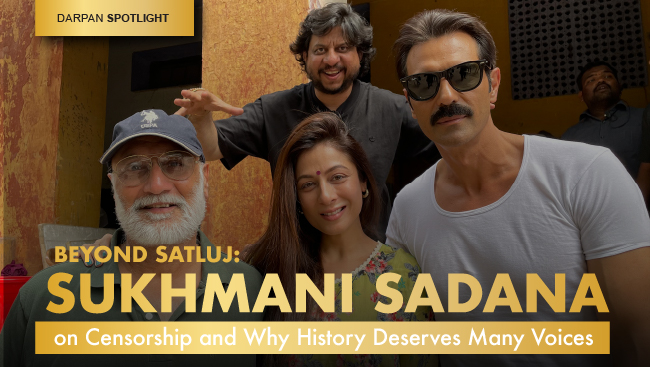
Beyond Satluj: Sukhmani Sadana on Censorship and Why History Deserves Many Voices

Ancy Mendonza Darpan, 16 Jul, 2026 01:29 PM
  • Beyond Satluj: Sukhmani Sadana on Censorship and Why History Deserves Many Voices

The conversation around Satluj has grown far beyond the film itself. Inspired by the life of human rights activist Jaswant Singh Khalra, the Honey Trehan-directed film—headlined by Diljit Dosanjh—was briefly available on ZEE5 before being removed following government action under the Information Technology Act. As debates around censorship, artistic freedom, and historical storytelling continue, actor and screenwriter Sukhmani Sadana, who plays a television journalist in the film, reflects on the responsibilities of storytellers, the changing role of journalism, and why history should never be reduced to a single perspective.  

Q1. Satluj has become part of a much larger conversation about censorship than cinema itself. Where do you think the line should be drawn between protecting public interest and protecting artistic freedom?  

Sukhmani Sadana: Storytelling comes with responsibility for everyone involved - the writer, director, producer, and actors. When films are based on real events, they should be made by people who approach the subject with honesty rather than the intention of provoking controversy. In Satluj, Honey Trehan presents history through a straightforward narrative without asking the audience what to think. Cinema should allow different perspectives to exist. If someone wishes to tell another side of the story, they should have the freedom to do that too. Audiences today are thoughtful enough to engage with different viewpoints and form their own opinions.  

Q2. You portray a fearless journalist in the film. Has journalism changed, or is courage still its defining quality?

Sukhmani Sadana: Courage remains the foundation of journalism. The challenges may look different today, but there are still journalists asking difficult questions and standing by their principles. At the same time, I do feel earlier generations displayed an extraordinary fearlessness despite having just as much to lose. That spirit continues to inspire me, and it was one of the reasons I connected so deeply with my character.  

Q3. Do controversies like this discourage filmmakers from telling politically or historically sensitive stories?  

Sukhmani Sadana: I don't think this changes the mindset of storytellers. There have always been filmmakers who choose to explore difficult subjects, just as there have always been those who prefer commercial cinema. Films dealing with complex history have existed for decades. Ultimately, it comes down to the kind of stories a filmmaker believes in telling.  

Q4. Has the controversy changed how people will remember Satluj?  

Sukhmani Sadana: I think the film would have found its audience regardless, because of the subject it explores. However, the controversy has undeniably created curiosity. Many people who may never have watched the film are now asking why it was restricted. In that sense, the conversation has become much bigger than the film itself. Attempts to suppress a story can sometimes make more people want to understand it.  

Q5. If a young journalist or filmmaker approached you today wanting to tell a difficult story rooted in history, but was worried, what would you tell them? 

Sukhmani Sadana: Tell the story you believe in but remember that storytelling carries immense responsibility. Your work should contribute to understanding rather than deepening divisions. Present the subject honestly, acknowledge different perspectives where appropriate, and trust the audience to think for themselves. Most importantly, don't be afraid to tell meaningful stories, but never misuse the power that comes with telling them.  
MORE Spotlights ARTICLES

Like Father, Like Son: Jaswinder Bhalla’s Legacy Lives On Through Pukhraj Bhalla

Like Father, Like Son: Jaswinder Bhalla’s Legacy Lives On Through Pukhraj Bhalla
Few figures in Punjabi entertainment are as beloved as Jaswinder Bhalla. As the industry marks the legendary actor and comedian’s first death anniversary this year, his absence continues to be deeply felt. Yet, his legacy lives on through his son, Pukhraj Bhalla, who is carving out a successful career while honoring the values and standards his father set. 

Like Father, Like Son: Jaswinder Bhalla’s Legacy Lives On Through Pukhraj Bhalla

Sarpreet Singh: A South Asian Story on Soccer’s Biggest Stage

Sarpreet Singh: A South Asian Story on Soccer’s Biggest Stage
As FIFA World Cup 2026 captivates audiences across North America, football is once again proving why it remains the world's most unifying sport. Across packed stadiums, passionate fan bases, and nations brought together by a shared love of the game, the tournament has become a celebration of cultures, communities, and dreams. 

Sarpreet Singh: A South Asian Story on Soccer’s Biggest Stage

Lata Pada: Dancing Across Cultures, Building a Legacy

Lata Pada: Dancing Across Cultures, Building a Legacy
For more than three decades, Lata Pada has been one of the most influential voices in Indian classical dance in Canada. A celebrated Bharatanatyam dancer, choreographer, educator, and founder of Sampradaya Dance Creations, she has dedicated her life to preserving tradition while reimagining its place in contemporary society. 

Lata Pada: Dancing Across Cultures, Building a Legacy

Meet the First Sikh from Canada to Summit Mount Everest: Ajaypal Singh Dhaliwal

Meet the First Sikh from Canada to Summit Mount Everest: Ajaypal Singh Dhaliwal
At 8,848 meters above sea level, the summit of Mount Everest is often described as the roof of the world. On May 20, 2026, Ajaypal Singh Dhaliwal became the first Sikh Canadian to reach it, a milestone celebrated across communities in Canada and beyond. For the Surrey-based lawyer, the achievement marked the culmination of years of training and perseverance, but the mountain's greatest lesson came during a perilous descent from the summit, an experience that left him with a renewed appreciation for humility, gratitude, and the value of everyday life. 

Meet the First Sikh from Canada to Summit Mount Everest: Ajaypal Singh Dhaliwal

Prince Manvendra Singh Gohil: A Royal Voice for Inclusion, Equality & Global Change

Prince Manvendra Singh Gohil: A Royal Voice for Inclusion, Equality & Global Change
For Prince Manvendra Singh Gohil, widely recognized as the world’s first openly gay prince from the Gohil dynasty of Gujarat, living authentically has never been a private journey. It has been a public responsibility shaped by courage, resistance, and transformation. Born into royalty yet defined by truth, he has spent decades challenging stigma and rebuilding the idea of legacy itself. 

Prince Manvendra Singh Gohil: A Royal Voice for Inclusion, Equality & Global Change

Nadir Ibadullah-The Mighty Man Keeping Iconic Tiny Minis Alive

Nadir Ibadullah-The Mighty Man Keeping Iconic Tiny Minis Alive
Before immigrating to Canada in 2004, Nadir had restored what he calls his “perfect Mini.” It had won admiration back home and even placed first at a local mall display. He parked it safely in his father’s garage before leaving, fully intending to one day ship it to Canada. But time and weather had other plans. 

Nadir Ibadullah-The Mighty Man Keeping Iconic Tiny Minis Alive

PrevNext