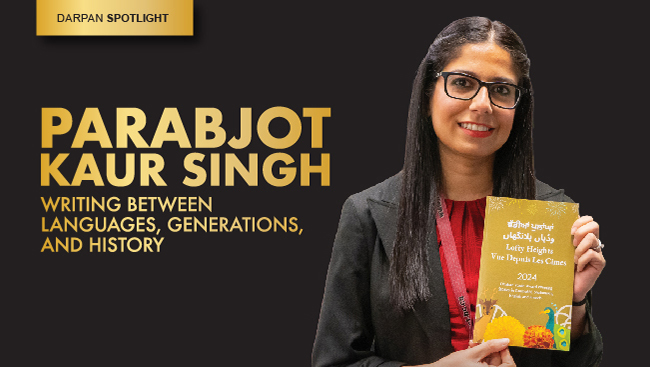
For Parabjot Kaur Singh, language is not just a subject she teaches. It is an inheritance, responsibility, and bridge. As a high school English and Punjabi teacher in British Columbia, her work inside the classroom is deeply intertwined with the stories she carries from home.
“My upbringing and relationship with language have played a significant role in shaping the stories I choose to tell,” she says. Born and raised in Canada to parents who immigrated from Punjab in the early 1990s, Parabjot grew up listening to stories of “pain, loss, struggle, and success.” Those narratives were not abstract history. They were family memories.
Punjabi was not treated as secondary in her household. It was revered. Her grandfather, Jarnail Singh Sekha, authored many books in Punjabi, leaving behind a literary legacy in Canada. “His legacy as a Punjabi writer in Canada gave me the tools to preserve the Punjabi language,” she highlights. Today, she gives back by teaching Punjabi in a classroom context, sharing her voice with younger generations growing up in B.C. as children of Punjabi immigrants.
Books surrounded her from childhood. “During my primary school years, my grandfather was actively involved in my education and instilled the life-long habit of reading,” she recalls. He read her English storybooks and verbally translated them into Punjabi, later teaching her Gurmukhi, an early bilingual foundation that shaped her writing. Her first book, Chewie, the Budgie, emerged from grief. “I wrote this book after the death of my pet bird,” she reminisces. Journaling through the loss, she found the memories forming a story.
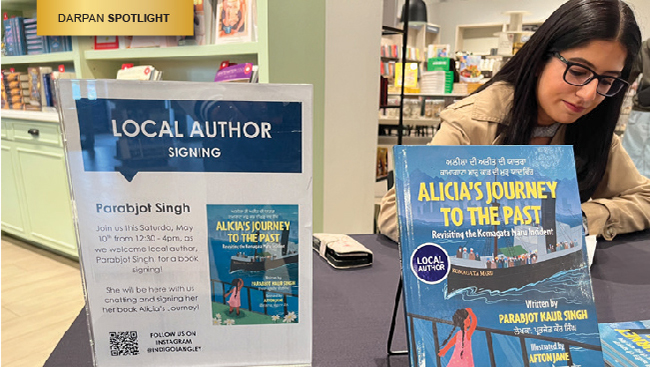
Her second book, Alicia’s Journey to the Past: Revisiting the Komagata Maru Incident, explores collective history. Parabjot says she did not learn about the tragedy growing up and later realized that there are limited resources for children and teens about Canadian history, with a focus on Punjabi immigrants in Canada. Writing the book was her way of centering those stories for young readers.
Alicia, a third-generation Canadian discovering her roots, is partly inspired by Parabjot’s own childhood. “Fitting in with ‘mainstream’ and ‘Punjabi’ communities was challenging because I felt a push and pull between both cultures,” she admits. The western name itself was also intentional, she points out, “The name ‘Alicia’ signifies the historical systemic struggles of acceptance and belonging.”
Bilingual storytelling is central to her mission. “It was important for this book to be bilingual because I wanted to bridge the gap between English and Punjabi,” she emphasizes. In addressing the Komagata Maru, she adds, “My goal was to present history by focusing on the human experience, teaching the truth, and fostering empathy and resilience,” ensuring children feel empowered to recognize injustice and help build a more inclusive future.
Ultimately, her hope is clear: “If we want children to grow and evolve into positive, healthy human beings, they must learn from the past, make positive choices in the present, and create a healthy life that will positively benefit families, communities, and the broader society.” Through language, memory, and history, Parabjot Kaur is ensuring the next generation does exactly that.