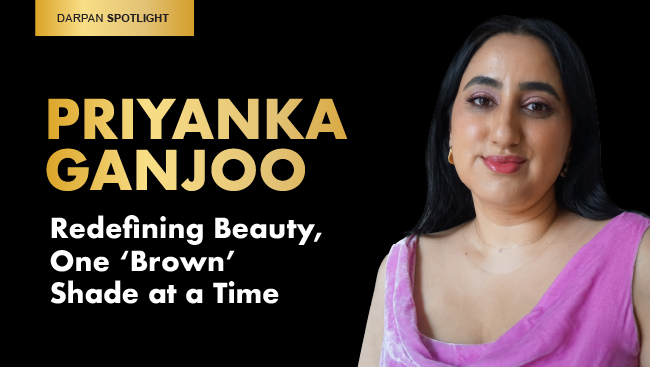
As the founder and CEO of Kulfi Beauty, Priyanka Ganjoo has become a trailblazer in modern beauty. Kulfi, the first-ever South Asian-owned beauty brand to be stocked at Sephora, has not only made waves with its vibrant color offerings but has also reshaped how South Asian representation is viewed in the global beauty space.
Known for its playful packaging, storytelling, and celebration of individuality, Kulfi is more than a brand; it is a cultural movement built around joy, authenticity, and community.
It’s a journey Ganjoo never imagined for herself. “It’s wild to me that I’m building a makeup brand because I didn’t even wear makeup growing up,” she admits. “I grew up feeling like makeup was not for me, that I didn’t have permission to participate in beauty, that it wasn’t meant for girls like me.” That sense of exclusion, paired with years of not seeing people who looked like her represented in beauty, planted the earliest seeds for what would later become Kulfi.
When she began working in the beauty industry from the business side in her late twenties, something shifted. “I discovered that makeup can be fun, and I discovered it on my own terms,” she recalls. “I remember playing around with eyeshadow at work, and it spilled all over my desk. It was glittery, and I was freaking out but also having so much fun at the same time. That was such a defining moment because I remember thinking that’s what beauty is. Beauty is color, it’s play, it’s fun.”

That moment of discovery became the heart of Kulfi. “It was an ‘aha’ moment for me, realizing that beauty doesn’t have to come with judgment or fitting into a certain standard. It can really be about expressing yourself,” she says.
When asked what nuances about South Asian skin tones the industry still misunderstands, Ganjoo points out that the problem goes far beyond oversight. “South Asian skin tones and undertones have been largely ignored by the global players in beauty,” she says. “It’s not even that they’ve been misunderstood but they just haven’t been studied at all. What we do in our process is keep our community front and center when we’re developing shades and products. Even with our concealer, we created 21 shades and worked with a lot of undertones. There’s still more we can do, but we’re already doing far more than what’s been done in the industry for a long time.”
She explains that it’s not rocket science; it’s about intention and care. “It just requires intentionality, resources, and effort behind serving the market you’re creating for. It’s about taking customer feedback and continuously getting better at developing products that work for our skin tones and undertones.”
Ganjoo highlights how diverse South Asian complexions truly are, spanning a spectrum of undertones from cool and warm to olive and peach. “With real people and real skin, we’ve developed an understanding of what shades truly complement different tones and undertones. That’s how we’re pushing boundaries through innovation and risk-taking.”
She recalls how this approach inspired Kulfi’s beloved Nude Lipstick Collection, which featured seven shades of nude. “It was funny because sometimes the difference between a brown nude and a light brown nude is so slight, but we wanted to take the risk to refine our understanding of what works across skin tones. That small variation in depth or undertone can make a huge difference in how it shows up on someone’s skin.”
For Ganjoo, beauty and mental health are deeply interconnected, an idea woven into the heart of Kulfi’s mission. “Beauty and mental health are definitely very intertwined in our approach,” she reflects. “When you think about seeing people who look like you in beauty brands and rethinking your idea of what it feels like to feel beautiful, that has a huge impact on mental health.”
One of her most memorable examples is Kulfi’s Free the Brow campaign. “We featured a young woman who had thick brows and a unibrow, and she was so proud of it. She was owning it. I loved the photography that came out of that campaign, and it was so healing for me because I’ve always had big brows. Growing up, I was made fun of for them and felt like I constantly had to go to threading salons. I was very conscious of my facial hair, and it affected my self-esteem. So, to see someone proudly owning her features, felt incredibly healing for me.”
Through campaigns like this, Kulfi continues to champion representation, self-acceptance, and community healing. “We hope that through our work and the representation we’re creating, more people feel seen,” Ganjoo says. “We also do give-back initiatives. This year, our give-back initiative was for the Palestine Children's Relief Fund, and every year we usually partner with different organizations. As we grow, we want to do more in the mental health space as well.”
For Priyanka Ganjoo, Kulfi is not just about beauty but about rewriting the narrative. By celebrating South Asian identity with authenticity and heart, she is creating space for countless others to feel confident in their skin, just as they are.