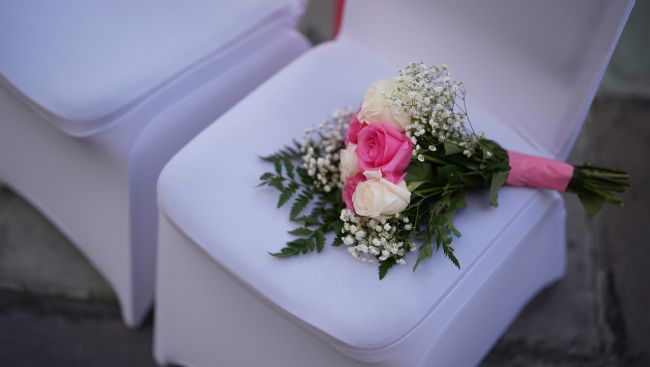
Instead of hiring a florist for her October wedding, Emily Day decided to grow her own flowers in her front yard in Calgary, Canada — a creative challenge that turned into a lesson on the hidden climate costs of the global flower industry. She said her homegrown arrangements were just as beautiful as store-bought ones and cost a fraction of the price.
Day and her fiance built garden boxes out of wooden shipping containers in March and filled them with blooms like yarrow, feverfew, strawflowers and statice. They harvested and dried them in midsummer ahead of fall frosts. On her wedding day, her bouquets featured autumn shades accented by blue echinops from a local farmer and tansy she foraged from roadside ditches.
Because her flowers were dried, they’ll last far longer than a typical wedding arrangement. In total, she spent about 1,300 Canadian dollars ($925), a fraction of what many couples pay florists. Day said growing her own flowers made her think more about the environmental costs behind imported blooms — from the plastic packaging they arrive in, to the fuel used to fly them across continents.
As Generation Z and millennials incorporate sustainability into weddings and other special events, some are growing their own bouquets, picking wildflowers or using potted plants. Businesses are sourcing their flowers locally and collecting and repurposing flowers when the event’s done.
Carbon emissions from importing fresh flowers
The path many imported fresh flowers take to North America often begins in South America and involves a supply chain full of carbon emissions, said Kai Chan, professor of sustainability science at the University of British Columbia.
Flowers perish quickly when they are cut, so they are refrigerated and transported on planes, both of which require energy and release planet-warming gases. Growing massive fields of roses, or any other single plant, typically requires clearing trees and other natural vegetation. This practice, known as monoculture, harms the environment by depleting soil nutrients and making the area more vulnerable to pests.
“It’s kind of antithetical to the way that ecosystems work … you’re fighting against nature at every turn,” Chan said.
He said buying flowers from local, small-scale farmers is generally favorable because the blooms don't travel as far and the farmers typically follow practices attuned to the local environment.
Shopping local for sustainable flowers
Holly Lukasiewicz, who owns District 2 Florals in Omaha, Nebraska, incorporates sustainable practices such as sourcing locally and avoiding the green foam blocks that are used to anchor arrangements but typically aren't biodegradable. For an extra fee, she’ll pick up the flowers and compost them. She also presses and preserves flowers for clients.
“When I started my business, I knew that I wanted to recycle everything that I could, compost what I could, repurpose what I could,” Lukasiewicz said.
Lukasiewicz hopes more clients will embrace seasonal and local selections rather than expecting any flower, any time of the year.
For decades, much of the flower industry moved abroad because of trade policies and lower costs. Imported flowers are often cheaper, especially when customers want something that can't be grown locally.
“Some people prefer locally-grown, sustainable products and are willing to pay that higher price point. But oftentimes most consumers go, ‘I’m going to buy the cheapest one that’s there,’” said Neil Anderson, professor of horticulture at the University of Minnesota.
Debra Prinzing, founder of the Slow Flowers Society that promotes sustainable floral practices, said that beyond being more sustainable, local and seasonal flowers can make an event more meaningful.
“If you care about local flowers for your wedding, then you know the story of where those flowers were grown,” she said. “Next year, when your anniversary comes up and you see those flowers in bloom or you see them at the farmers market, they’ll remind you of your wedding.”
Esther Lee, editorial director at The Knot wedding planning website, said that a significant number of couples say sustainability is important to their wedding plans. She said couples hope to personalize their event and give guests a sense of the region where the event is being held.
“There is just such a unique ambiance and element to the local flora of a place,” Lee said.
Artificial flowers are sometimes advertised as a sustainable alternative to fresh flowers, but it is important to evaluate data from manufacturers that back up this claim, said Silvia Bellezza, associate professor of business at Columbia Business School. Many artificial flowers are made of plastic and are imported, so “we shouldn’t take the claim that they are more sustainable at face value,” she said.
For Day, the bride that grew her own flowers, that story didn’t end when the night was over. Her guests took home the dried flowers, and a friend later borrowed several arrangements for her own ceremony.
“That’s what’s cool about them too, is you can reuse them time and time again,” Day said. “And then when they get beat up, unlike plastic flowers, you can just throw them in your compost and say, ‘go back to the earth, see you later.’”
Picture Courtesy: AP Photo/Rebecca Blackwell, File