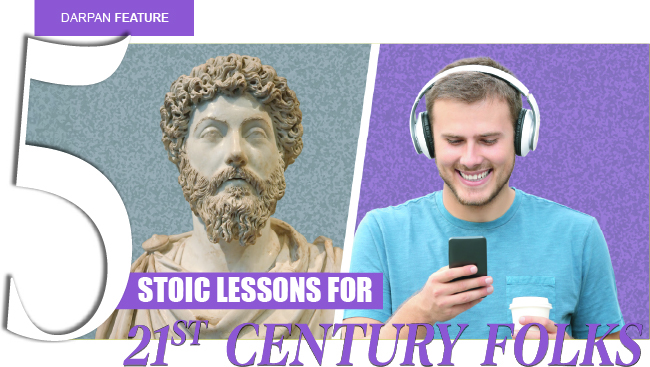
One of Rome’s most powerful rulers, Marcus Aurelius, who reigned from 161 to 180 CE, is now remembered as one of the greatest philosophers of the ancient world.
His personal reflections have turned into a book known as 'Meditations,' which propounds stoicism, a value system that teaches how to live a good and happy life by focusing on what is within your control.
Even though these reflections were written over 2,000 years ago, they continue to resonate in our own era. The 21st century may be defined by smartphones, climate change, political division, and rapid technological disruptions.
However, the challenges Aurelius grappled with are timeless. Here are 5 Stoic lessons from the Roman emperor that could serve as a toolkit for thriving in the 21st century.
1. Focus On What You Can Control

In 'Meditations', the Roman emperor reminded himself that he could not control external events, only his reactions to them. In today’s world of nonstop news cycles and social media outrage, where people often feel crushed by the weight of problems they cannot fix, this seems like a radical idea. Climate change, political turmoil, pandemics, and social strife can create a sense of helplessness. Nevertheless, people can focus on daily habits, personal choices, and local actions as they can control them.
For instance, the Swedish teenager Greta Thunberg could not halt global warming by herself, but she sparked a movement by speaking out regularly. Ordinary people can practice this stoic principle by recycling, voting, or volunteering locally instead of drowning in despair. Aurelius' advice, in short, tells the 21st-century person to master his or her response to life events to live a stress-free life.
2. Be Present in a Distracted World

Long before 'living like Zen' became a lifestyle choice for millions, Aurelius had written about living as if each day could be the last. What he really meant was being mindful in day-to-day life.
This was not a call to recklessness but a reminder that life exists only in the present moment. Living in the present feels like a challenge in the 21st century, where people's attention spans are affected by notifications, emails, and endless feeds pulling us away from the present.
Companies like Google train employees in mindfulness to boost focus and reduce stress. Athletes like Novak Djokovic credit mindfulness practices with helping them perform under pressure.
For ordinary people, living in the present could mean putting the phone aside during meals, focusing deeply on a single project, or simply observing five minutes of silence each day. Aurelius' advice, in short, reminds us that in a distracted world, attention is not just a resource but a form of resistance.
3. Redefine Leadership as Service

As the Roman ruler, Aurelius consistently reminded himself to act with justice and humility. He saw leadership as a form of duty rather than privilege. This runs counter to the 21st century’s tendency to equate leadership with self-promotion, celebrity branding, or accumulation of power. Nevertheless, there are several examples of service-driven leadership in this century, too.
Ratan Tata, as the Chairman of the Tata Group, showed how empathetic leadership can inspire generations. Following the dastardly terrorist attack on November 26, 2008, which targeted the Hotel Taj in Mumbai, Tata rushed to the site and supervised the rescue efforts until the last moment. Another example of service-oriented leadership was Patagonia founder Yvon Chouinard, who gave away his company to fight climate change, prioritizing service over profit.
The Roman emperor’s reminder feels poignant in an era when the pursuit of status often overshadows genuine integrity.
4. Build Resilience Through Perspective

Aurelius endured wars and plagues, yet he found strength by zooming out his perspective. He saw his troubles as fleeting in the ocean of time. For stoics, adversity is a part of the natural flow of existence. This perspective is deeply useful in our century, marked by rapid disruption and uncertainty.
The COVID-19 pandemic tested global resilience. Jobs were lost, routines upended, and uncertainty felt suffocating. Yet many also discovered adaptability: families reconnected, remote work reshaped employment, and communities supported one another. This was resilience born of perspective, where hardship did not define the entirety of life. Entrepreneurs, artists, and professionals often face failure before success.
Oprah Winfrey, once fired from her first television job, reframed rejection as growth. This mindset echoes Aurelius' Stoic training: adversity is not the end but an opportunity to develop strength and resilience.
5. Protect Your Inner Freedom

Perhaps the most enduring insight in 'Meditations' is that freedom is internal. It does not depend on possessions, status, or applause but on mastery of one’s own desires and thoughts. Aurelius warned against being enslaved by anger, greed, or the pursuit of external validation.
Consumer culture in the 21st century equates happiness with products, while social media turns self-worth into a contest of likes and followers. Algorithms are designed to manipulate impulses, leaving many trapped in cycles of comparison and distraction.
Yet inner freedom remains attainable. Movements like digital minimalism have helped people reclaim autonomy from technology. Athletes such as LeBron James have demonstrated the value of disciplined routines and mental focus, showing that mastery of self is a foundation for success.
For ordinary people, inner freedom might mean limiting screen time, practicing gratitude, or pursuing hobbies for their own sake rather than for online approval.