Wearing high heels can lead to health issues later on in life.
High heels are fashionable; they are said to boost self confidence and make you feel like you can conquer the world. But not many are aware that a pair of high heels comes with health issues as well. “Women’s shoes, especially heel height, have always been for appearance. What is ignored or forgotten is the effect [it has] on multiple joints, ranging from the toes to the lower spine,” says Dr. Don Nixdorf, a well-known chiropractor from Richmond.
Further elaborating his statement, he points out to a research from the University of Alabama at Birmingham that reported on the increase of ankle fracture from high heels. The findings, published in the Journal of Foot and Ankle Injuries, shows that high-heeled-shoe-related injuries doubled between 2002 and 2012.
To start with, physical issues of high heels are more commonly associated with toes and low back conditions. “The high heel style usually includes a narrowing of the front of the footwear. The elevation of the heel pushes more weight bearing onto the joints of the toes, at the same time forcing the first toe (great toe) inwards,” explains Dr. Nixdorf about the impact of heels on toes.
Usually, low back problems are a result of sporting high heels. It is believed that 55 per cent of women experience spine conditions, particularly low back, more frequently than men. “While high heels are not the sole reason for women’s low back pain, it is a common report from most patients,” adds Dr. Nixdorf.
Low back conditions, the chiropractor educates, include the change of weight bearing, primarily affecting the components of joints including the fourth and fifth (L4, L5) lumbar and sacrum. “These joints include the disc, facets and the associated nerve tissue passing through those spaces. Muscles, tendons and ligaments associated with these joints will also be under greater stress in response to the increase of what is referred to as the sacral base angle.”
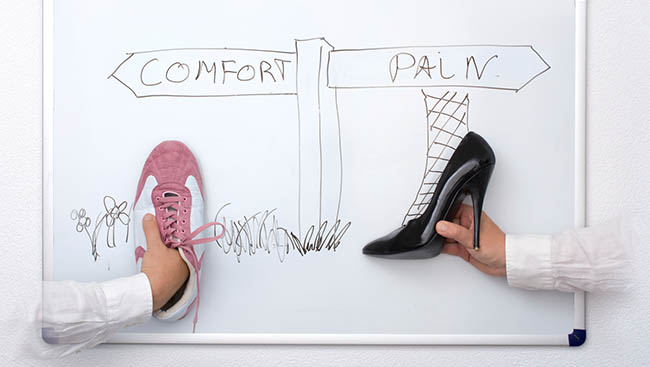
In simpler terms: wearing high heels can result in the dramatic change of the position of weight bearing bone joints. “The prolonged impact on joints can initiate gradual cartilage change from altered weight bearing in knees of some individuals,” says Dr. Nixdorf, warning that recovery of injuries happened at work, sport or through accidents and falls can be aggravated with high heels.
Discontinuing the daily use of heeled shoes can be a great step to avoid these health conditions. In fact, younger women should refrain from wearing heels to avoid malformation of the big toe. “Early use in youth may impact the ossification or growth areas with changes referred to as hallux valgus deformity (bunion),” points out Dr. Nixdorf, warning against the use of point-toe heels. “Regular use of high heel with point toes under the age of 20 may impact the position of toes (hallux valgus) later on.”
Dr. Nixdorf suggests avoiding associated footwear and seeking advice from an expert if you face low back issues. “Women should consider consultation with a podiatrist if specific foot/toe problems arise, and a chiropractic doctor if the lower back pain, including the common symptoms in muscle, motion and leg, occurs.”
He also advices on the selection of footwear: comfort of foot, ankle, knee, hip and lower spine should all be thought about and intuitively felt during selection and fitting. “Being aware of the basic impact on spine and associated joints from elevating the heel and placing weight on the toes is an important addition to shoe selection.”