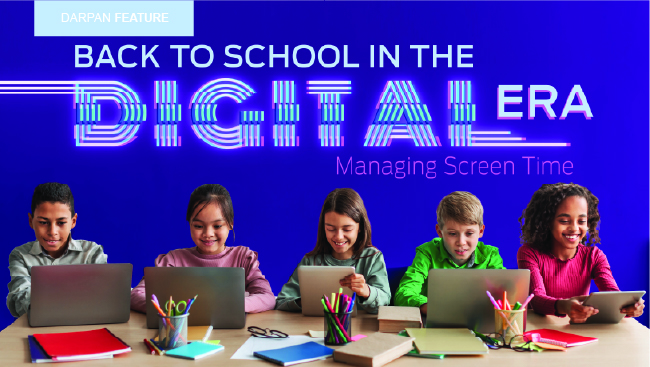
In today’s digital world, parenting has taken on a whole new dimension—especially when it comes to screen time. Laptops, tablets, smartphones, and apps have become staples in both home and school settings.
Yet, while digital tools are increasingly essential for education, they also pose challenges, particularly when it comes to managing children's recreational screen use. Parents often find themselves in a challenging position: trying to support their child's learning while also limiting their screen exposure.
This dilemma is becoming more pressing as schools incorporate digital learning into daily instruction. Many teachers now ask students to bring devices like iPads to class for accessing assignments, conducting research, and engaging in classroom collaboration.
Simultaneously, experts and educators warn about the risks of excessive screen time, especially related to social media, gaming, and passive consumption of content. The result? A balancing act that can be confusing for both parents and students.
The Ministry of Education and Child Care acknowledges this growing challenge. The Ministry notes that digital platforms present unique challenges and opportunities for students, families, and the education sector. In response, it is actively working to promote healthy and safe digital habits, both during and outside of school hours. All school districts in British Columbia are required to enforce codes of conduct that limit students’ use of personal digital devices—like smartphones and tablets—within classrooms.
Such guidelines empower teachers to create rules that work for their particular class environments. As per the Ministry, teachers have professional autonomy over how they teach topics to best meet the learning needs of individual students; this includes using digital tools in an age-appropriate, locally relevant way. While classrooms adapt to digital teaching methods, the Ministry encourages parents to take the lead when it comes to managing screen time at home.
High School Teacher Parabjot Kaur Singh sees these complexities play out every day in her classroom. “Phones are the new norm in high schools, and I believe that phones are here to stay,” she says. “Balancing screen time for school and recreational use is an ongoing challenge for high school kids today.” According to Singh, cellphone rules vary widely between teachers and schools. In some classrooms, students must place their phones in pouches upon entry; in others, phones are permitted for learning purposes only.
Still, some educators strike a balance by allowing limited phone use at specific times during the lesson. Moreover, Singh reveals that some teachers co-create rules with their students and come to a compromise that works for students and the teacher. For example, students may use their phones 5 or 10 minutes before the bell rings or during a five-minute break between lessons.
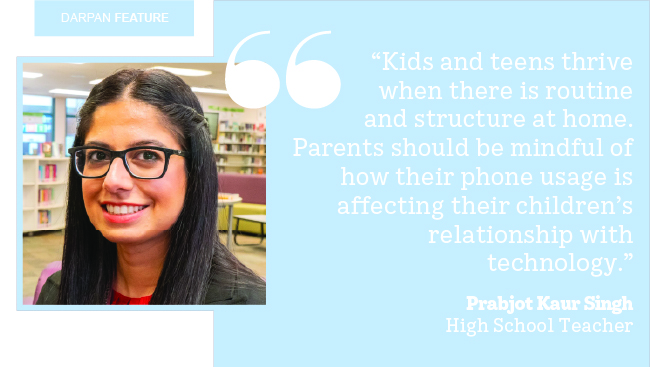
Despite varied approaches, one thing is clear: boundaries must be clearly defined, both at school and at home. Singh emphasizes the importance of intentional parenting when it comes to managing screen time outside of the classroom. “Kids and teens thrive when there is routine and structure at home,” she explains. “Parents should be mindful of how their phone usage is affecting their children’s relationship with technology.”
She offers practical suggestions such as implementing household-wide rules—for instance, no phones at the dinner table—and designating communal phone-free zones. “Parents and teens can agree on an area in the house where everybody can put their phones before having dinner. If anyone violates that rule, there should be a reasonable consequence.”
For younger children, especially, routines are key. Singh recommends that parents create designated times for screen use. “If the child disagrees or begins to throw a tantrum, parents must stick to their words and reason compassionately. Consistency is key for any change and commitment.”
The responsibility of managing digital exposure doesn’t rest solely with families. Ultimately, schools must work collaboratively with parents by maintaining transparency and providing regular updates on digital learning tools and expectations. By fostering a strong partnership between home and school, students can receive consistent messages about healthy digital behavior.
Nevertheless, technology is not inherently negative. When used intentionally and responsibly, it can enhance learning, creativity, and connectivity. Digital platforms offer students access to online libraries, virtual experiments, and global perspectives that would otherwise be out of reach. They allow teachers to customize learning experiences and keep parents involved in their child's academic journey.
At the same time, experts continue to caution against the downsides of unrestricted access. Excessive screen time has been linked to sleep disruptions, reduced physical activity, and mental health concerns. Social media, in particular, has drawn scrutiny for its role in shaping self-image and social interactions, especially among teenagers.
To navigate this digital landscape, families must cultivate digital literacy at home. This means having open conversations about online safety, teaching kids to recognize misinformation, and encouraging critical thinking about the content they consume. Additionally, parents must be on the same page. They need to be role models for their children when it comes to screen habits. Undoubtedly, kids will follow what they see.
In the digital age, balance is more important than ever. It’s not about removing screens entirely—it’s about using them wisely. By setting boundaries, modeling healthy habits, and working together, parents and educators can ensure that technology empowers rather than overwhelms the next generation of learners.