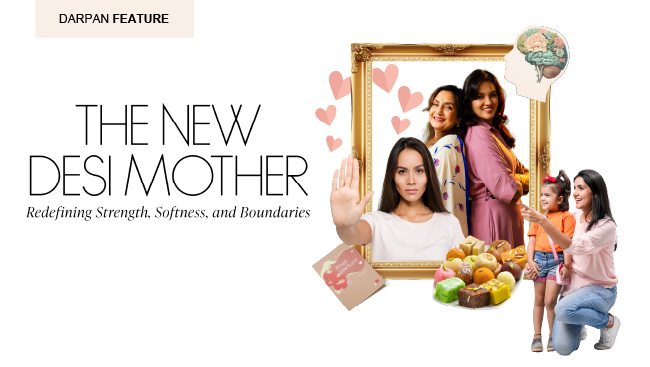
Across living rooms where generations navigate tradition and change together, a quiet evolution is underway. The new Desi mother is not rebelling against tradition or rejecting the values she was raised with. She is refining them, keeping the connection, community, food, and language while questioning the fear, silence, and self-sacrifice that often came with them. For many millennial South Asian mothers, the challenge is not choosing between culture and modern parenting, but learning how to hold both.
Raman Sanghera, nutritionist and mother of four, sees this shift daily in her work and in her own home. “The biggest challenge is unlearning, while still honoring the people who raised us,” she says. “Many of us grew up where respect meant obedience. Parents didn’t apologize; emotions weren’t talked through; they were managed quietly. You adjusted, you didn’t question.”
Now, she explains, parenting looks different. “We apologize when we lose our temper. We explain instead of saying ‘because I said so.’ We sit at the edge of the bed and talk things through. We’re setting respectful boundaries with extended family, even when it feels uncomfortable.” For Sanghera, this is not cultural rejection. “It’s not about rejecting our culture. It’s about evolving it. We’re keeping the closeness and family values, but replacing fear with communication. And that shift is generational.”
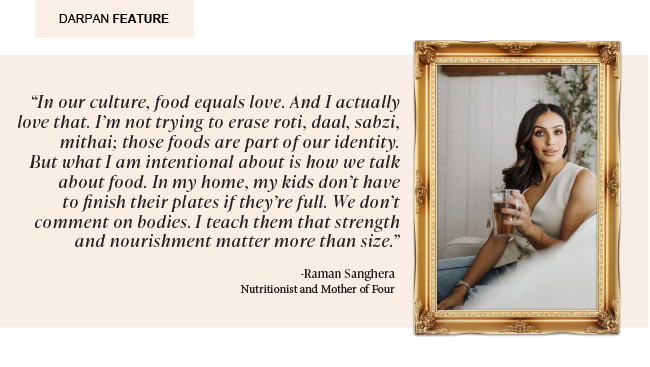
Food is often where that generational tension surfaces most clearly. In South Asian homes, feeding someone is an act of love. Second helpings are affection, mithai is a celebration, and comments about weight are a symbol of concern, even if they sting. In Sanghera’s home, the script has changed. “In our culture, food equals love. And I actually love that. I’m not trying to erase roti, daal, sabzi, mithai; those foods are part of our identity. But what I am intentional about is how we talk about food. In my home, my kids don’t have to finish their plates if they’re full. No food is ‘good’ or ‘bad’. We talk about balance. We don’t comment on bodies. I teach them that strength and nourishment matter more than size.”
Inevitably, when extended family members offer unsolicited opinions, she responds calmly. “We’re teaching her to listen to her body.” Her philosophy is simple yet powerful: “You can honor tradition without inheriting everything that came with it.” To Sanghera, the new Desi mother is intentional. “She’s keeping the connection, the community, the food, the language. But she’s removing the fear-based parenting, the food pressure, the body-shaming, and the silence.” Most impactfully, she adds, “Our kids won’t have to heal from what we had to.”
Prabhjot Gandham, women’s strength and postpartum wellness coach, sees another critical layer of this generational shift: physical recovery and maternal health. “One of the biggest challenges I see is that many South Asian women were raised to believe that being a good mother means putting themselves last,” she admits. “Our culture is incredibly loving and family-oriented, which is beautiful. But many women in this generation are also more educated about postpartum recovery, mental health, and parenting choices. They’re asking questions our mothers and grandmothers may never have had the space to ask.”
Undoubtedly, that awareness creates tension. “How do I respect my family, my culture, and my elders while also doing what feels right for my child and myself?” Gandham asks. “The modern South Asian mother is far more informed than previous generations. She’s learning about postpartum recovery, nervous system regulation, breastfeeding support, and rebuilding her body safely after birth. But navigating that while still honoring elders can feel complicated.”
Physical recovery, Gandham emphasizes, is not vanity. It is foundational. “Physical recovery after birth is one of the most overlooked parts of motherhood, especially in our community,” she outlines. “Many women are expected to ‘rest’ for a short time and then jump right back into roles and responsibilities, but very few are actually taught how to rebuild their bodies safely. When a woman reconnects with her core, her breath, and her strength again, something deeper shifts. She stops feeling like she has to shrink herself in motherhood. Instead, she starts to feel capable again. When women rebuild their strength after birth, they stop just surviving motherhood—they start leading within it.”
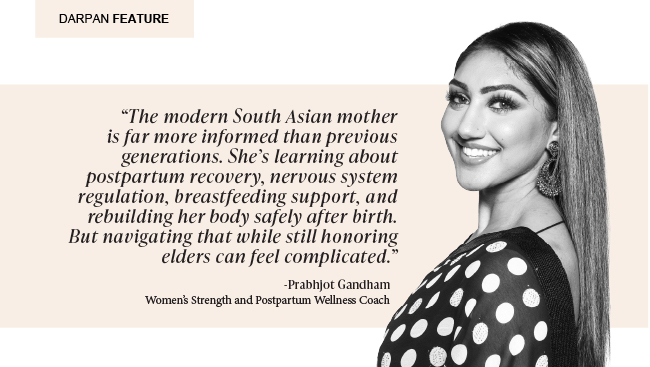
Setting boundaries is central to this new era of parenting. “Many of our parents and elders offer advice from a place of love and lived experience,” she acknowledges. “But it’s also okay to say, ‘This is what works best for our family.’” Culture, she reminds her clients, is not fixed. “Culture evolves through each generation. Using new knowledge doesn’t mean you’re turning your back on tradition. It means you’re building on it.” At the heart of it all is yet another powerful truth: “Honoring our culture shouldn’t require abandoning ourselves.”
As such, the new Desi mother is not louder than the generations before her. She is simply more aware. She is protecting her peace while protecting her heritage. She is not perfect. She is intentional. And in that intention lies something transformative. By balancing tradition with boundaries, nourishment with neutrality, strength with softness, she is quietly breaking cycles. She is raising children who will understand both where they come from and who they are allowed to become.
The new Desi mother is not choosing between culture and self. She is choosing both, on her own terms.