In many South Asian households, conversations about weddings and babies flow easily, but fertility struggles are endured quietly. IVF, miscarriage, delayed motherhood, and reproductive challenges remain whispered topics. The pressure to conceive is loud, while the space to speak honestly is small. Shaped by cultural expectations and family dynamics, this silence carries grief, confusion, resilience, and hope.
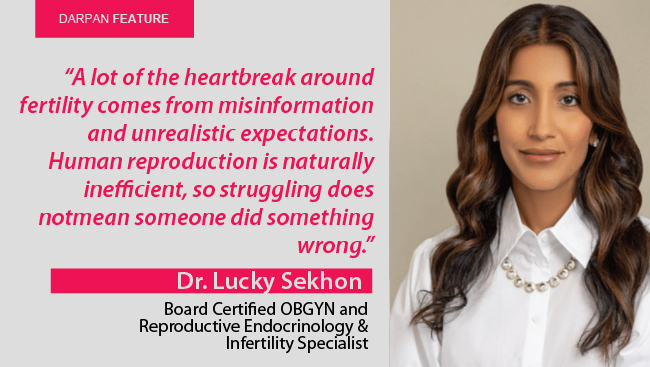
From a medical perspective, double board-certified OB/GYN and Reproductive Endocrinology & Infertility (REI) specialist, Dr. Lucky Sekhon, sees how cultural silence can directly affect care. “In my practice, one of the biggest challenges is how silent fertility struggles can be in South Asian communities,” she explains. “Many women feel pressure to keep it private, which can delay getting help and make the experience isolating.”
That delay can be significant. In communities where fertility is assumed rather than discussed, early signs of reproductive issues are often normalized or minimized. “There is also intense family and cultural pressure to conceive quickly after marriage, which adds stress and can make it hard to set boundaries around intrusive questions and unsolicited advice,” Dr. Sekhon says. The expectation to produce good news can overshadow the reality that conception is not always immediate or straightforward.
Clinically, she also sees patterns that frequently go undiagnosed. “I also see many patients dealing with issues like irregular ovulation and PCOS, sometimes alongside insulin resistance, which can complicate fertility and often goes undiagnosed for years because symptoms get normalized.” Irregular cycles, painful periods, or metabolic symptoms may be brushed aside as typical, leaving women without clarity for years.
A core part of Dr. Sekhon’s work is reframing the narrative around infertility. “I start by reminding patients that infertility is a medical issue, not a personal failure,” she highlights. In communities where fertility is closely tied to identity and womanhood, that distinction is powerful. When conception does not happen quickly, many women internalize shame.
Instead of blame, she encourages information and agency. “We focus on practical steps: understand age and timeline, get the right evaluation early, and make decisions based on data rather than fear.” Knowledge can counteract both misinformation and panic. It also helps women advocate for themselves in medical and family settings.
Mental health, she adds, cannot be an afterthought. “I also encourage women to protect their mental health and to practice scripts and boundaries with family members, because constant pressure and commentary can be deeply draining.” In cultures where elders’ opinions carry weight, setting boundaries can feel uncomfortable, yet it is often necessary.
Much of the heartbreak she witnesses, she reveals, is rooted in misunderstanding. “A lot of the heartbreak around fertility comes from misinformation and unrealistic expectations. Human reproduction is naturally inefficient, so struggling does not mean someone did something wrong.” That reminder alone can ease years of quiet self-blame.
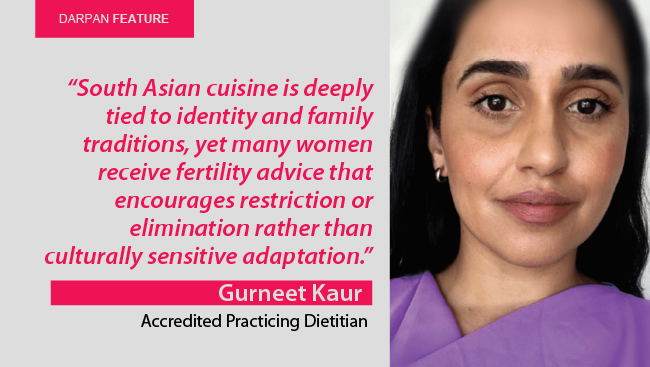
While Dr. Sekhon addresses the medical and emotional dimensions, Gurneet Kaur, an accredited practicing dietitian (APD) specializing in fertility nutrition, approaches fertility through the lens of nutrition and metabolic health. She sees a similar cultural gap between expectation and biology. “In my clinical work, one of the most significant challenges South Asian women face is the gap between cultural expectations and biological reality,” she notes. “Many women grow up with the assumption that pregnancy will happen naturally and quickly after marriage, so when conception takes longer, there is often a deep but unspoken sense of personal responsibility or failure.”
She also observes how symptoms are often normalized. “Reproductive health symptoms are also frequently normalized. Painful periods, irregular cycles, fatigue, or metabolic symptoms associated with conditions such as PCOS or endometriosis are often dismissed as normal, which delays early intervention.” By the time support is sought, women may have spent years navigating symptoms alone.
Privacy, while culturally protective, can also intensify isolation. “There is also a strong culture of privacy surrounding fertility struggles. Miscarriage, IVF, and assisted reproductive treatments are rarely discussed openly within families or communities,” Kaur details. “While privacy can feel protective, it can also create profound isolation, leaving women feeling as though they are the only ones experiencing these challenges.”
Food adds another layer of complexity in South Asian households, where meals are central to identity and connection. “South Asian cuisine is deeply tied to identity and family traditions, yet many women receive fertility advice that encourages restriction or elimination rather than culturally sensitive adaptation,” she points out. “This can create confusion and unnecessary guilt around eating.” For women already navigating emotional strain, rigid or culturally disconnected advice can add stress rather than support.
Kaur emphasizes that fertility is physiological, not moral. “A central part of my work is helping women understand that fertility is influenced by physiology, not personal worth or effort alone.” When women understand the interaction between ovulation, hormones, inflammation, and metabolic health, she notes that self-blame often shifts toward empowerment.
She focuses on sustainable, evidence-based changes. “Importantly, the goal is not perfection or restrictive dieting. Consistency, nourishment, and cultural relevance are far more effective long-term.” Integrating supportive changes into familiar foods, rather than abandoning them, reduces stress and improves adherence.
Encouragingly, she is seeing cultural shifts. “One encouraging shift I am seeing is that South Asian women are increasingly seeking fertility education earlier and approaching reproductive health more proactively.” That said, stigma remains, particularly around assisted reproductive technologies. “Normalizing open conversations around miscarriage, delayed motherhood, and fertility treatment is essential for reducing stigma,” she reminds. “When women hear shared experiences, it helps reframe fertility challenges as health experiences rather than personal shortcomings.”
At its core, fertility is both medical and emotional, and it deserves open, informed conversation. Breaking the silence does not mean abandoning privacy. It means replacing shame with understanding and recognizing that seeking help is a strength, not a failure. Women should have space to speak honestly about their reproductive journeys without fear of judgment. When conversations shift from whispers to dialogue, women gain more than information. They gain clarity, community, and the reassurance that they are not alone.