

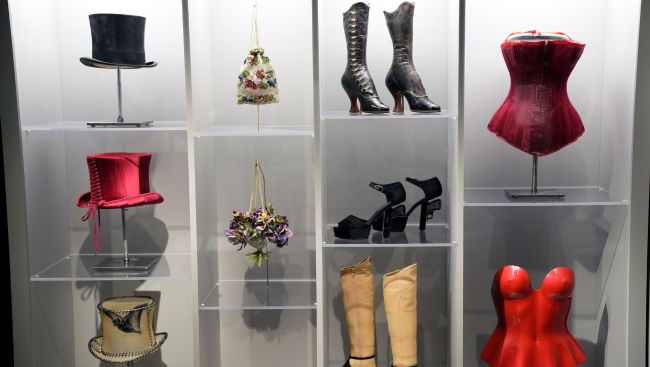
Fashion and Freud? From top hats to stilettos, bustiers to bullet dresses, what we choose to put on our backs is interpreted through the lens of psychoanalysis in a new exhibit five years in the making.
Valerie Steele, director of The Museum at FIT, curated nearly 100 designer pieces to offer a road map of sorts between fashion and such things as the unconscious mind, the need for armor and the pull of desire.
And she noted during a walk-through of the exhibit a day before Wednesday's opening that Freud himself was a fashionista, in rigidly conventional English-style suits made of the best materials and tailored to perfection.
While Steele, 69, has never spent time on a psychoanalyst's couch, she's been intrigued by the practice's interplay with fashion for quite some time.
“Ever since I was in graduate school, when I started to focus on the history of fashion, it seemed to me that despite all of the dead ends and real problems with psychoanalysis, it did provide clues to explaining the power and allure of fashion, as well as the hostility that is addressed to fashion,” she said.
Here are some takeaways from the exhibit, “Dress, Dreams & Desire: Fashion and Psychoanalysis,” which runs at the Fashion Institute of Technology's museum from Sept. 10 to Jan. 4. Steele has written a companion book due out in November.
Father of psychoanalysis as fashion darling
Historian Peter Gay once wrote: “We all speak Freud, whether we know it or not.” Fashion is no exception.
As the exhibit notes, Marc Jacobs put out a simple dress in 1990 called the “Freudian Slip.” It was emblazoned with the image of Freud. John Galliano created a collection for Dior called “Freud or Fetish” in 2000. It was an exploration of sexual fantasy.
“I am trying to symbolize what fetishism evokes in the psychology of clothing," Galliano said in his show notes.
Prada, meanwhile, debuted a film at the Cannes Film Festival in 2012 titled “A Therapy.” It was directed by Roman Polansky and features Helena Bonham Carter as patient and Ben Kingsley as psychoanalyst. At one point, the analyst dons his patient's fur coat and gazes at himself in a mirror as we hear her ask: “What does it all mean?”
Mirrors and Schiaparelli
The exhibit includes a cropped black velvet jacket that Elsa Schiaparelli created back in 1938. It's called the “Hall of Mirrors,” for trompe l’oeil gold and silver mirrors at the breast with glass sequins and buttons that evoke classical busts.
It was a meditation on how women were culturally perceived.
Steele said the jacket has sometimes been interpreted as a reflection of French psychoanalyst Jacques Lacan's “mirror stage" of body image development. A baby looks in a mirror, the theory goes, and sees a whole person rather than a collection of fragmented parts. But wholeness, Lacan believed, is illusion.
Schiaparelli, who died in 1973, spoke about a mother's gaze as a child's first mirror, and how her own mother often declared her ugly to the point that she sometimes failed to recognize herself in a mirror.
So many phallic symbols, so much time
Freud was way on board when it came to phallic symbols, especially in dreams and broad cultural contexts.
Hello, top hats and stilettos, the ultimate phallic representations in fashion, Steele said. The exhibit explores desire and sexuality, including the idea of the “phallic woman.” Steele included one of Jean Paul Gaultier's “cone-bra” dresses, a style embraced by Madonna back in the day with protruding cones, or bullets, at the breast.
Freud certainly didn't invent the concept of phallic symbols or female sexual symbols.
“These have existed for millennia everywhere from ancient Rome to ancient India, but he saw them as being a crucial part of the human individual unconscious," Steele said.
Fashion and the naked body
Freud saw clothes as loopholes for women to get around the idea of nudity as shameful. It's an idea that plays out on runways today. A replica of the famous, plunging, green Versace dress that Jennifer Lopez wore to the 2000 Grammys is in the exhibit. Naked dresses then proliferated on red carpets and fashion shows.
“One of Freud's ideas was that people wanted to show off their naked bodies and their genitals,” Steele said.
It started with a bit of bosom and arm in evening dresses, moving on to a splash of legs in the 1920s and bare backs in the '30s.
British psychologist and psychoanalyst John Flügel and, later, fashion historian James Laver in the '30s wondered whether erogenous zones in fashion shifted to maintain the male gaze. Not so, Steele said.
The Hays Code was a more likely culprit in some cases. From 1934 to 1968, guidelines enforced by the Motion Picture Producers and Distributors of America dictated what could and could not be shown on screen.
The idea of backs as sexy, for instance, evolved precisely because they were shown, Steele said.
Fashion as a second skin
Fashion is often referred to as a second skin. In the second of two rooms in the exhibit, curators demonstrate how it's so much more.
What we wear, Steele said, “can be holding you like a hug. It can be protecting you like armor. And it can be sexualizing, either by framing bits of the naked body or by emphasizing, say, the curves and the muscles of the body."
Look no further than a red leather bustier by Issey Miyake from 1983, or a dress by Rei Kawakubo that demonstrates her use of structures that architecturally encase the body.
Contemporary French psychoanalyst Pascale Navarri, quoted in the exhibit, said it this way: “What the look of fashion exposes is, simultaneously, our vulnerability about being seen and not being seen.”
Picture Courtesy: Charles Sykes/Invision/AP


