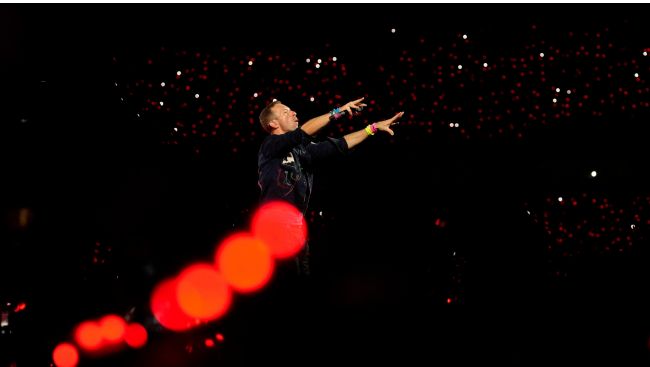
When the “KissCam” at a Coldplay concert landed on a couple who tried (but failed) to duck out of the spotlight, the internet immediately got to work.
In hours, the clip was just about everywhere. Endless memes, parody videos and photos of the pair's shocked faces filled social media feeds.
Online sleuths rushed to identify who was on camera. Artificial intelligence and software company Astronomer eventually confirmed that its CEO and chief people officer were in fact the couple in the video — and announced the CEO's resignation over the weekend.
The incident's fallout has, of course, generated conversations about business ethics, corporate accountability and the repercussions that conflicts of interest among leadership can cause. But there are also broader implications at play in our increasingly online world — about the state of potentially being visible everywhere you go or tracked through “social media surveillance."
Experts say it's more and more common for moments that may have been intended to be private, or at least reserved to a single physical venue, to make their way online and even go global today.
So in the era of lightning-fast social sharing and when cameras are practically inescapable, does being in public hold any expectation of privacy anymore? Is every experience simply fodder for the world to see?
Cameras are everywhere
It's no secret that cameras are filming much of our lives these days. From CCTV security systems to Ring doorbells, businesses, schools and neighborhoods use ample video surveillance around the clock. Sporting and concert venues have also filmed fans for years, often projecting playful bits of audience participation to the rest of the crowd. In short, the on-scene viewer becomes part of the product — and the center of attention.
And of course, consumers can record just about anything if they have a smartphone in their pocket — and, if it's enticing to other social media users, that footage can quickly spread through cyberspace.
Ellis Cashmore, author of the book “Celebrity Culture,” proposes that the rapid fame of last week’s KissCam moment probably answers a question many have been asking for years: “Is the private life still what it was? And the answer is, of course, there’s no such thing as the private life anymore,” he notes. “Certainly not in the traditional sense of the term.”
“I’m not sure that we can assume privacy at a concert with hundreds of other people,” adds Mary Angela Bock, an associate professor in the University of Texas at Austin’s School of Journalism and Media. “We can’t assume privacy on the street anymore.”
Some version of the KissCam has long been a staple at big events — from timeouts during sports games to romantic songs played by artists at their concerts. It’s easy to miss, but most venues have signs to inform the audience that they could be filmed during the event. What’s been different in more recent years, experts note, is how quickly those moments can travel beyond the physical space where they actually unfold.
That isn’t only limited to what shows up on a jumbotron. Sometimes it only takes one person in the crowd to capture any interaction on their phone and post the video online — where it can zip around the world.
“It’s not just the camera," Bock says. “It’s the distribution system that is wild and new.”
Once something's viral, doxing often follows
Then there's the second ring of exposure — what happens after the video or photos spread.
Experts point to growing instances of social media users rushing to publicly identify, or dox, the people captured on camera — much like how quickly the internet committed to finding those involved in the Coldplay moment, for example.
The LinkedIn pages belonging both to Astronomer’s now-former CEO and chief people officer remained disabled on Monday, and The Associated Press could not reach either for comment.
But it isn't limited to company executives. Beyond someone simply spotting a familiar face and spreading the word, technological advances — including AI — have made it easier and faster overall to find just about anyone in an online post. This can happen with videos and photos shared on social media each day, even if it doesn't go viral, experts warn.
“It’s a little bit unsettling how easily we can be identified with biometrics, how our faces are online, how social media can track us — and how the internet has gone from being a place of interaction, to a gigantic surveillance system," Bock says. “When you think about it, we are being surveilled by our social media. They’re tracking us in exchange for entertaining us.”
And of course, such moments can also impact people who were not actually on camera. As easy as it can be to be identified online today, the internet is notorious for cutting a broad swath or not always getting it right. That sometimes produces harassment of individuals not actually involved.
At last week's Coldplay concert, for example, many social media users speculated that a third person seen near the two caught on camera was another Astronomer employee — leading to swarms of posts targeting her. But the company later confirmed that she was not at the event and said no other employees were in the video circulating online.
For the now-viral moment, “we can talk about what’s right and wrong, and whether they deserved it,” says Alison Taylor, a clinical associate professor at New York University’s Stern School of Business. Still, it’s a “very frightening thing to get a lot of abuse and harassment online,” Taylor notes. “There are real human beings behind this.”
It’s hard to think that that these kind of viral moments will ever go away — and there are few legal restrictions to stop users from sharing clips of interactions recorded from anything from a concert to the street widely online. But on an individual level, Bock says it can be helpful to “think before you share” and question whether something’s really accurate.
“Social media has changed so much,” Bock says. “But we really have not, as a society, caught up with the technology in terms of our ethics and our etiquette.”
Picture Courtesy: AP Photo/Rajanish Kakade, File