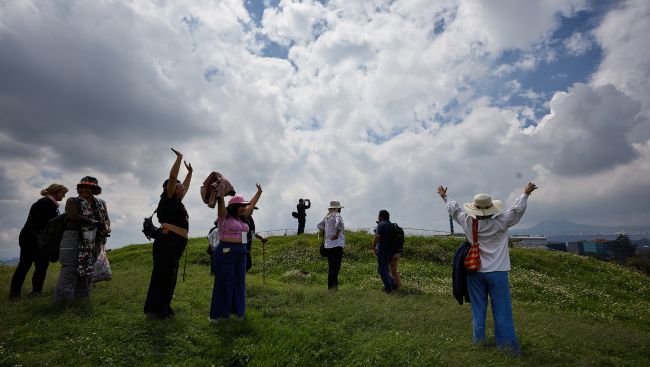
Amid the constant blare of car horns in southern Mexico City, it's hard to imagine that Cuicuilco was once the heart of a thriving ancient civilization. Yet atop its circular pyramid, now surrounded by buildings and a shopping center, a pre-Hispanic fire god was revered.
“This is incredible,” said Evangelina Báez, who spent a recent morning at Cuicuilco with her daughters. “In the midst of so much urbanization, there’s still this haven of peace.”
Her visit was part of a monthly tour program crafted by the National Institute of Anthropology and History, known by its Spanish initials as INAH.
Aside from overseeing Mexico’s archaeological sites and museums, the institute safeguards the country’s cultural heritage, from restoring damaged monuments and artworks to reviewing construction projects to ensure they don’t harm archaeological remains.
Its historians and archeologists also lead excursions like the one in Cuicuilco. Each academic expert picks a location, proposes a walking itinerary to the INAH and, once approved, it’s offered to the public for about 260 pesos ($15).
“I joined these tours with the intention of sharing our living heritage,” said archaeologist Denisse Gómez after greeting guests in Cuicuilco. “Our content is always up to date.”
According to Mónica de Alba, who oversees the tours, the INAH excursions date back to 1957, when an archaeologist decided to share the institute’s research with colleagues and students.
“People are beginning to realize how much the city has to offer,” said De Alba, explaining that the INAH offers around 130 tours per year in downtown Mexico City alone. “There are even travel agents who pretend to be participants to copy our routes.”
María Luisa Maya, 77, often joins these tours as a solo visitor. Her favorite so far was one to an archaeological site in Guerrero, a southern Mexican state along the Pacific coast.
“I’ve been doing this for about eight years,” she said. “But that’s nothing. I’ve met people who have come for 20 or 25.”
Traces of a lost city
Cuicuilco means “the place where songs and dances are made” in the Nahua language.
Still, the precise name of its people is unknown, given that the city’s splendor dates back to the pre-Classic era from 400 to 200 B.C. and few clues are left to dig deeper into its history.
“The Nahuas gave them that name, which reveals that this area was never forgotten,” said archaeologist Pablo Martínez, who co-led the visit with Gómez. “It was always remembered, and even after its decline, the Teotihuacan people came here to make offerings.”
The archaeological site is a quiet corner nestled between two of Mexico City’s busiest avenues. Yet according to Martínez, the settlements went far beyond the vicinity and Cuicuilco's population reached 40,000.
“What we see today is just a small part of the city,” he said. “Merely its pyramidal base.”
Now covered in grass and resembling a truncated cone, the pyramid was used for ritual purposes. The details of the ceremonies are unknown, but female figurines preserved at the site’s museum suggest that offerings were related to fertility.
“We think they offered perishable objects such as corn, flowers and seeds,” Gómez said. “They were feeding the gods.”
Echoes of living heritage
According to official records, Mexico’s most visited archaeological sites are Teotihuacán and Chichén Itzá. The first is a pre-Aztec city northeast of the capital known for its monumental Sun and Moon pyramids. The latter is a major Mayan site in the Southeast famed for its 12th-century Temple of Kukulkán.
The INAH oversees both. But its tours focus on shedding light on Mexico’s hidden gems.
During an excursion preceding Cuicuilco’s, visitors walked through a neighborhood in Ecatepec, on the outskirts of Mexico City, where open-air markets, street food and religious festivals keep local traditions alive. A few days prior, another tour focused on La Merced market, where flowers, prayers and music filled the aisles during the feast of Our Lady of Mercy.
October’s schedule takes into account Day of the Dead traditions. But tours will feature a variety of places like Xochimilco, where visitors can take a moonlit boat tour through its canals and chinampas, and Templo Mayor, the Aztec empire’s main religious and social center in ancient Tenochtitlán.
“These tours allow the general public to get closer to societies that are distant in time and space,” said historian Jesús López del Río, who will lead an upcoming tour on human sacrifices to deities in Mesoamérica.
“Approaching the pre-Hispanic past is not only about how the Maya used zero in their calculations or how the Mexica built a city on a lake,” he added. “It’s about understanding how those societies worked — their way of seeing and relating to the world.”
Picture Courtesy: AP Photo/Ginnette Riquelme