When pastry chef Tino Gierig is asked what the famous Dresden stollen tastes like, his eyes sparkle and his voice rises to an enthusiastic sing-song as as he describes the rich delicacy filled with raisins and other dried fruits.
“Stollen tastes like Christmas, like family, like tradition, like hominess, peace, serenity," the 55-year-old said as he lovingly kneaded his buttery yeast dough before folding in golden raisins in his Dresdner Backhaus bakery.
Bakers in the eastern German city of Dresden have been making stollen for hundreds of years and it is now a treasured Christmas tradition. It is usually cut on the first weekend of Advent — the four-week period leading up to Christmas — and served with coffee and Christmas cookies.
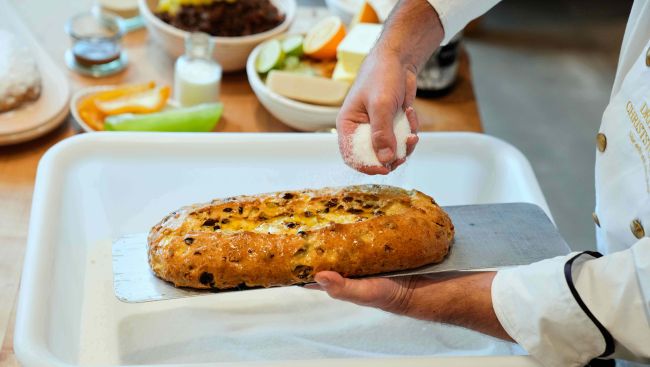
After baking several loaves of stollen in his Dresden bakery in November, Gierig picked off some slightly burned raisins from the top, brushed the pastry with butter, sprinkled granulated sugar on top, and in a final touch dusted it with powdered sugar.
The 55-year-old is precise in his baking, and also particular about how to define his hand-baked Christmas specialty: “It's a heavy yeast dough, it’s not bread, it’s not cake. It's a pastry that is only made for the Advent season.”
In Germany the desert is often called Christstollen, and to Gierig it looks “like Christ Child wrapped in swaddling clothes.”
“This kind of baking has a lot to do with symbolism,” Gierig said.
A protected brand
While Gierig's description sounds like an ode to Christmas baking and the creation of stollen in particular, stollen is also big business with an organization that is dedicated to protecting and promoting the brand.
The Dresden Stollen Protection Association awards a coveted golden quality seal as a certificate of authenticity to bakeries that fulfill certain conditions and which are located in or near Dresden. The products are checked every year to make sure they fulfill all the expectations of the association.
According to the strict rules, stollen must be made with heaps of butter – at least 50% of the flour content – as well as a generous load of golden raisins, candied orange and lemon peel as well as some sweet and bitter almonds. The addition of margarine, artificial preservatives or artificial flavors is not allowed.
The Dresdner Christstollen is additionally protected by European Union rules that stipulate where and how it needs to be produced, just like Lübecker Marzipan from the northern German city of Lübeck, Schwarzwälder Schinken ham from the Black Forest, or Aachener Printen gingerbread from the western German city of Aachen.
Nonetheless, the bakeries, which have often been run by the same families for many generations, can add their own mix of spices and flavors. They usually include include vanilla and cardamom, and sometimes tonka beans, cinnamon, nutmeg or cloves.
“There are just so many flavors from all over the world in there that have blended together, making it simply a wonderful symbiosis,” Gierig said.
In 2024, more than 5 million loaves were sold, about 20% of which were exported. Austria and Switzerland are the main countries of export, but Gierig says he also sells many stollen online to customers in the United States.
When stored in a dry, dark and cool place, the specialty keeps for many weeks.
A tradition with roots in the Middle Ages
While today's recipes are fancy in ingredients and elaborate in preparation, Dresden stollen's medieval origins are humble.
Stollen was first mentioned in a document in 1474 on an invoice from the city's Christian Bartolomai Hospital, according to the association.
However, at that time, it was not yet considered a Christmas delicacy, but a fasting pastry that consisted only of flour, yeast and water.
Butter was not allowed until Pope Innocent VIII in Rome granted a special request by Elector Ernest of Saxony to lift the butter ban in 1491. From then on, stollen bakers have been also allowed to use more substantial ingredients.
While some of the more exotic spices were hard to get during the Communist decades in East Germany, stollen was among the most coveted delicacies in the country. Even Germans living in post-war capitalist West Germany were always hoping to get an original Dresden stollen package for Christmas from their brethren in the East as none of the stollen made in the west came anywhere close to the original.
Picture Courtesy: AP Photo/Ebrahim Noroozi