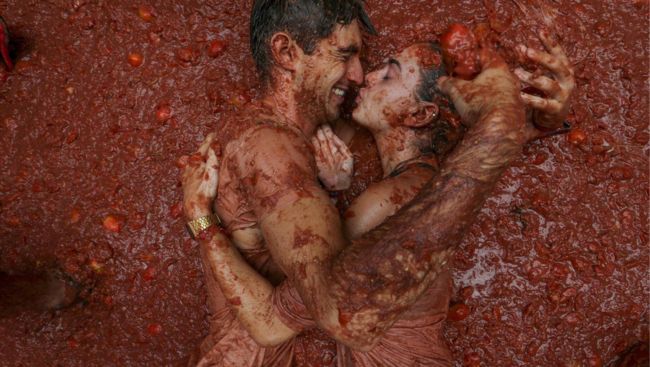
Thousands of people will paint a town red with tomato pulp Wednesday, flinging the fruit at one another in the 80th anniversary of Spain’s famous “Tomatina” tomato street fight.
The hourlong event brings 120 tons of overripe tomatoes to the eastern town of Buñol, where tarp-covered buildings flank a crowd of up to 22,000 participants awaiting their ammo. Non-local attendees pay 15 euros ($17.50) for a ticket and arrive from countries across the globe or cities a bus ride away.
“When it’s going on, it’s just a blur of tomatoes,” said Adrian Columb of Ireland, who attended in 1999. “It was a blast.”
Here’s what to know about the “Tomatina” festival:
The anniversary of a spontaneous food fight
Held on the last Wednesday of August, the event was inspired by a food fight between local children who pelted each other with tomatoes in 1945.
After becoming a yearly tradition, “Tomatina” was briefly banned in the 1950s by Spanish dictator Francisco Franco, a decision locals protested. Televised media attention in the 1980s turned the festival into a national event, eventually drawing an international crowd.
In 2002, Spain officially recognized the festival as an international tourism attraction. Since then, the event has only been suspended twice, in 2020 and 2021, because of the coronavirus pandemic.
The tomatoes aren’t edible
The tomatoes thrown aren’t from crops treated like those used for food. That’s because they’re grown exclusively for the festival, said Buñol Deputy Mayor Sergio Galarza.
“If ‘Tomatina’ didn’t exist, these tomatoes wouldn’t be cultivated because there wouldn’t be a need for them,” Galarza said.
This year’s supply hails from Don Benito, a town over 5 hours away.
There’s only one rule
There are no teams, no points and no referees, but there is a guideline: To avoid injuries, participants are encouraged to squash the tomatoes before hurling them (and of course, refrain from hurling anything else).
Even then, many people don swimming goggles and earplugs for protection.
When Columb attended, he said, a friend of his finished the battle with two black eyes. “But I know he’s kind of tall, so maybe he was a target,” Columb added.
“You finish exhausted,” said Galarza, who grew up going to the festival before becoming its chief councilor. “Your arms are worn out, everything is worn out from moving and launching it all.”
The mash of projectiles leaves attendees “up to your ankles deep in this tomato puree,” Columb said.
Once the hour is up, marked by the sound of a cannon shot, crowds shuffle to wash off at nearby communal showers while the town’s streets are hosed. Though the stains on clothes are likely irreversible, the citric acid in the tomatoes acts as an effective cleaning agent on the pavement. Three to four hours later, the streets are sometimes left cleaner than before.
Other countries have taken inspiration
Similar tomato-flinging festivals have taken place in Florida, London, Amsterdam, the Colombian town of Sutamarchán and, most recently, Hyderabad, India.
Still, for Galarza, a native of the festival’s original location, “Tomatina” is synonymous with Buñol, he said.
“The truth is that it’s exciting because year after year, you can see how ‘Tomatina’ grows and evolves,” Galarza said, “and you can enjoy a festival that is super wholesome.”
Picture Courtesy: AP Photo/Alberto Saiz, File