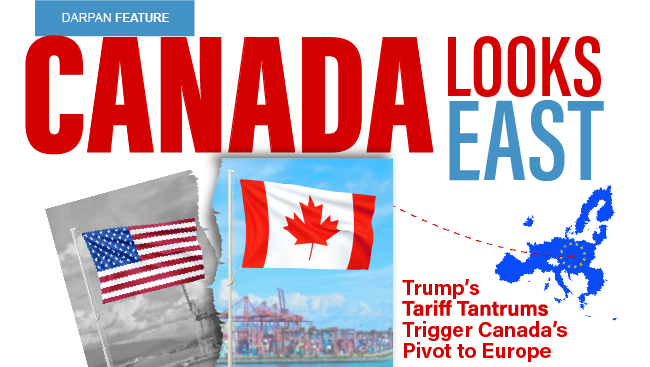
One word has come to define Donald Trump's second term as the President of the United States (U.S.): tariffs. The unpredictable and arbitrary nature of Trump's reciprocal tariffs has overwhelmed Canada—and the world. Currently, Canada faces a 35% tariff on its exports. Along with 50% tariffs on steel and aluminum, Canada remains one of the highest-tariffed nations.
Even as Canada and the U.S. are still engaged in trade talks, which can lead to a deal that might reduce tariffs, Prime Minister Mark Carney’s recent war of words with Trump has indicated that things will not remain the same between the two neighbors.

The U.S. accounts for 75.9% of Canada’s goods exports and 50.2% of service exports. However, thanks to Trump’s tariff tantrums, Canada’s new credo in the Trumpian era seems to be ‘Look East’, in a bid to economically diversify and reduce its dependence on the U.S. An immediate goal could be to strengthen its ties across the Atlantic, with the 27-member European Union (EU).
Warming Up to the EU
Canada and the EU already have a trade deal—the Canada-European Union Trade Agreement (CETA)—since September 2017. But in the Trumpian era, Canada’s trade relationship with the European Union is set to take center stage, potentially dislodging the U.S. as the predominant economic partner. While PM Carney has declared that the “80-year period when the U.S. embraced the mantle of global economic leadership is over”, he has reiterated Canada’s pivot to the EU.
During the 20th EU-Canada Summit in June 2025, Canada and the EU announced a ‘Strategic Partnership of the Future’ to increase cooperation in defense, trade, and commerce on both sides of the Atlantic. Both parties have already launched comprehensive negotiations on trade and economy, which could, in the words of the PM, generate “long-term prosperity for workers, businesses, and citizens in Canada as well as the European Union.”
An official communique from the Canadian PM’s Office reads: “Canada’s new government is focused on strengthening and diversifying our international partnerships. We will work with the EU and other allies to build a new international, rules-based system for a more secure and prosperous world.”
Three particular developments headline Canada’s EU pivot in the Trumpian era. Firstly, a new industrial policy is under formulation, which will focus on protecting and creating jobs in the world’s second-largest country. Secondly, Canada and the EU will deepen their strategic partnership in securing the raw material supply chain, which will tap into Ottawa’s vast mineral resources. Thirdly, both parties are seriously contemplating a digital trade agreement, which aims to make internet-based trade seamless.
How Has CETA Worked Out So Far
The CETA eliminates tariffs on 99% of Canada’s exports, making the EU an attractive trade destination. As per Statistics Canada, merchandise exports have increased from C$22.9 billion in 2016 to C$34.6 billion in 2024. That’s a 51% jump in just eight years. The 2017 trade deal has made Canadian goods more attractive in European markets, as per official data from the Canadian government. That’s because most Canadian products have become tariff-free. This has directly aided the growth of the metal and automobile sectors—both attracted high tariffs until CETA came into effect. The metals sector has grown 378% while the automobile sector has expanded by 89% since the deal came into effect in 2017. These sectors, which employ over a million people, have historically been dependent on U.S. markets.
CETA has also proven to be a blessing for Small & Medium Enterprises (SMEs) in Canada. After CETA, SMEs’ share in total exports to the EU reached 44%. This is still lower compared to 50% in the Americas and 52% in Oceania. Notably, SMEs represent over 99% of Canadian businesses and almost 90% of all private-sector jobs. A rejuvenated CETA is likely to further ease trading barriers for SMEs, who represent the ordinary, hard-working Canadians.
It’s not just about big businesses and trade. CETA has also aided Canadian wages to grow by 0.1%, according to a 2025 study. The bilateral trade deal has also been good for Canada’s green-tech industry, reflecting increased demand for green technologies.
Challenges and Future Outlook
While both governments keep harping about the positives emerging from CETA, which undoubtedly are aplenty, several challenges remain:
- The reshaping of Canada's highly concentrated trade could have a short-to-medium-term impact on SMEs that have largely been dependent on the U.S. The proliferation of cheaper EU goods in the Trumpian era could increase competition and put additional stress on SMEs.
- The EU's stringent digital laws—Digital Services Act and Digital Markets Act—could be detrimental to Canadians, especially those owning SMEs, trying to penetrate the 27-member market.
- The biggest issue that has been raised across both sides of the Atlantic is the provisions on investment protection, which are not yet in place.
It is, however, important to note that these challenges are being looked into at the governmental level. So, remedial measures could open new opportunities for 40 million Canadians in the future.
Trump’s tariff tantrums provide Canada with the opportunity to unshackle itself from the U.S. CETA is the first step towards realizing such a reality. But only time will tell whether Canada can replicate the success of CETA with other partners in the East.
Disclaimer: All statistics and updates were accurate at the time of publication and may have changed thereafter.