No matter where one is in the world, free food is offered to anyone who reaches the doorstop of any Gurdwara regardless of faith.
The tradition of langar is a longstanding symbol of selfless service. No matter where one is in the world, free food is offered to anyone who reaches the doorstop of any Gurdwara regardless of faith. As the largest free kitchen in the world, Sri Harmandir Sahib ji, popularly known as the Golden Temple, serves 50,000 to 100,000 people a day. The concept of langar, in the Sikh context, originates from the first Guru, who, in his youth, received money from his father to conduct business. However, rather than yielding a profit, Guru Nanak Dev ji chose to feed hungry pilgrims. Today, many pay homage to Gurdwara Sacha Sauda Sahib ji, situated on the monumental spot where the pilgrims were fed. This event gave rise to a tradition which was further solidified by the Gurus that followed.

The strongest wave surrounding the format of langar came from Mata Khivi ji, wife of the second Guru, Guru Angad Dev ji. Being in charge for serving langar, she has been praised in historical texts for her genuine generosity and passion towards serving others. The third Guru, Guru Amardas ji, implemented a rule at Sri Goindwal Sahib ji, according to which no one could meet the Guru until they had eaten langar. This rule was not even bent for the emperor, which was a revolutionary move in a hierarchical society. This Gurdwara is at the center of the inception of many religious elements including sports, Gurmukhi and langar.
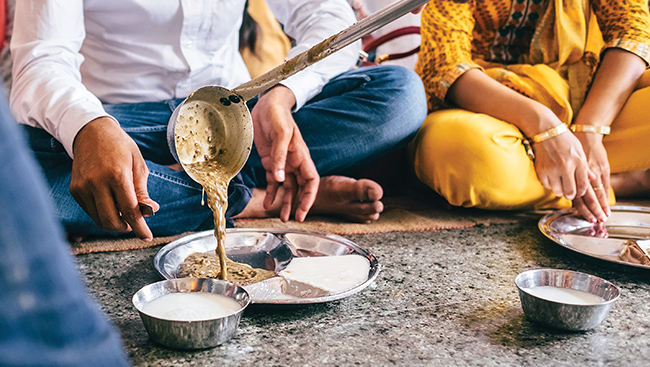
The importance of langar and its unique purpose can be traced back to its beginnings in India. At a time when the caste system was heavily dominant, the poor could not even enter religious temples. Using separate utensils, food was often thrown at devotees rather than served based on discriminatory grounds. The concept of Pangat, or langar, introduced a philosophy where both the king and beggar would eat the same food at the same level. Symbolically, and literally, one is not higher or lower than the other.
Therefore, langar depicts a message of equality and oneness, breaking the shackles of colour, caste, community, gender or status. There is no special treatment and nothing is hidden from the public, instilling values of humble acceptance and gratitude. Moreover, the original term being Guru Ka Langar, implicates that the langar does not belong to a specific country, person or institution. Transcending beyond discrimination, even the process of preparation, cooking, serving and cleaning is a shared experience.

For this reason, it is also important to recognize that langar is not just limited to food; it entails serving people to fulfil their needs in any area – be it of medication, clothing or even education. While langar comes in many forms, the essence of serving others wholeheartedly allows one to find in themselves the heart to give without expecting anything in return. For both the giver and receiver, the impact is a treasured experience.
In the modern age, however, we must be careful in preserving the true meaning of langar, rooted in its simplicity and compassion towards humanity. As the channels through which we serve evolve, we should not compete with others, but recognize service as a catalyst of unity. Playing our role entails simple steps such as being more mindful, taking only what we need, reducing imperishable waste and promoting health. Taking these steps paves the path for one to reap maximum utility from a more wholesome experience and truly embrace the glory of langar!

ABOUT THE AUTHOR: Naina Grewal is a youth radio show host on Red FM and is pursuing a Business and Communication Joint Major at SFU as a student on the President’s and Dean’s Honour Roll. Recently recognized as Surrey Board of Trade’s Top 25 Under 25, Naina is an engaged community volunteer, passionate about creating dialogue, and stirring youth involvement.