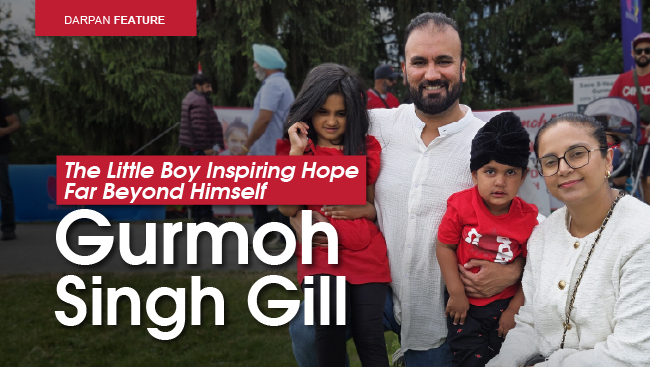
Three-year-old Gurmoh Singh Gill may never fully understand why strangers across the world know his name. But for countless families living with rare diseases, the little boy from Surrey has become something far greater than a fundraising campaign - he has become hope.
For his parents, Dr. Navpreet and Dr. Stalin Gill, life changed when they realized their son wasn't meeting the same milestones as his older sister. He wasn't walking independently, and something didn't feel right. They went from one doctor to another - from family physicians to pediatricians and neurologists. Everything, they were told, was normal. At one point, Gurmoh was even diagnosed with cerebral palsy. His parents refused to accept it. “We knew something wasn't fitting," says Stalin.
After insisting on further testing and paying for investigations themselves, the family finally received an answer earlier this year. Gurmoh has an ultra-rare genetic condition called hereditary spastic paraplegia caused by a rare mutation that progressively damages the nerves controlling movement. Every day it threatens to take away abilities he still has today.
For most families, that would have been the end of the story. For the Gills, it became the beginning of a fight.
They launched a fundraiser to develop a gene therapy that could potentially stop the disease in its tracks. The cost is staggering—an estimated $8 million—but the response has been even more extraordinary. They’ve raised around $2.4 million through campaigns and community support.
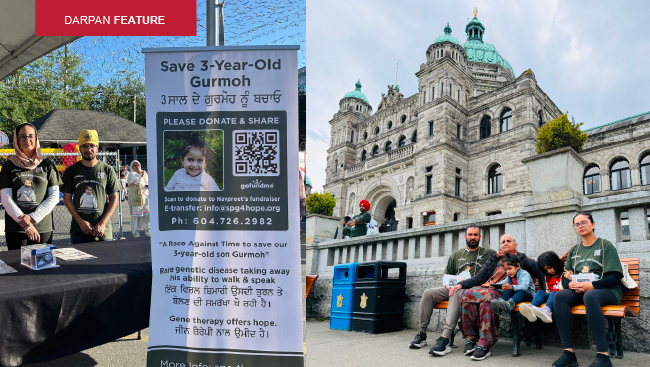
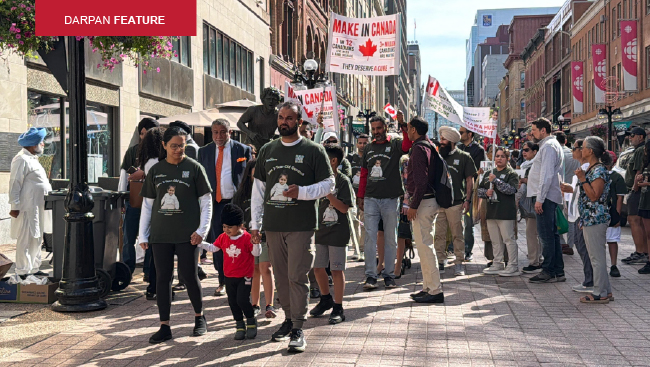
People who have never met Gurmoh have donated, prayed and shown up. Then came the messages from other parents. A father in India called Stalin, whose own child lives with a rare disease. The family had left Canada and returned to India after receiving their son's diagnosis, overwhelmed by fear and uncertainty. "He told me, ‘My son deserves parents like you.’ Another mother from Edmonton told me that whenever she goes to the Gurdwara, she prays for Gurmoh first, because if they can develop a therapy for him, they might be able to develop one for her son later on,” Stalin recalls.
These are a few of countless conversations the family has had with parents around the world. Some need help finding clinical trials. Others need assistance writing emails or translating medical information: “We've been able to help so many other parents who can't write an email or understand English. We're helping them connect with the right people.”
In many ways, Gurmoh's story has become bigger than one little boy in Surrey.
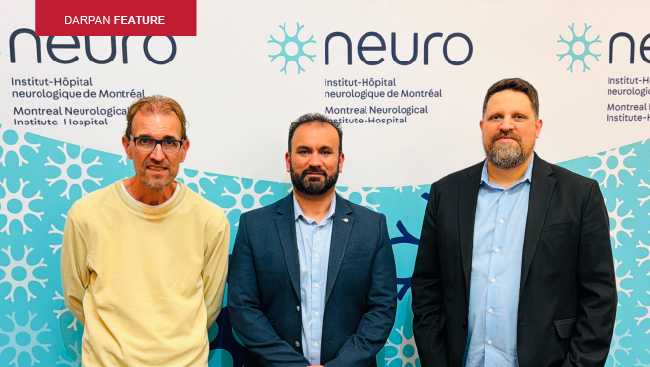
Researchers at McGill University, who are working on developing the gene therapy for Gurmoh under the leadership of Dr. Ziv Gan-Or, see something bigger too. If they succeed, it could lay the groundwork for treatments for thousands of other rare neurological diseases. If fundraising and regulatory approvals stay on track, they hope to have the therapy ready by next summer. And unlike traditional medications that require years of treatment, this therapy would be delivered through a single injection. "He would be cured within 15 minutes as soon as the injection is in," says Stalin. "One injection, and it's a done deal."
The science already exists, but the infrastructure does not. And that, perhaps, is the most frustrating part of this story.
Despite Canada's reputation for universal healthcare, families like the Gills often find themselves navigating a system that seems entirely unprepared for rare diseases. British Columbia does not have a pediatric neurogeneticist, the specialist best equipped to treat children like Gurmoh. The province doesn't have a laboratory capable of performing the genetic testing his diagnosis required. His samples had to be sent to Finland. The family says they were told the wait for an MRI under sedation in B.C. can be as long as three and a half years. Three and a half years is an eternity when a child's nerves are deteriorating.
There is no central registry for rare diseases in the province. No single institution for families to call, and absolutely no clear pathway for parents who suddenly find themselves facing an ultra-rare diagnosis. And while Canada speaks often about becoming a leader in healthcare innovation, families battling rare diseases continue to rely heavily on philanthropy and community fundraising to access groundbreaking therapies.
According to the Canadian Organization for Rare Disorders, approximately one in 12 Canadians lives with a rare disease, two-thirds of them children. Rare, it turns out, is not so rare after all. The irony isn't lost on Stalin. He says governments often wait until children become disabled before providing meaningful support: “What if we invested before that happened? Why do we want kids in wheelchairs and hospital beds?” These are questions worth asking.
Because the infrastructure required to develop Gurmoh's therapy would not disappear after his treatment. It could become the foundation for future gene therapies in Canada, making treatments faster and more affordable for countless other families.
This isn't simply about one child. It's about whether Canada is prepared to embrace a future where rare diseases can be treated, and perhaps one day cured. It's about whether innovation is something we celebrate in speeches or something we're willing to invest in when real families need it.
Most of all, it's about hope.
The kind carried by two parents who have put their careers on hold to save their son. The kind shared by communities that have rallied around a little boy they've never met. And the kind held by families across the world who now look at Gurmoh and see possibility. "There are millions of Gurmohs in Canada with different names," Stalin says.
For now, one little boy from Surrey continues to play with his fire truck and dream of becoming a firefighter. Unaware that, in trying to save him, an entire movement may be taking shape around him.