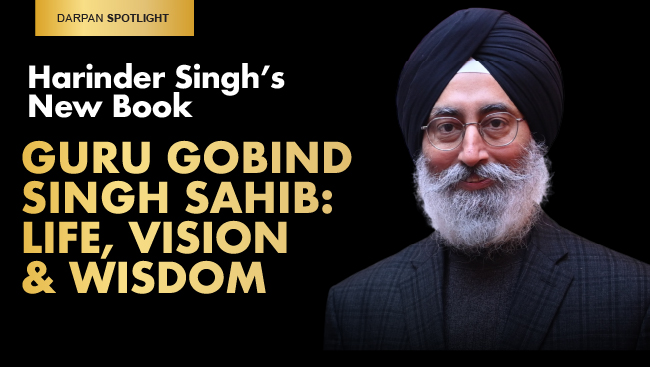
In a year marking the 350th anniversary of Guru Gobind Singh Ji’s coronation, Sikh scholar Harinder Singh offers a strikingly layered contribution to global Sikh discourse through his book, Guru Gobind Singh Sahib: Life, Vision & Wisdom. Singh’s work spans Sikh thought through teaching, research, and public dialogue, and this book arises from that ongoing engagement.
More than a historical account, the work is a carefully crafted convergence of theology, art, and lived experience; it is an effort to move beyond familiar narratives and into a deeper encounter with the Tenth Guru’s vision. At the heart of the book lies an intentional interplay between text and visual expression. Singh explains, “The writing came first. The sabad (words-sounds) shaped the foundation of the book, particularly the ten Sabad Hajare compositions attributed to Guru Gobind Singh Sahib.”
The visual dimension emerged later, developed collaboratively with Kiran Kaur, “The paintings were not meant to illustrate, but to carry the spirit of the compositions into a present-day context and allow a sense of presence to emerge.” This distinction is crucial. Rather than reducing Sikh tradition to imagery, the book preserves its core emphasis on internal contemplation, described by Singh as an experience that cannot rest on explanation alone, but needs space, attentiveness, and a willingness to encounter.

Drawing from historical voices like Bhai Nand Lal Goya and Chandra Sain Sainapati, Singh emphasizes dimensions frequently overlooked, particularly the inward discipline of sovereignty. He details, "Sovereignty is usually read outwardly, in terms of authority or resistance. In the Guru’s articulation, it begins inwardly. It asks for alignment, removes dependence, and places one under a single allegiance.”
Singh’s concept of leadership is also framed as rooted in love and alignment rather than authority. He references the Guru’s teaching, “Guru Gobind Singh Sahib is clear: ‘Jin Prem Kio Tin Hi Prabhu Paio’—those who love come to realize the 1-Divine.” Such a model, he suggests, challenges contemporary leadership cultures that prioritize visibility over substance, urging instead a shift toward reflection, steadiness, and justice-centered action.
Singh’s personal journey further deepens the narrative. He recounts moving from a childhood sense of “hero worship” to a more intimate and transformative relationship with the Guru. “Hero worship may begin the journey, but it cannot complete it,” he reflects. The shift is not merely intellectual but experiential. He highlights, “Knowing expands understanding. Feeling deepens the connection.” For younger generations, especially those in the diaspora, this movement is not about abandoning inherited traditions but entering them more fully.
While visibility and representation dominate contemporary conversations, Singh urges a return to foundational principles. By presenting Guru Gobind Singh Ji as the embodiment of political-spiritual sovereignty, the book invites readers not only to learn but to reflect on how they live, decide, and align themselves in an increasingly complex world.
As Singh puts it, “The question for Sikhs globally is not only how we are seen, but also how we self-identify and live. What guides our decisions? What do we stand under? How do we remain in the Guru’s Command-Grace while living across different contexts?”