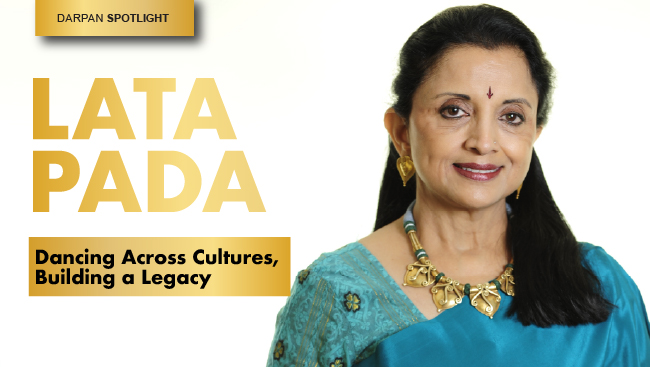
For more than three decades, Lata Pada has been one of the most influential voices in Indian classical dance in Canada. A celebrated Bharatanatyam dancer, choreographer, educator, and founder of Sampradaya Dance Creations, she has dedicated her life to preserving tradition while reimagining its place in contemporary society.
Born and raised in Mumbai, India, Pada began learning Bharatanatyam at the age of six. At the time, she had no idea dance would become her life’s work. “I knew I enjoyed it very much, and I was fortunate to have a good teacher who gave me a strong foundation,” she recalls.
Her training continued through childhood before being briefly interrupted by university studies and a move abroad. After marrying and immigrating to Canada as a young bride, Pada found herself in Thompson, Manitoba, a remote northern town where Indian classical dance was virtually unknown. The move marked the beginning of an unexpected journey. While adapting to life in Canada, Pada discovered that her artistic background sparked curiosity among local audiences. “There were no Indians in Thompson at that time, and people had never seen anything like classical Indian dance,” she says. Invitations to perform soon followed, allowing her to introduce Bharatanatyam to audiences who had little exposure to South Asian culture.
Unlike many newcomers who settle in large multicultural centers, Pada’s early years unfolded in a community with almost no South Asian presence. Rather than feeling isolated, she embraced the opportunity to connect deeply with local culture. “We learned Canadian folk songs, went ice fishing, and really became part of the community,” she says. “It gave us experiences many newcomers may not have when they arrive in larger cities.”
Her family later moved to Indonesia, where she spent a decade continuing her Bharatanatyam training with renowned guru Kalyanasundaram while also studying Balinese dance. The experience broadened her artistic outlook and deepened her understanding of how culture can be expressed through movement.
Today, Pada describes herself as comfortably rooted in both Canada and India. “I don’t see those identities as separate,” she explains. “They are very strongly synthesized.” While Canada provided opportunities, support, and artistic freedom, India remains central to her creative foundation. Her approach reflects the experience of many immigrants who learn to navigate multiple cultural realities without sacrificing either. “I feel privileged that I had the chance to learn such a wonderful classical art form,” she says. “At the same time, I deeply appreciate everything Canada has offered artists like me.”
In 1990, Pada founded Sampradaya Dance Creations with a vision of elevating Bharatanatyam within Canada’s cultural landscape. At the time, misconceptions about Indian classical dance were common. Many audiences viewed it as a folk dance or lacked awareness of the years of rigorous training required to master the form. “I wanted people to understand its depth, sophistication, and artistic richness,” she says. Drawing from contemporary themes while remaining grounded in classical technique, she introduced Bharatanatyam to wider audiences through collaborations with artists from Korean, Chinese, Flamenco, and Caribbean traditions. These artistic exchanges helped establish Bharatanatyam as a respected and relevant part of Canada’s performing arts ecosystem.
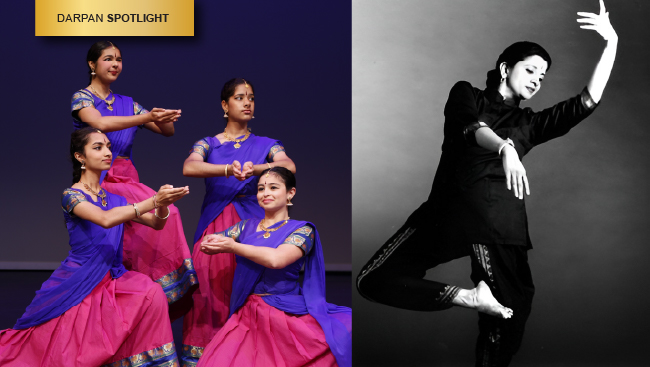
Over the years, Pada’s productions have explored themes that transcend cultural boundaries. Works such as Mandala drew connections between Tibetan sand mandalas and Hindu yantras, blending Bharatanatyam with Kathak, contemporary staging, and cross-cultural musical influences. For Pada, innovation does not mean abandoning tradition. Instead, it means discovering new ways to communicate timeless ideas. “Any theme you want to present can be expressed through Bharatanatyam,” she says. “Its vocabulary is incredibly comprehensive and versatile.” Through movement, rhythm, gesture, and facial expression, Bharatanatyam offers a complete artistic language capable of addressing both ancient stories and contemporary concerns.
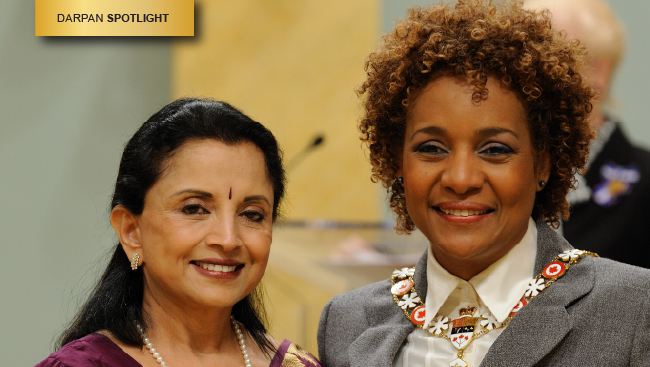
Pada’s contributions have earned national and international recognition. In 2008, she became the first South Asian performing artist to be appointed a Member of the Order of Canada, one of the country’s highest civilian honors, recognizing her contributions as a dancer, choreographer, educator, and community leader. She later received the Pravasi Bharatiya Samman Award from the President of India and the Queen Elizabeth II Diamond Jubilee Medal. She received a Graduate degree in Dance from York University in 1996 and was also appointed an adjunct professor in the Graduate Faculty of Dance at York University.
Her journey has also been shaped by the profound personal loss of her husband and two daughters in the Air India Flight 182 tragedy, an experience that strengthened her commitment to advocacy and the value of the arts in society.
Today, Sampradaya continues to nurture future generations of dancers while expanding opportunities for Indian classical artists across Canada. Through initiatives such as the upcoming Summer Skies Festival in Mississauga, Pada remains committed to creating platforms where diverse artistic voices can thrive.
Reflecting on a lifetime devoted to dance, she measures success not through accolades but through impact. “Dance has given me tremendous fulfillment,” she says. “Now, my focus is on supporting the next generation and ensuring these traditions continue to evolve and flourish.” For Lata Pada, Bharatanatyam has never been simply a performance art. It is a bridge between cultures, generations, and identities, a living tradition she has spent a lifetime helping Canada understand, appreciate, and celebrate.