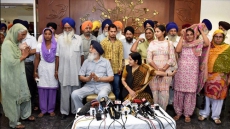
Bollywood and other films showing anything to do with the Sikh religion or portraying characters as Sikhs are running into trouble with the Shiromani Gurdwara Parbandhak Committee (SGPC), the mini-parliament of Sikh religion, and other Sikh groups.
The latest controversy is over the film "Nanak Shah Fakir", which portrays the life and times of Sikhism's founder Guru Nanak Dev and his family and is to be released on April 17. The SGPC has sought a ban on the release of the film, which garnered a lot of appreciation at the Cannes Film Festival and the Sikh Film Festivals at Toronto and Los Angeles.
Produced by Harinder Singh Sikka, a Sikh, the film's release is being objected to by the SGPC, the Akal Takht and radical Sikh groups like the Dal Khalsa and All India Sikh Students Federation (AISSF).
"The said movie (Nanak Shah Fakir) is an assault on the fundamental tenets of the Sikh religion. Sikhs cannot allow denigration of their religion in pictorial or other forms," Dal Khalsa leader Kanwarpal Singh told IANS.
SGPC president Avtar Singh Makkar has shot off a letter to Prime Minister Narendra Modi and union Information and Broadcasting Minister Arun Jaitley, pointing out that the film violated Sikh tenets which did not allow the portrayal of the Guru and his family by human beings.
Though Sikka claimed that the whole episode is driven by some "political agenda", Makkar refuted him saying that the SGPC never cleared the film.
"What is happening now is plain politics and pressure tactics by fringe elements who were also against the release of 'Chaar Sahibzaade'," Sikka said in a statement. Directed by Harry Baweja, "Chaar Sahibzaade" was a 2014 animated historical film on the sacrifices of the sons of the 10th Sikh guru, Gobind Singh.
This is not the first time that a film has run into trouble with the SGPC, Akal Takht - the highest temporal seat of Sikh religion - and fringe Sikh groups.
In recent years, the SGPC has even objected to films which have been cleared by the Central Board of Film Certification (CBFC), better known as the Censor Board.

The films that have run into trouble in recent years include "MSG - The Messenger" (2015) of controversial godman Gurmeet Ram Rahim Singh of Dera Sacha Sauda sect, "Singh is Kinng" (2008), "Son of Sardar" (2008) and "Jo Bole So Nihal" (2005).
In May 2005, "Jo Bole So Nihal" shows were hit by blasts in two cinema halls in New Delhi. The film had Sunny Deol, son of famous yesteryear actor Dharmendra, who belongs to a Sikh family, playing the lead.
One of the biggest blockbusters of recent years, "Singh is Kinng" had Akshay Kumar as a turbaned Sikh protagonist throughout the film. Some Sikh bodies though did object to the way his beard was cut in the film.
Top male actors Salman Khan, Ajay Devgn, Sanjay Dutt and Saif Ali Khan have played Sikh characters with turban and beards in Hindi films. Ranbir Kapoor, whose mother Neetu Singh comes from a Sikh family, followed suit in "Rocket Singh".

The SGPC, which is not against the portrayal of Sikh characters, does want that any film concerning the religion should be shown to its committee.
"Any reference to the Sikh religion and portrayal of Sikhs should be done in a proper manner. This should be cleared by the SGPC," Makkar said, adding that the SGPC wanted that the Censor Board should have at least two of its (SGPC) nominees so that controversies are avoided.