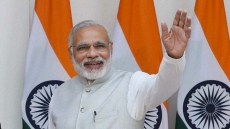
Prime Minister Narendra Modi on Monday expanded his government's 'Sabka Saath, Sabka Vikas' motto to include 'Sabka Nyay', assuring free legal aid for the vulnerable sections of the society.
"I believe in 'Sabka Saath, Sabka Vikas' and with that there must be 'Sabka Nyay'," Modi said, urging that the spread of legal awareness should be merged with awareness about judicial institutions.
"Along with legal awareness, there must be institutional awareness. People must know systems that are in place."
Addressing the legal fraternity on Legal Services Day, Modi said people were unaware of services rendered by the judiciary and legal in promoting legal literacy and securing the rights of the most disadvantaged sections of the society.
He admitted that he himself was not aware of this dimension of judiciary until now.
Appreciating the more than 8.5 crore cases settled by Lok Adalats since the National Legal Services Authority (NALSA) was constituted on December 5, 1995, Modi said they should be part of research projects for students in the national law universities so that they understand their functioning during the course of their education.
He said students should do research on Lok Adalats in different areas and submit their project reports with suggestions.
Pointing out that no institution can remain in a situation of status quo, Modi said everything must change as status quoist situation was fraught with stagnation.
He gave the instance of the successful implementation 'Pradhan Mantri Jan Dhan Yogna' where 40 percent people were brought within the fold of country's banking system by opening their accounts with zero balance.
Recalling the contribution of the NALSA in spreading legal awareness, Justice T.S. Thakur, who will succeed Chief Justice H.L. Dattu as Chief Justice of India on December 3, said: "No system, no society, no polity can survive if you don't ensure justice to poor.

"It (justice to poor) is upholding the constitutional mandate."
Justice T.S. Thakur said the settlement of cases through Lok Adalats was not just a win-win situation for parties to the dispute, it also reduced the burden of many cases as matters settled before Lok Adalats cannot be challenged.
He dwelt on the seven areas on which the NALSA will now focus involving women and child trafficking, drug abuse, securing the rights of unorganised workers and mentally sick, effective implementation of poverty alleviation schemes and child friendly legal services.
Justice Anil R. Dave, chairman of the Supreme Court Legal Services Committee (SCLSC), pointed to the ever increasing burden of pending litigations in courts, saying one of the reasons was less number of judges.
While in the US, there are 104 judges for every 10 lakh population and 75 judges for 10 lakh people in Canada, Justice Dave said that in India, it was just 15 judges for that many people.
"That is one of the reasons for our arrears," he said.
Law Minister D.V. Sadananda Gowda said every lawyer's contribution to free legal aid must be counted before designating him as a senior lawyer and subsequently considering him for appointment as a judge.
In his message, Chief Justice Dattu said: "A robust and effective legal system, that fearless upholds the rule, of law is one of the foundational pillars of democracy."
"It is of equal importance that the legal system itself is democratised, which would ensure that every citizen of our country has equal access to the legal system - equally swift, equally effective and equally impartial."
Pointing to the "diversity and complexity" of the society, Chief Justice Dattu said that while great strides have been made in breaking down area old barriers but many sections of our society continue to be vulnerable to abuse and exploration in various forms.

"It is essential that these vulnerable sections be provided equal and effective access to Justice" and the same is the mandate of the Article 39A of the constitution, he said.