Year after flash floods, has Uttarakhand bounced back to normalcy?
Saurabh Yadav IANS, 15 Jun, 2014 11:59 AM
On June 16, 2013, there was unusually heavy rain in Uttarakhand. In the catchment area of the upper Ganga tributaries, rain water flooded the valleys, washing away huge rocks and trees with it, and caused a huge loss to life and property. More than 5,000 people were dead and missing in the state.
I worked on a relief effort with friends in Uttarkashi district in July and August of 2013. We decided to focus here as three of our team had completed mountaineering courses from the Nehru Institute of Mountaineering in Uttarkashi town and we had local help.
The core group reached Uttarkashi on July 6. This small mountain town is where the Assi Ganga and Bhagirathi rivers meet. The previous year, on Aug 6, a cloudburst upstream had made the Assi Ganga flood and change course, washing away a bridge, roads and houses. Near Uttarkashi, a house still stood like a toy in the middle of the Assi Ganga river bed, a fierce symbol of the river's power.
This year, the waters came from Gangotri, through the Bhagirathi. The road was missing at many points and walking was the only way for many villagers. Gangotri was cut off from Uttarkashi and remained so till late September, when the Border Roads Organisation (BRO), which maintains the roads in this region, was able to effect repairs.
A lot of relief aid was coming in to Uttarakhand - some of it was stuck at Dehradun and Rishikesh, the two regional hubs. Some goods were unusable after lying in the rain for days. Most of the relief was quickly cornered by people at or near the roadhead who had barely lost anything in the tragedy. The ones who needed it most were far away from the main roads, sometimes a day's walk through uncertain paths. We saw multiple agencies working in Uttarkashi and, for weeks, the same villagers collected rations and stocked up for months. Just 30 km away, the Bhatwari block had at least five villages completely cut off by road and others with no access to rations.
The only aid reaching here was by Pawan Hans helicopters that the state government was using. This was not enough for the area. We decided to supply essential items to these villages. We set up base camp in Uttarkashi with a designated office and maps of the area. We rented accommodation and set up a working kitchen for our volunteers.
We took food essentials from NGOs and the government and, making manageable loads, ferried them using porters over the 30-km distance. It was not easy, the trail was unsafe; in some cases our team crossed rock fall zones and saw people injured by the rain of boulders from above. On days of heavy rain, no one risked the already perilous journey.
The porters were Gurkhalis, tough men who walked on the slippery, shifting, wet trails wearing flimsy sandals, with just a large plastic sheet to cover them from the rain. The loads they carried on their back were stocked at Bhatwari.
Bhatwari is the largest village on this stretch and sits in a broad valley. There was no loss of life or property here. There were villages on the hills around it, with between 60 and 300 families, and the only way to reach them was by walking, up to 16 km one way.
We took census lists from the sarpanches and then distributed the material village by village, based on their need communicated to us.
Through friends, we got doctors to come up for a week at a stretch to help. We set up three medical camps and our porters carried the medicines. The doctors saw more than 3,000 patients. Skin diseases, water-borne diseases and gynaecological problems were common. No lady doctor had ever visited the area.
We shared details of what we did with the district administration so that aid was better distributed and doctors could be sent where they were needed. With a small mobile team and accurate information we reached areas major aid organisations struggled to get to.
In the two months in Uttarkashi, we also got to see how life there has been affected by landslides. The connecting road to Haridwar was constantly blocked and BRO bulldozers were constantly battling the piles of rock and mud. In one instance, six days went by before the road was open. Vegetables, milk and fuel fell short. The trucks ferrying aid material also took multiple days to reach us. These landslides threaten the economy of the hill state and happen every monsoon without fail.
A year after the tragedy, the monsoon is just building up across the country. Will the roads to Uttarkashi stand this monsoon?
(Saurabh Yadav is a journalist and community worker. The views expressed are personal. He can be contacted at saurabh.yadav@gmail.com)
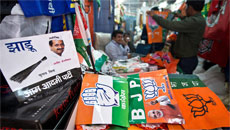
Narendra Modi is not far off the mark when he says that the May 16 results will be the Congress's worst. Drawing room and tea-stall chatter nowadays centres on whether the 128-year-old no longer a Grand Old Party will be able to reach the 100-seat mark in the 545-member Lok Sabha in which two MPs are nominated.
The Congress is headed for a historical defeat in the Lok Sabha elections, BJP's prime ministerial candidate Narendra Modi said Monday. Addressing a rally in Mumbai, the Bharatiya Janata Party leader said the Congress will not get seats in double digits in any state.
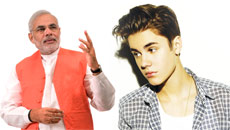
BJP prime ministerial candidate Narendra Modi had many more “NO” votes than Canadian pop singer Justin Bieber and polled far fewer popular votes than AAP leader Arvind Kejriwal in a TIME 100 list of the most influential people in the world live poll as of late Sunday.
He remains one of India's most prized voters. Mahant Bharatdas Darshandas is the lone voter in the midst of Gujarat's Gir forest, home to the Asiatic lion, for whom an entire election team sets up a polling booth every election - and will do so again on April 30.
BJP's prime ministerial candidate Narendra Modi Sunday hit out at the Congress-led UPA, terming it a "maa betey ki sarkar" (a mother-son government) and urged people to vote them out.
A CNN story on what it called "India's first social media election" also began with how during the Holi festival more than three million Twitter followers of Modi "received a personalised greeting from him."