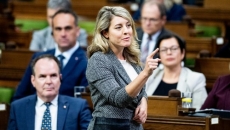
Prime Minister Mark Carney unveiled Canada's long-promised updated strategy on artificial intelligence Thursday -- a technology his government says is quickly changing how the world works.
The document emphasizes education for all Canadians and encouraging business to adopt AI, while promising to protect workers and children from potential harms.
The strategy is a high-level document that is light on timelines and details but gives a sense of where the government sees AI going in the near future.
Here are some of the key takeaways from the government's "AI for All" plan:
1. Building trust: The strategy notes that many Canadians simply don't trust artificial intelligence and the government is looking to change that. The plan says that "for Canada to thrive in the era of AI, Canadians need to trust its promise."
The strategy says the government plans to invest $50 million in the Canadian AI Safety Institute to monitor emerging risks and advance research. The government also promises to create "Canadian Trusted AI Certification" to help consumers and businesses identify trustworthy products in the marketplace.
2. Public education: The government plans to offer free entry-level AI education courses at public libraries and seniors' centres to help people better understand the technology.
It also talks of "practical AI learning" in schools and post-secondary institutions. The goal is to see "AI literacy content" reach one million post-secondary students and train 3,000 teachers on how to bring the tech into the classroom.
Carney said in his remarks Thursday that he wants to ensure all students have access to "trusted AI agents" that can help them, regardless of their area of study.
The strategy says low levels of AI literacy and public trust are "binding constraints" on the technology's growth in Canada.
3. AI on the job: One of the challenges the government has identified is the relatively low level of AI adoption by governments and small and medium sized businesses compared to other countries.
While it acknowledges some people worry about losing their jobs to the technology, the strategy forecasts the creation of 250,000 "AI-relevant" jobs by 2031. The government says it's going to encourage the creation of 90,000 AI-related jobs for young people by putting relevant placements in programs like Canada Summer Jobs.
The strategy also talks about creating programs to help people in a wide range of professions and careers learn about practical ways they can use AI in their work. Carney said the goal is AI implementation that is "pro-worker."
4 Security and protection: The strategy talks about introducing legislation to protect adults and children from AI-related harm. This will include consumer privacy legislation to ensure personal data is not inappropriately used for things like surveillance pricing.
The strategy also talks about updating laws and regulations to protect children and vulnerable groups online, and to limit algorithmic biases. This effort will include legal tools to combat deepfake images -- frequently used as a form of sexual violence -- and work to keep interactions with chatbots safe.
5. Investing billions in Canadian AI: The strategy outlines billions of dollars in public funding to support a wide variety of programs, including education and training aimed at further developing AI in Canada.
Carney said it's important to have a strong AI presence in Canada so that companies will be accountable to Canadian laws and regulation on privacy and security.
The government is earmarking $500 million for a new Canadian Tech Growth Fund aimed at helping Canadian AI companies secure capital investment. The strategy says this would allow the government to take equity stakes in AI companies.
Picture Courtesy: THE CANADIAN PRESS/Arlyn McAdorey