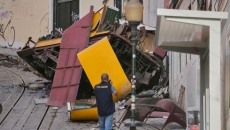
Minutes after a massive 9.0 magnitude earthquake strikes off Vancouver Island one summer's day, thousands of British Columbians are dead or injured in the wreckage — then comes the tsunami, aftershocks and chaos.
Distraught survivors overwhelm hospitals as they search for loved ones. Road and rail links are damaged by the quake, then inundated by tsunami flooding. Food and medical shortages follow.
The scenario of a "megathrust" earthquake is described in a B.C. government risk analysis that foresees more than 3,400 fatalities and more than 10,000 injuries on the day of the main shock.
"After the earthquake, thousands more are killed or injured by triggered hazards, such as the tsunami, aftershocks and fires," it reads.
The scenario also describes costs of $128 billion, the destruction of 18,000 buildings and extensive damage to 10,000 more, while economic growth is halved and GDP and job losses stretch over the next decade.
It says the heaviest damage could occur on Vancouver Island and a roughly 20-kilometre band including Vancouver along the mainland, from the U.S. border to the Sunshine Coast.
The analysis is part of the B.C. disaster and climate risk assessment, dated October 2025, which also outlines several other "extreme event" scenarios — severe flooding in the Fraser Valley, high-tide flooding on the southwest coast following a winter storm, an urban interface fire, and a drought that last years.
Edwin Nissen, professor of earth and ocean sciences at the University of Victoria, said the report's estimates of fatalities and destroyed buildings rest on simulations.
"You can sort of run a simulation of what the earthquake would look like, and then how much ground-shaking it will cause," said Nissen, who was not involved in the report.
He added that these simulations would then consider the structural integrity of homes based on their physical location, material and building code.
"On a purely personal level, wood-frame homes are generally relatively safe from shaking," he said. "If it's brick, that's bad. If you are on bedrock, if you are close to bedrock, that is good. If you are not on bedrock, that is less good."
Nissen said the figures in the report come with a "huge amount of uncertainty" because of factors such as the time of day and year when a quake strikes.
He said earthquakes in the winter can be more deadly, because the ground has absorbed more water, making landslides and the liquification of soil more likely.
But he said such reports were needed on a regular basis.
"I think it's good that they update these emergency reports every few years, because I think the science moves quite quickly. The engineering moves quite quickly."
The report says the last comparable earthquake in the region happened in 1700.
Nissen said researchers know of that quake through oral records from First Nations, as well from more recent scientific studies of the Cascadia fault, which stretches for 1,000 kilometres from mid-to-northern Vancouver through the Pacific to Northern California.
The report pegs the likelihood of such an extreme event between two to 10 per cent within the next 30 years. It also lists the 2004 9.1-magnitude Indian Ocean earthquake as comparable "in terms of its tectonic setting, length of rupture and tsunami generation."
While the last regional earthquake of this magnitude happened more than 300 years ago, Nissen said that they do not occur on a regular schedule.
"Sometimes, you can have two in quick succession, 100 years apart," he said. "Other times, you could have a gap of 800 years."
The range of probabilities could be large, he added.
"But the fact is, it could happen any time, so we do need to be prepared for it."
Nissen also said scientists are a "little blind" when it comes to the Cascadia subduction zone, because they have not been able to record many moderate earthquakes.
Picture Courtesy: THE CANADIAN PRESS/AP Photo