

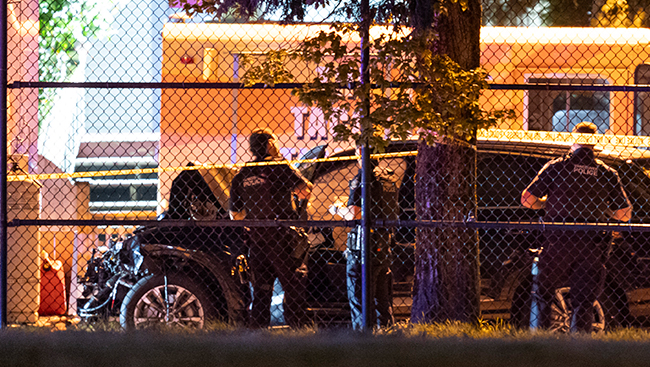
A car ramming Saturday at a Filipino community festival in Vancouver that killed 11 people marks at least the fourth attack in seven years in which vehicles have been deployed as deadly weapons against groups of people in Canada.
Perpetrators fuelled by motives ranging from terrorism and far-right extremism to misogyny and mental illness have turned increasingly to the tactic in recent decades.
Vehicles are "easily obtainable, and a ramming attack requires little preparation" or skill, notes a 2018 study from San Jose State University's Mineta Transportation Institute.
The gruesome practice has also proven devastating, yielding ahigh death toll in horrific fashion when crowds are gathered.
"It is in fact an effective tactic for motivated individuals to do harm, if you think about it, because it doesn't require any special training," said Jennifer Magnus, who teaches public safety and law enforcement at Wilfrid Laurier University in Waterloo, Ont.
"They can grab a vehicle, whether they rent it or use their own, and then just use it as a weapon against innocent bystanders."
Magnus, who served as a Calgary police officer for 14 years, also stressed the trauma and dread spawned by mass killings.
"It creates that level of fear in citizens."
Vancouver's interim police chief said a 30-year-old local man was arrested in the Saturday night attack, which saw a black Audi SUV plow through a crowded South Vancouver street at high speed. Police said 11 people had died as of Sunday afternoon, with dozens more injured.
Police said on social media platform X they were “confident” the attack was not an act of terrorism.
Nonetheless, the methods of defending against vehicle-based attacks overlap with counterterrorist prevention, relying on physical barriers, emergency planning, intelligence and social media monitoring.
With the threat of rammings on the rise, authorities have tried to insulate public spaces from easy assaults, installing metal bollards — stubby steel posts designed to stop a car from breaching busy streets or buildings.
New York City is one of several whose streetscapes are being reshaped by anti-vehicle obstacles. It has erected hundreds of bollards at popular spots after two high-profile vehicle attacks in 2017.
Mobile barriers are also an option for events such as concerts, parades and police funerals.
"The police service contacts the city, and they'll use their dump trucks or heavy trucks to block alley accesses," said Magnus, referring to memorials for fallen officers.
"Even for festivals, you'll often see big city vehicles parked on entrance points, and they may close roadways down and put barriers up."
In Vancouver, Deputy Chief Const. Steve Rai called Saturday's attack a "watershed moment" for first responders and public officials.
"It goes without saying this will change the landscape for deployment for police going forward," he said.
But recent attacks have underscored how tough it is to fully seal off the threat.
New Orleans officials were in the process of replacing bollards when a pickup truck driver ripped through a crowd of Bourbon Street revellers early on New Year's Day this year, killing 14.
Even when they are in place, some bollards struggle towithstand the impact from a large vehicle, Magnus said.
"The police will block access points, but you can only block so many," she added.
Meanwhile, the frequency and "lethality" of car rammings by terrorist organizations have increased sharply in recent decades, according to the Mineta study.
Canada is no exception. While mass shootings north of the border are rare relative to its southern neighbour, car-ramming attacks have ramped up in the past 10 years.
In February 2023, a Quebec man was charged with killing two children and injuring six others after he allegedly drove a city bus into a Montreal-area daycare. The Crown and defence jointly submitted evidence the man was likely in a state of psychosis at the time and have recommended he be found not criminally responsible.
Four members of a Muslim family out for a walk were struck and killed by a pickup truck in London, Ont., in June 2021 in an incident a judge later deemed an act of terrorism by a self-professed white nationalist.
In Toronto, a 25-year-old man drove a rented van into mostly female pedestrians on Yonge Street in April 2018, killing 11 people.
Parallel incidents have become frighteningly common across the globe.
Six people including a nine-year-old child died in Germany and more than 300 suffered injuries after a man evaded protective measures to speed through a Christmas market in the eastern city of Magdeburg in December.
In southern China, a man plowed his car into a group outside asports centre in November, killing 35 in the country's deadliest mass slaying in years.
Picture Courtesy: THE CANADIAN PRESS/Rich Lam


