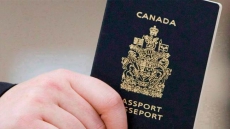
OTTAWA — A increase in asylum claims in Canada could eventually mean a staggering 11-year wait for a hearing and $2.97 billion in social supports for claimants in the meantime, an internal government analysis has concluded.
The Immigration and Refugee Board is already trying to whittle down its current backlog, but received no new money in the latest federal budget.
With 2017 application numbers expected to far exceed earlier projections, the board simply can't keep up, says the memo, obtained by The Canadian Press under the Access to Information Act.
That puts the entire asylum system at risk, opposition MPs warned Thursday as they urged the Liberal government to do more than simply study the issue and then leave it to the board to find "efficiencies" to handle the problem.
Ensuring the right processes are in place to support government policy on immigration is essential, said Conservative immigration critic Michelle Rempel, warning the situation could erode public support for Canada's policy of welcoming refugees.
"When the government ignores that, you start getting politicized rhetoric that's polarized on the right and the left, instead of being compassionate about people," Rempel said.
"And that's the government's fault."
The Immigration Department memorandum was drawn up this spring amid a flood of people illegally crossing into Canada from the U.S. to claim asylum, dominating headlines and raising pointed House of Commons questions about the integrity of Canada's borders and immigration system.

The department was asked to explore estimated backlogs at the Immigration and Refugee Board and the associated wait times under different scenarios, following a meeting about the U.S. border-crosser issue in March.
Since January, at least 2,700 people have been intercepted by the RCMP between legal border points; most went on to file claims. The memo does not directly address the impact of the border crossers, though certain sections were redacted.
But those numbers are only part of the mix.
Asylum claims have been steadily rising since 2015; that year, there were 16,115, and in 2016 there were 23,895. As of April this year, the last month for which data is publicly available, there were already 12,040 claims in the system.
The memo projects that claim levels will hit 36,000 this year and could continue to increase after that.
"This scenario best reflects current concerns around increased volumes of claimants observed to date in 2017, and takes into account overall increases in asylum intake from 2015 to 2016," it says.
The memo goes on to say that by the end of 2021, the new system inventory would grow to approximately 192,700 claims, equivalent to 133 months' worth of output from the board, or a wait time of approximately 11 years.
The social support costs for claimants — education, social assistance and health care — were $600 a month each in 2016-17, the memo said. At that claim volume, those costs could climb to $2.97 billion from 2017 through 2021.
The numbers should be read with caution, said Janet Dench, executive director for the Canadian Council for Refugees. Refugee claimants pay taxes, yet can't access many of the same benefits Canadians do, she noted.

"To provide a figure for total costs without factoring in taxes paid makes no more sense than if we were to calculate the average use of services by a Canadian over a lifetime and say that is the cost to Canada of each baby that is born," Dench said.
Two other scenarios were examined: intake for 2017 remaining at the originally projected number of 28,000 claims, and claims rising to 36,000 with no growth after that.
In the first scenario, wait times would be between four to five years; in the second, around six years.
The IRB has been sounding the alarm for months over its ability to keep pace with the rising numbers, citing a number of factors including vacancies for decision-maker positions and the legislative requirement for hearings to be scheduled within certain timelines.
A backlog has arisen, the note explains, because hearings need to be scheduled as soon as the claims are filed, and the board simply can't keep up with the pace.
The board has tried to deal with the backlog on its own by, among other things, redeploying half its capacity to address backlogged claims. Repeated pleas for more money, however, have only been met by the immigration minister's insistence that the board find ways to be more efficient.
That might not be enough, says the analysis.
"The rate of backlog growth presented in these scenarios could be mitigated in part by these efficiencies, but not avoided altogether," the note said.
Last Friday, Immigration Minister Ahmed Hussen announced a wide-ranging review of the IRB, bringing in a former deputy minister in the department to study the system and report back by the summer of 2018.
A study won't cut it, said NDP Immigration critic Jenny Kwan.
"He can't just say I'm going to study this year again and hope the problem will go away," she said.
It will not go away until they take real action and the need to resource the IRB properly."