Monday, June 29, 2026
ADVT 
National

B.C. Astronomer Gets Rare Look At Binary Pulsar Before It Vanishes For 160 Years

The Canadian Press, 09 Jan, 2015 02:56 PM
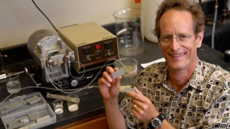
    A B.C. astronomer helped uncover some of the secrets of a rare and mysterious occupant of our universe — a binary pulsar system — before it disappeared from view for the next 160 years.
     
    Ingrid Stairs, a professor of astrophysics and astronomy at the University of British Columbia, spent the last decade examining the system called J1906 with an international team.
     
    The system is 25,000 light years from Earth and consists of a pulsar — a highly magnetized, rapidly rotating neutron star — that orbits around a companion star in just under four hours.
     
    Neutron stars are the dense, collapsed remnants of massive stars that have undergone supernova explosions.
     
    The pulsar emits a lighthouse-like beam of radio waves that the team has been monitoring. But because the pulsar's spin axis "wobbles" like a spinning top, the region that emits the waves moves and eventually they no longer reach Earth.
     
    The waves have been growing fainter for years and have now nearly disappeared, said Stairs.
     
    "We would expect it to come back again eventually ... but (that) takes about 160 years," she said. "We sort of got lucky detecting the system when we did."
     
    The team was able to determine the masses of the two stars by measuring changes in the orbit thanks to Albert Einstein's theory of general relativity.
     
    The stars each weigh more than the Sun, but are over 100 times closer together than Earth is to the Sun. Their speedy orbit results in extreme gravity, Stairs said.
     
    "Imagine those orbiting each other every four hours, if you can. That's a very compact orbit with very massive objects," she said.
     
    Stairs said astronomers know of about 2,400 pulsars — and just 10 of those are double neutron star systems. 
     
    She said it's "quite likely" the companion in J1906 is a neutron star but it may also be a white dwarf. A white dwarf is a remnant of low-mass star.    
     
    Only a handful of double neutron star systems have had their masses measured and J1906 is the youngest yet, according to a UBC news release.
     
    "One of the interesting things about the system is that it is a very, very young pulsar that we see. In the systems that we think are double neutron systems, usually we see a pulsar that is quite old," Stairs said.
     
    Stairs and her team published the results of their research in the Astrophysical Journal and presented them at the American Astronomical Society meeting in Seattle on Jan. 8.
     
    The lead author on the study was Joeri van Leeuwen, an astrophysicist at the Netherlands Institute for Radio Astronomy and the University of Amsterdam.


    MORE National ARTICLES

    More Canadian help coming on Ebola, Harper tells Obama

    More Canadian help coming on Ebola, Harper tells Obama
    WASHINGTON - Canada is about to announce new measures in the fight against Ebola, Prime Minister Stephen Harper told his U.S. counterpart Thursday amid increased fear over the spreading virus.

    More Canadian help coming on Ebola, Harper tells Obama

    Paradis says Canada spending $8M to help kids affected by fighting in Iraq

    Paradis says Canada spending $8M to help kids affected by fighting in Iraq
    OTTAWA - Canada is donating $8 million to a UNICEF effort to meet education and protection needs of Iraqi children.

    Paradis says Canada spending $8M to help kids affected by fighting in Iraq

    International energy researcher to focus on oilsands at Calgary university

    International energy researcher to focus on oilsands at Calgary university
    CALGARY - Nanotechnology similar to that used to kill tumours in cancer patients could be adapted to improve in situ oil recovery in Alberta's oilsands, says an international researcher.

    International energy researcher to focus on oilsands at Calgary university

    Learning the secrets of lost Franklin Expedition vessel HMS Erebus

    Learning the secrets of lost Franklin Expedition vessel HMS Erebus
    VANCOUVER - The recent discovery of a Royal Navy wreck in Canada's Arctic has opened a historical window onto the 19th century, allowing archeologists to investigate the long, lost Franklin Expedition like a detective would examine a crime scene.

    Learning the secrets of lost Franklin Expedition vessel HMS Erebus

    Luka Rocco Magnotta's murder trial hears from son of ex-PM Jean Chretien

    Luka Rocco Magnotta's murder trial hears from son of ex-PM Jean Chretien
    MONTREAL - Luka Rocco Magnotta's murder trial has heard from one of the sons of former prime minister Jean Chretien.

    Luka Rocco Magnotta's murder trial hears from son of ex-PM Jean Chretien

    Ex-PM Chretien backs Trudeau position on Iraq, criticizes Harper in column

    Ex-PM Chretien backs Trudeau position on Iraq, criticizes Harper in column
    TORONTO - Former prime minister Jean Chretien says he supports Liberal Leader Justin Trudeau’s decision to oppose Canada’s air combat mission in Iraq.

    Ex-PM Chretien backs Trudeau position on Iraq, criticizes Harper in column