The British Columbia government won't be making big service cuts or raising taxes in the 2026 budget, even as it faces a projected $11.2 billion deficit.
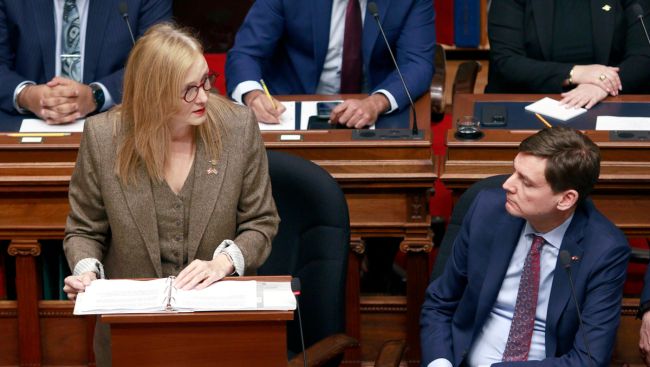
Instead, B.C. Finance Minister Brenda Bailey says the government knows it needs to "operate more efficiently," adding that Tuesday's budget "goes further" to curtail staff costs in a process already underway via a hiring freeze and attrition.
"It's a very serious budget for very serious times," Bailey told a news conference Sunday.
The Finance Ministry has said the provincial public service has shrunk by over 1,500 people since restrictions started in 2024, with most of those through attrition.
Of the employees who left the public service since January 2025, 40 per cent were resignations, 18 per cent were retirements and 34 per cent were due to job terms ending.
Bailey said Sunday that the province is focused on protecting core services including health care and education as well as public safety.
She said the budget can be described as "disciplined, focused and serious."
"There are many who have expressed to me that now is the time to make big cuts and bring the deficit down quickly and there are others who strongly hold the view that we should be raising taxes and doubling down on providing even more services than we're doing right now," she said.
"This budget is neither of those things."
She said bringing down the deficit and handling the province's debt will allow the province to invest in services that British Columbians need.
She said she will have more to say about "where the deficit sits" on Tuesday, but "the important part of the plan is that the deficit will come down year over year."
"That work is going to take time," she said.
"We're doing this work at the same time as we're driving forward with efficiencies and we're protecting core services."
The British Columbia government didn't have the opportunity to hint about what was coming in the provincial budget in its annual throne speech last week.
The speech, which is normally used to promote the government's agenda for the legislative session, instead focused on helping a community recover from the mass shooting in Tumbler Ridge that left nine dead, including the killer. Five pupils aged 12 or 13 and a teaching assistant died at Tumbler Ridge Secondary School, as well as the shooter's mother and half brother at their home.
Bailey said Sunday that the province will be there for the people of Tumbler Ridge as they recover, "but in government we must go forward and we will be presenting Budget 2026 on Tuesday as scheduled."
When asked whether the government has pivoted to allocate any funds in the budget to building a new school in the northeastern community or create temporary classrooms for the survivors, she said it has not.
"Budget 2026 was kind of in the can before the terrible events of last Tuesday, but what's important to know is that we have a contingency fund for unexpected things," she said.
Both Bailey and the premier had earlier foreshadowed a cinching of government spending.
Bailey recently predicted that she was going to be the "least popular person in the province for a while," after she tables her budget. One economist has said he is not so sure.
Marc Lee, senior economist with the Canadian Centre for Policy Alternatives, said in an interview ahead of Bailey's Sunday comments that he hopes the budget avoids deep cuts.
"But my sense is that they are talking a particular line around austerity now, but it won't actually be as bad come budget day," Lee said.
"I hope that I'm proven correct."
A background briefing authorized by the premier's office and delivered to reporters on Thursday also pointed in a similar direction.
The deficit is too high, but the government is committed to protecting core services, while also creating financial room for any unforeseen economic eventualities, the briefing said.
The most recent government forecast pegs this fiscal year's provincial deficit at $11.2 billion, and Shannon Salter, deputy minister to Premier David Eby, said in a recent email that B.C. has an "unsustainable provincial budget deficit."
Eby himself has publicly previewed cost-cutting measures at a recent unrelated news conference.
"We have to reduce those expenditures, and we will do so in the budget," he said.
He added that government will continue to reduce the size of the public sector.
"There is room for us to reduce the bureaucracy and administration while protecting core front-line services for British Columbians and that is what we are going to do."
Bailey had made the statements about her forecasted dip in popularity at a business audience hosted by the Greater Vancouver Board of Trade last month. That drew an immediate response from the Conservative Party of B.C.
Peter Milobar, who is the finance critic and among 10 candidates running for the party's leadership, said Bailey's comments raise the question of where all the money has gone.
"When the government is previewing cuts and new difficulties for families in the upcoming budget, it’s a question that must be asked," Milobar said in a release. "Under this Eby government, announcements haven’t translated into actions or outcomes.”
“The numbers show that nearly every aspect of life in British Columbia has gotten harder under the NDP government, despite unprecedented spending,” he said.
Milobar said Eby "inherited strong finances and squandered them," pointing to B.C.'s almost $6 billion surplus when Eby replaced the late John Horgan as premier.
Conservatives said the provincial debt has also "exploded" under Eby. When he took office in 2022/23, total debt was $89.4 billion, the release said. It is now projected to top $155 billion this fiscal year.
"It’s time to get back to basics, restore fiscal discipline and present a credible plan to balance the budget," Milobar said.
But Lee said fears around the debt and the deficit are "overblown," noting that B.C.'s debt-relative-to-GDP is the second-lowest in Canada.
Figures from Statistics Canada published in late 2025 show B.C.'s net debt-to-GDP ratio at 3.8 per cent, Alberta's at 2.1 per cent.
Lee said the current budget shows a contingency fund of $4 billion.
He said previous government spending has also created assets, like hospitals, schools, and highways, and it's a difficult economic climate.
"We are in the middle of a trade war," he said. Housing is also undergoing a major downturn and B.C.'s population growth is stagnating, he added.
"So, I don't think anyone's arguing that the B.C. government should be running a surplus or even balancing the budget," he said. "So, the question is: how large a deficit is OK … and then what are the costs associated with getting there?"
Picture Courtesy: THE CANADIAN PRESS/Chad Hipolito