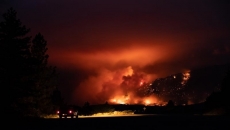
A wildfire in Lytton, B.C., during historically high temperatures points to a serious need to prevent similar occurrences, says the chairwoman of the Transportation Safety Board, which is investigating the possibility that a freight train could have been linked to the disaster.
Kathy Fox said an update on the investigation will be provided in the coming days, but a full report on any contributing factors related to the June 30 inferno that forced residents to escape could take up to two years.
Rail activity that sets fire to something on the right of way can have serious consequences, she said.
"Therefore, I think this is certainly a wake-up call to really look at what precautions need to be taken by railway companies, particularly when you're operating in extreme temperatures and in areas that are already bone dry and can go up with not much ignition," Fox said.
The safety board's investigation was launched after evidence provided by the RCMP and the BC Wildfire Service suggested the fire that killed two people may have been sparked by a train. The board is also investigating another fire in Sparwood involving a train after a report from another train's crew and a nearby brush fire, Fox said.
Fox said there were 100 reported fires sparked by rail operations in 2019 and 76 in 2020.
She said the board would work to determine the underlying causes of the Lytton fire before considering any safety deficiencies that must be addressed, including whether more surveillance is needed of trains and locomotives, as well as clearing of right of ways.
"At the end of the day, you've got to look at how do you prevent a fire from starting on a train or how do you prevent a train from throwing off combustible materials that then ignite a fire, to what can you do to mitigate through observation," Fox said.
That could also involve more inspections and limits or restrictions on operating conditions during periods of extreme heat in areas that are at risk of wildfires, she said of the village where the temperature hit a Canadian record of 49.6 C the day before the wildfire erupted.
Transport Canada said railway companies are legally responsible for the safety of their infrastructure, equipment and operations.
"This includes ongoing inspection, testing and maintenance programs in accordance with regulatory requirements, as well as any particular operating and environmental conditions."
Canadian Pacific Railway, which, along with Canadian National Railway, has a route through Lytton, resumed service about a week after the fire, prompting Matt Pasco, chairman of the Nlaka'pamux National Tribal Council, to say operations should have been paused during dry conditions.
CN Rail has said one of its trains shown on a video circulating on social media suggesting it was linked to the fire in Lytton and the nearby First Nation had actually passed through hours before the wildfire started and that smoke in the video was from a different fire.
CN spokesman Mathieu Gaudreault said current safety protocols include monitoring of passing trains by employees in the field for potential fire hazards as well as clearance of vegetation along the railway's right of way.
"Moreover, we are increasing patrols that precede and follow trains," he said in a statement. "These patrols are equipped with fire suppression equipment and keep a constant lookout for any signs of fire risk."
Andy Cummings, a spokesman for CP Rail, said the railway is closely monitoring conditions across its network to maintain safe operations.
"CP increases the regular inspections of locomotives and other equipment during periods of extreme conditions," he said in a statement. "CP has emergency response equipment that includes water trucks that can operate on roads and the railway and are positioned in our B.C. corridor."
Fox said railways are responsible for keeping their right of ways clear of any obstacles that could impede visibility or be a source of fire as part of regulations overseen by Transport Canada, but maintenance along tracks is a "complex matter" that involves the jurisdiction of landowners, including municipalities or provincial governments.
Federal Transport Minister Omar Alghabra ordered Canada's two major railway operators to take several steps in fire prevention along their lines as the heat, along with dry conditions, scorches B.C.
However, Fox said it can be difficult for crews to even know a train has caused a fire.
Many freight and passenger trains are equipped with forward-facing video cameras and in some cases, if they have a trailing locomotive, a rear-facing camera may also be installed.
"It really depends on what type of car it is and which way it's facing," Fox said. "For example, you could have a locomotive at the end of the train that has a camera, but if the locomotive is turned around the other way, it's obviously not going to capture anything behind the train."
Increased traction while a train is speeding up can throw sparks that could smoulder before a fire is ignited, she said.
"So, it's a challenge for the railways and it's a challenge for everybody, particularly in a situation like we have in B.C. now where it's so hot and so dry and it doesn't take much to ignite a fire."