The British Columbia government plans to spend $8.7 billion over three years on infrastructure as well as on supports for families and businesses to help build the economic recovery from COVID-19.
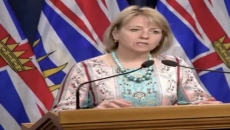
Finance Minister Selina Robinson said Tuesday the deficit for the 2021-22 budget is projected to be $9.7 billion, lower than the $13.6 billion forecast last December, due to higher-than-expected revenues and lower government spending.
The budget forecasts three consecutive years of billion-dollar deficits with the provincial debt hitting almost $103 billion and the prospect of a return to balanced books in seven to nine years' time, Robinson said at a news conference.
“The pandemic will end, but our work to build a better future will not,” she said. “The work ahead will require the collective efforts of all British Columbians and I know we are all up to the task.”
The provincial government is promising to spend $3.5 billion more than last year on infrastructure to build hospitals and schools, and improve transit and roads, creating 85,000 jobs.
Among those projects is extending SkyTrain service to Langley in the Fraser Valley and completing a toll-free replacement for the George Massey Tunnel south of Vancouver.
There will also be $3.1 billion spent over three years in the health-care and mental health systems, including more supports for older people to stay in their homes and $500 million to address the overdose crisis.
B.C.’s economic outlook has improved since the last fiscal update, with higher than anticipated revenue from the retail, real estate and export sectors, but financial forecasting during a pandemic is difficult, said Robinson.
The budget also includes more than $4 billion in pandemic contingency and allowance funds to offer supports during what are still considered volatile times, she said.
“There is uncertainty regarding how COVID-19 variants of concern may impact recovery here, across the country and globally,” she said. “The outlook is conditional on assumptions, which could change substantially over the coming months."
She said the budget's projections are underpinned on the assumption that immunization campaigns will be well underway around the world and that travel restrictions will ease.
Robinson said a $120-million tourism support fund is based on projections of recovery in the industry.
"We're also hopeful British Columbians can hang tight and do the right thing for the next number of weeks to get us through this current spring wave so that there might be local tourism for this summer," she said. "That's what we're all hoping for."
The Vancouver Board of Trade said in a statement it welcomes the government's continued investments in support initiatives, but there is more to do.
"We are still striving for a post-pandemic vision for the economy that attracts investment, creates good jobs and promotes opportunity," said Bridgitte Anderson, the board's CEO. "It's not clear this budget puts B.C. on the fast track in an increasingly competitive world."
Samantha Howard, a Canadian Federation of Independent Business director, said small businesses, which have been hit hard during the pandemic, wanted to see more support in the budget.
"We didn't see a clear path forward for small business recovery," she said.
The budget forecasts economic growth of 4.4 per cent this year after declining by 5.3 per cent in 2020, Robinson said.
B.C.’s $10-a-day daycare plan, which currently includes 35,000 families, will double with the budget, she said. It also increases the wage enhancement for early childhood educators to $4 per hour, bringing their average wage to about $25 an hour.
She said she expected B.C.’s daycare program to be improved with the federal government's child-care plans announced in Monday's budget.
Starting this fall, children under 12 will ride transit for free across B.C., a $672 annual saving for each child in Metro Vancouver and $400 per child outside of the Vancouver area.
“There are challenges ahead, but I am confident that by drawing on our shared resilience, we will get through these challenges together,” Robinson said.