It should have been a very bad day for David Eby's government.
But on Dec. 3, the morning after the pending closure of the pulp mill in Crofton, B.C., was announced with the loss of 350 jobs, the political focus was on the leadership saga in the Opposition B.C. Conservatives, as 20 of the party's MLAs called on then-leader John Rustad to quit.
It was emblematic of the chaos in the Conservative ranks over the past year, which Eby acknowledged has been politically beneficial to his NDP government.
But he rejected the suggestion that he got a hall pass in 2025, after eking out a one-seat majority in the October 2024 election.
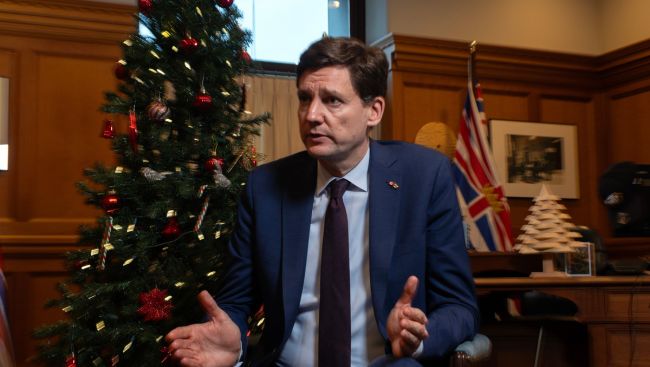
"If that was a hall pass, then I guess I'll never ask to go to the bathroom again in school," Eby said in a year-end interview.
"It was a very eventful and very challenging set of sessions, and it is huge piece of work that we have to do as British Columbians in this very consequential moment for our province."
It has been a tough year for Eby, with strained NDP relations with First Nations, unions and environmentalists.
But on the Conservative side, Rustad saw his ranks in the legislature reduced from 44 to 39 as MLAs lost confidence in a leadership marked by defections, claims of blackmail and caucus-room mobile phone checks in an attempt to find those members leaking information.
Conservatives, in other words, were busy drawing attention to themselves, and away from other issues. Rustad has since resigned, with Trevor Halford installed as interim leader while jostling begins for a leadership race
"A lot of people assume that the Conservative chaos is helpful," Eby said.
"On one level, it certainly is politically. But I think ultimately, some of what we've seen come out of the Conservatives is quite corrosive in terms of the work we have to do in this province."
The Conservative chaos has raised the question of whether Eby would try to take advantage by calling an early election.
Eby said British Columbians would go into an election if the Opposition succeeded in blocking legislation. He pointed to his government's decision to declare the recent vote on the North Coast Transmission Line a confidence measure — it passed by one vote, with the help of Speaker Raj Chouhan.
"But we're not seeking an election here," Eby said, when pressed about the likelihood of a snap election in 2026. "I also want to say we're ready, if it's necessary. We're fundraising, we're debt-free, we're ready to go if we have to, but British Columbians don't want an election."
The big issues of the year — the U.S. trade war, a public service strike, and court rulings on Indigenous claims — have all tested the cohesion of his party's coalition.
Eby's government responded to U.S. protectionism with several pieces of legislation during the spring session, but their political price may turn out to be high.
Two bills intended to fast-track resource projects drew loud opposition from First Nations and environmentalists. Both bills also needed Chouhan's vote to pass.
First Nations have also been critical of Eby's suggestions that the Declaration on the Rights of Indigenous Peoples Act many need to be amended after a court ruling found that government had failed to consult First Nations on B.C.'s mineral claims regime.
The ruling added to the tensions between government and First Nations in the wake of the Cowichan Tribes Aboriginal title ruling, which raised concerns about the implications for private land ownership in the title area in Richmond, B.C., and beyond.
"We have disagreements from time to time — there's no question," Eby said of his government's relationship with First Nations. "But the trajectory of the work is clear. We're working with First Nations across the province."
He said the government amended legislation all time and would continue to do so, "to make sure that we're respecting the bright lines that British Columbians have, that they stay in charge … not the courts, that private property is protected."
Unions, meanwhile, called on the government to reverse a BC Ferries' decision to purchase four new vessels from a shipyard owned by China's Communist government. Then there was the largest public service strike in B.C. history, which lasted eight weeks until a deal with the British Columbia General Employees' Union was struck in late October.
The strike saw union leaders question the labour credentials of the NDP, while newly elected B.C. Greens Leader Emily Lowan demonstratively walked the picket line with workers.
Environmentalists both outside and within the NDP have been critical of the government touting new resource projects in northern B.C.
Then there is the state of B.C.'s finances. When Eby replaced the late John Horgan as premier in November 2022, forecasts showed B.C. with a surplus of almost $6 billion.
Fast forward three years and there's a forecast deficit of $11.2 billion.
Eby said there's a different reality compared with 2022, with resource prices down.
"So, in a province that is resource-dependent, we see these booms and these busts from time to time," he said. "The decision is: do we keep working to support British Columbians, or do we cut back?"
While B.C. could make cuts, "people are really struggling right now," Eby said. "So, our focus remains supporting British Columbians through this time."
Eby said government has reduced the public service by 1,100 positions, but the province needs more schools and hospitals.
"The bottom line is, we're not going to cut our way out of this," he added.
Eby acknowledged that not everybody in the party agrees with his government's direction.
"I think that there are a lot of people within my NDP-movement world, who are activists, who have very strong positions on the environment, on involuntary care, on other big, challenging issues, Indigenous rights, and other pieces where they might disagree with the particular position government has taken on one of those issues," he said.
But he also pointed to the NDP's leadership review last month, which saw almost 83 per cent of delegates support him.
"The gratitude that I have, is that we came out of our convention united, that I have the support of the vast majority of our delegates, and that they trust me, and they trust our government to do this delicate work," he said.
"They understand the complexities of the moment we're in by supporting the interests of British Columbians and that's all I ask for."
Picture Courtesy: THE CANADIAN PRESS/Chad Hipolito