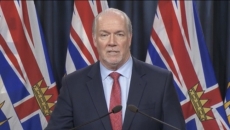
British Columbia's top doctor has extended COVID-19 restrictions on gatherings in order to slow down the spread of the virus amid concerns about new variants, including a third one from California that could potentially be detected in the province.
Dr. Bonnie Henry said Friday a "hard push" is needed so youth sports and faith programs as well as limited social interactions can resume by the end of the month after controls were put in place in November.
We all want to get to the days of fewer restrictions. The timeline for easing restrictions depends on our individual actions, and factors like variants of concern, vaccine supply and hospitalizations. We need a little more time, and to keep following the data & science. #CovidBC
— BC Government News (@BCGovNews) February 5, 2021
The restrictions that were set to end at midnight local time are needed to see a "smooth, flat path to the finish," Henry said.
All #CovidBC public health orders and restrictions in BC are being kept in place. We need to use this time to reduce the potential for new COVID-19 variants to spread in our province, as we await more vaccine from the manufacturers. We can get to the brighter, safer days ahead.
— BC Government News (@BCGovNews) February 5, 2021
Gatherings during the Super Bowl, Family Day, the Lunar New Year and Valentine's Day could threaten progress made while promised vaccines have not yet been delivered, she said.
"In places where we have not seen transmission before, social gatherings that happened over the Christmas break for example, social gatherings that have happened on ski hills and other places have led to rapid transmission in some communities."
The province has recorded 10 new cases of the U.K. and South African variants, for a total of 28 new variant cases.
Among the 19 cases of the U.K. variant, five were linked to travel, while one of the nine cases of the South African variant is related to travel. Tests for a variant from Brazil have been conducted but no cases have so far been detected.
Dr. Bonnie Henry, provincial health officer, and Adrian Dix, Minister of Health, provide an update on the Province's latest epidemiological modelling. https://t.co/xG4ri67mud
— BC Government News (@BCGovNews) February 5, 2021
Henry said she intentionally did not set a deadline for an end to her orders because if variants start to spread, "all bets are off" and some restrictions may need to be increased.
"We are in a place of a little bit of more uncertainty and we need to buy some time to understand if the positive things we are seeing are going to allow us to take away some of the restrictions we have in place now. And we don't yet know that."
Henry said she will continually review the data to determine if restrictions may be loosened before the end of the month.
"It's not going to be, 'Yay, we're out of this, we're back to normal,'" she said, adding a slow and thoughtful increase in social connections that everyone wants will be crucial.
"Now's the time to prepare for how to do that safely. And I think if we look around at jurisdictions around us, Alberta, Ontario and Quebec, they are actually looking at lifting some of the restrictions to take them to a place where we are now, so we need to put that in context, too," she said.
"I want us to safely go to restaurants, to safely go to retail shops, to safely go to our hairdressers and other important businesses in our community."
However, the risk of faster-spreading variants is concerning, and health officials have been discussing the possibility of a variant circulating in the Los Angeles area because of the amount of truck traffic transporting goods across the border to British Columbia from California, Henry said.
"We are in discussions with the federal government about how do we put in a rational way, and hopefully a co-ordinated way with the U.S., of having periodic testing of people who are essential workers coming back and forth across the border."
After vaccination for the most vulnerable people in long-term care and assisted-living facilities as well as health-care workers, Henry said the province will refocus its efforts on immunizing people over 80 in the community before starting mass vaccinations.
However, she said she needs more confidence that vaccine doses promised by Ottawa will be arriving when expected.
Health Minister Adrian Dix said 10 per cent of B.C.'s population will be vaccinated by the end of March based on current timelines around vaccine delivery, and that number is set to rise to 50 per cent by the end of June.
"We need to recognize that in the short run, right now, we have to maintain our actions to ... hold the line in transmission in the community."