The federal government is looking to give workers and students a leg up with a budget that commits billions to training, benefits and debt relief, as those hit hardest by the COVID-19 pandemic try to dust themselves off.
Live from the House of Commons: @CAFreeland, the Deputy Prime Minister and Minister of Finance, is introducing our government’s plan to beat this virus and build back better. Tune in now to learn more about #Budget2021: https://t.co/G7FYXYREse
— Justin Trudeau (@JustinTrudeau) April 19, 2021
The first Liberal budget in more than two years aims to create nearly 500,000 training and work placements — 215,000 of them for students — in a bid to perk up the country's economic comeback.
To that end, it pledges $2.4 billion over three years to developing skills and trades, with about 40 per cent earmarked for training in sectors ranging from health care to construction.
It adds on $8.9 billion more to beef up the Canada Workers Benefit in a boost to low-wage workers, who will have a higher income threshold at which their benefit starts to shrink.
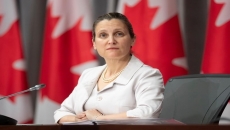
“Low-wage workers in Canada work harder than anyone else in this country, for less pay. In the past year they've faced both significant infection risks and layoffs. And many live below the poverty line, even though they work full-time," Finance Minister Chrystia Freeland said Monday.
The benefit boost — given in the form of a tax refund — will extend income top-ups to about a million more Canadians and lift nearly 100,000 people out of poverty, she said.
The income threshold will rise this year to nearly $23,000 for single individuals without dependents and more than $26,000 for families. The change will allow a single, full-time minimum-wage earner to receive about $1,000 more in benefits.
Geneviève Tellier, a political science professor from the University of Ottawa, said the added work incentive and the budget's emphasis on training represent a "market-oriented vision" of government assistance.
"They are saying you can work and not be penalized, up to a certain point," she said, referring to the workers benefit.
Notably absent from the 739-page document is any mention of a guaranteed basic income, which Liberals voted to include in their policy book at their convention earlier this month in spite of Prime Minister Justin Trudeau’s stated hesitation on the issue.
"I think it’s the end of the conversation for a CERB (Canada Emergency Response Benefit) that would be permanent, the $2,000 per month for every Canadian," Tellier said.
"I don’t see any signs in this budget that they want to think about it."
The budget also allots $5.7 billion over five years to helping post-secondary students, though the vast majority is earmarked for this year and next.
Some $3.1 billion of the total will go to doubling federal student grants in that two-year timeframe, on top of $393 million set aside to waive interest on federal student loans for an extra year until March 2023.
The government also plans to raise the threshold for repayment assistance to $40,000 for borrowers living alone, meaning anyone living under their own roof and earning that amount or less would not need to make interest payments.
The pandemic has been particularly rough on students, with about 50 per cent unemployed in July and August, according to Statistics Canada.
The budget measures mark an attempt to help hard-hit workers and students, but also to keep them from crossing over to the more spend-happy NDP in a possible federal election this year. New Democrats have proposed multiple policies to appeal to those groups, including a $20 minimum wage, billions in cancelled student debt, universal pharmacare and a wealth tax.
Other Liberal measures include bumping the federal minimum wage to $15, pledging $300 million to programs for Black and women entrepreneurs and other underrepresented groups, and recommitting to protect gig workers through promised amendments to the Canada Labour Code.
About 300,000 Canadians who had a job before the pandemic remain out of work, Freeland said.
"More Canadians may lose their jobs in this month's lockdowns," she said. "That is a lot of human tragedies."
Highlights from the federal Liberal budget tabled Monday by Finance Minister Chrystia Freeland:
— $30 billion over the next five years, and $8.3 billion ongoing for early learning and child care and Indigenous early learning and child care. The plan would aim to see an average drop in fees next year by 50 per cent for preschooler daycare spaces and an average of $10-a-day care by 2026.
— $3 billion over five years, starting in 2022-23, to Health Canada to support provinces and territories in improving standards for long-term care. The government says this funding will keep seniors safe and improve their quality of life.
— $2.2 billion in Canada’s bio-manufacturing and life-sciences sector to rebuild Canada’s national capacity in bio-manufacturing and vaccine development and production.
— Introducing legislation to establish a federal minimum wage of $15 per hour, rising with inflation, with provisions to ensure that where provincial or territorial minimum wages are higher, that wage will prevail.
— A new Canada Recovery Hiring Program to provide eligible employers with a subsidy of up to 50 per cent on the incremental remuneration paid to eligible employees between June 6 and November 20. The program will provide $595 million to make it easier for businesses to hire back laid-off workers or to bring in new ones.
— $17.6 billion towards a green recovery to create jobs, build a clean economy, and fight and protect against climate change.
— $1 billion over six years, starting in 2021-22, to the Universal Broadband Fund to support a more rapid rollout of broadband projects in collaboration with provinces and territories and other partners.
— $18 billion over the next five years to try to narrow the socio-economic gap between Indigenous and non-Indigenous people, including $6 billion for infrastructure in Indigenous communities, and $2.2 billion to help end the tragedy of missing and murdered Indigenous women and girls.
— $2.5 billion and reallocate $1.3 billion in existing funding in order to help build, repair or support 35,000 housing units.
— Introduce Canada’s first national tax on vacant property owned by non-residents.
— Introducing a new tax on the sales, for personal use, of luxury cars and personal aircraft with a retail sales price over $100,000, and boats, for personal use, over $250,000.
— Includes $100 billion in new spending over the next three years.
— Records a $155 billion deficit for 2021-22.