
Sunday, June 21, 2026
ADVT 
National

Budget watchdog predicts zero population growth this year

Darpan News Desk The Canadian Press, 26 Feb, 2026 10:53 AM
  • Budget watchdog predicts zero population growth this year

The parliamentary budget officer predicts Canada's rate of population growth will remain flat in 2026, mainly due to cuts to non-permanent resident admissions in the latest federal Immigration Levels Plan.

This would be the second year in a row with zero population growth in Canada, which follows several years of above-average growth years, including two record breaking years in 2022 and 2023.

Statistics Canada reported flat growth in 2025, with the PBO report finding any gains in population were offset by a decline in the non-permanent resident population of 382,000 people.

It said population growth averaged 1.1. per cent annually between 1972 and 2015, before it began to see greater increases driven primarily by immigration.

Growth hit a new record in 2022, when Canada's population grew by more than one million people for the first time in a single year. It exceeded that marker again in 2023, when annual population growth peaked at 3.1 per cent.

Statistics Canada data shows immigration-driven population growth in 2023 of 1.2 million people, with a combination of permanent and non-permanent arrivals.

The PBO analysis of annual immigration targets projects the government will hit its goal of reducing the population share of non-permanent residents from a peak of 7.6 per cent in October 2024 to less than five per cent by the end of 2027 — one year later than originally planned.

The federal immigration plan includes a dramatic cut to the number of new temporary work and student visas, from almost 674,000 in 2025 to 385,000 this year.

The plan sets a target of 380,000 permanent resident admissions annually between 2026 and 2028, with two one-time programs to fast-track permanent residency for 148,000 non-permanent residents over the next two years.

These one-time programs are focused on speeding up access to permanent residency for eligible people and some temporary workers.

The 2026 levels plan says one of those programs is meant for up to 115,000 individuals who can't return to their home countries and are already on track for permanent residency.

The other program looks to accelerate permanent residency status for up to 33,000 temporary workers who have put down "strong roots" and are employed in jobs that help to build the economy, says the levels plan.

The PBO predicts these one-time programs will play a significant role in reducing the number of non-permanent residents in Canada to less than five per cent of the population by the end of 2027.

The PBO report says while these two programs are in addition to the broader 380,000 person permanent resident target, the outflow of non-permanent residents is expected to offset population growth.

The PBO predicts the non-permanent resident population will decline by 385,000 this year, and by an additional 289,000 people in 2027.

The report notes about 80 per cent of this decline is expected to involve work permit holders leaving the country. The remaining decline projection is based on a combination of some student visa holders leaving and people becoming permanent residents.

The PBO report projects that Canada's population will grow by 0.3 per cent in 2027 before stabilizing at around 0.8 per cent annually in the medium term.

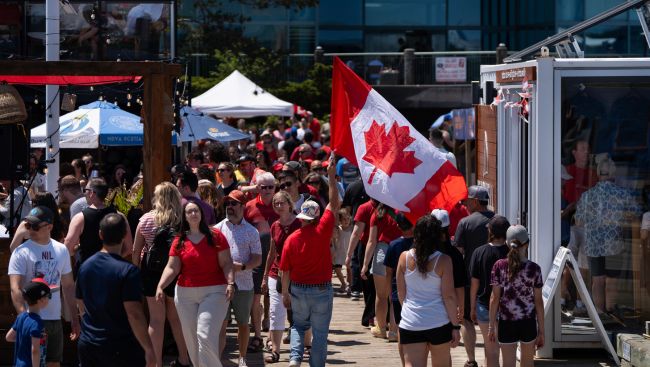
Picture Courtesy: THE CANADIAN PRESS/Darren Calabrese

MORE National ARTICLES

'All bets are off': B.C. pulls liquor, changes procurement after U.S. tariffs

'All bets are off': B.C. pulls liquor, changes procurement after U.S. tariffs
British Columbia Premier David Eby says the province and the country is strong enough to weather the storm in the threat to Canada's sovereignty coming from a former friend. Eby took the unusual step of interrupting B.C.'s budget lockup to address how the province will respond after U.S. President Donald Trump imposed tariffs on Canadian goods.

'All bets are off': B.C. pulls liquor, changes procurement after U.S. tariffs

B.C. budget to buffer province against Trump's 'uncertainty and disorder': minister

B.C. budget to buffer province against Trump's 'uncertainty and disorder': minister
Brenda Bailey's budget is being handed down on the same day that Trump says a 25 per cent U.S. tariff will be placed on Canadian goods, while Canadian energy will face 10 per cent tariffs. Bailey says Trump's tariffs came "completely out of nowhere" when he announced them last November and they've already changed B.C.'s financial circumstances.

B.C. budget to buffer province against Trump's 'uncertainty and disorder': minister

Poilievre says Canadian counter-tariffs should go to fund tax cuts

Poilievre says Canadian counter-tariffs should go to fund tax cuts
Conservative Leader Pierre Poilievre says Canada needs to retaliate against American tariffs by targeting U.S. goods Canada can make, does not need or can obtain elsewhere. Poilievre says Canada needs to cut taxes to counteract the domestic impact of tariffs and points to the carbon price, the capital gains tax and income tax.

Poilievre says Canadian counter-tariffs should go to fund tax cuts

Canadians say they will stop buying U.S. products as Trump’s tariffs take effect

Canadians say they will stop buying U.S. products as Trump’s tariffs take effect
Canadians say they are ready to use their wallets to fight the trade war with the United States, which began today as President Donald Trump imposed 25 per cent tariffs on Canadian goods. Haligonians interviewed today said they are focused on buying Canadian whenever possible, and many said they had already stopped purchasing American products, as Trump had been threatening tariffs for months.

Canadians say they will stop buying U.S. products as Trump’s tariffs take effect

How Canadians are reacting to Donald Trump's tariffs

How Canadians are reacting to Donald Trump's tariffs
Canada is immediately imposing 25 per cent retaliatory tariffs on $30 billion worth of American products, and will expand that to cover another $125 billion in U.S. goods in 21 days. Here’s how political, business and union leaders reacted Tuesday.

How Canadians are reacting to Donald Trump's tariffs

The trade war is on between Canada and the U.S. Here's what you need to know

The trade war is on between Canada and the U.S. Here's what you need to know
A trade war between Canada and its largest trading partner has begun, with tariffs imposed by U.S. President Donald Trump now in effect and Prime Minister Justin Trudeau responding with a package of retaliatory tariffs. Stocks are tumbling, businesses are warning of impending layoffs and further measures from both countries are likely in the coming days.

The trade war is on between Canada and the U.S. Here's what you need to know