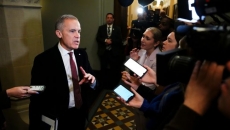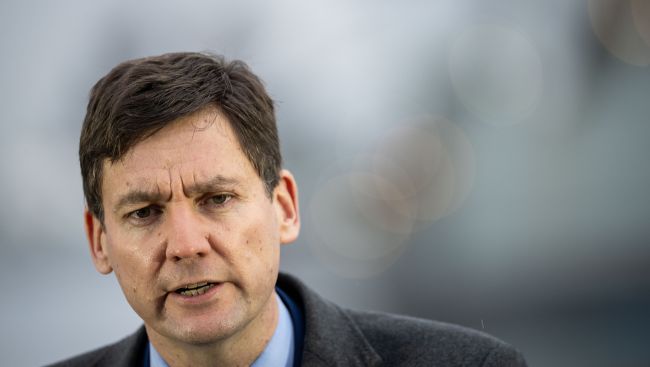
British Columbia Premier David Eby has been served up a heap of criticism about his government's budget while attending a breakfast meeting of business leaders.
Bridgitte Anderson, president and CEO of the Greater Vancouver Board of Trade, said Friday that she hoped Eby heard the "concerns and the anxiety of the business community" about Tuesday's budget, which forecasts a $13.1 billion deficit.
"I think it's fair to say that the business community and the province are on two different pages right now," Anderson said at the event in Vancouver.
She said the business community was struggling to understand how the province planned to bring the deficit back on a "sustainable path" when it is projected to rise by nearly $4 billion next year.
"Your government came in with a surplus," she said, referring to the forecast surplus of almost $6 billion when Eby succeeded John Horgan as premier in November 2022.
"We're now on a trajectory that is very concerning for the business community. So again, I would ask you, what is the plan?"
Unless significant cuts were made, it looked like government might have to raise taxes again, Anderson added.
Tuesday's budget included the first increase to the tax rate on the bottom income tax bracket in more than a quarter-century, and the expansion of the provincial sales tax to some professional services, which Anderson said would add costs to small businesses, major projects and the delivery of housing.
"This is going to impact our members significantly," she said.
Eby acknowledged that there had been a "big jump" in the deficit, because B.C. had seen a "deterioration" in revenues from natural resources.
He said his government "inherited a massive infrastructure debt" that is now being fixed through investments in schools, hospitals and roads.
"That kind of debt, that's tied to infrastructure, is positive, and that drives growth," he said.
But the premier also acknowledged that government has been spending too much on administration, saying that Tuesday's budget "stabilizes" provincial finances by finding savings in the public sector, while protecting health care and education.
He said the provincial economy will see "significant momentum" as various major projects get underway and the federal government boosts defence spending in B.C.
Eby defended the expansion of the PST, a decision he acknowledged was not popular with the business community.
But he called it a "reflection" of British Columbia's changing economy, which has historically been driven by resources, but is increasingly moving toward services.
"We do require a tax base in order to support the services that your employees count on, everything from health care to child care to education and so on," he said.
Eby's appearance came after the board gave the budget a "D" rating, the worst since Anderson assumed the group's presidency in 2019.
The premier pointed to the metrics of other provinces.
"So I don't mind getting a D if other students in the class are also graded and I don't pretend to be perfect, and British Columbia doesn't pretend to be perfect, but I think we're doing an OK job compared with our relevant comparators," he said.
He pushed back against Anderson when she said that one member of her organization told her about plans to move to Alberta because of the PST expansion.
"It's hard to defeat an anecdote," Eby responded, adding that B.C. offered more economic potential and certainty than its neighbouring province.
"Alberta is talking about moving out of the country," he said.
Picture Courtesy: THE CANADIAN PRESS/Ethan Cairns