A new report from the Canada Energy Regulator is projecting significant growth in electrical generation between now and 2050, in part due to new artificial intelligence data centres' thirst for power.
The federal agency gamed out four supply and demand scenarios for Canada's oil, gas and electricity markets: current measures, higher, lower and net-zero.
In all cases, power generation is projected to balloon — by 30 per cent at the low end to double today's level at the high end.
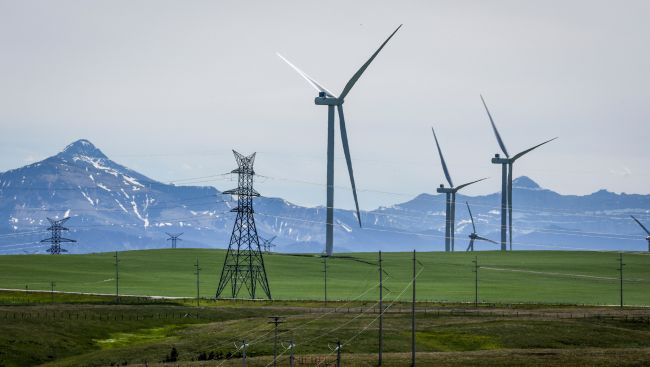
"To meet rising power demand in all the scenarios, we see surging wind power alongside a diverse mix of other less variable supply sources," CER chief economist Darren Christie told reporters Tuesday.
In all scenarios, wind energy makes up the bulk of the power capacity additions, with about 50 to 150 more gigawatts feeding into the grid than 2023 levels by 2050.
The CER has accounted for a great deal of uncertainty around the power demand from data centres, enormous structures that house the vast computing firepower needed for artificial intelligence and other tech applications. A massive amount of power is needed to run the machinery and keep it from overheating, prompting some big tech players to ink exclusive deals with an adjacent power plant.
The regulator's projection for data centre demand by 2050 ranges from 1.5 gigawatts to 12 gigawatts, which would be in the ballpark of what the entire province of Alberta currently uses during times of peak demand.
The CER put together its models based on the federal policies in place as of November of last year. They don't bake in changes to Ottawa's electric vehicle program in February, including the scrapping of a mandate to have all new cars be electric by 2035.
The war embroiling much of the Middle East in recent weeks was also not explicitly factored into the CER's projections. The conflict has cut off shipments of crude from the Persian Gulf through the strategically vital Strait of Hormuz, driving global prices up roughly 45 per cent from their pre-war levels.
"We do see that with the current run up in crude oil prices, for example, markets are still anticipating that they're going to come back down over the next couple of years to levels that are not too different from what we had prior to the crisis," he said.
"We have a range of prices in our scenarios that I think capture the kind of impacts that we're seeing right now."
Canada's crude oil production could see a 12 per cent dip or a 18 per cent boost by 2050, depending on a wide range of factors.
Production was 5.5 million barrels a day in 2024.
Under the status quo, production would reach 6.1 million barrels per day in 2042 and level off to 5.9 million barrels per day by 2050.
In a high scenario buoyed by strong prices, production would peak at 6.7 million barrels a day in 2044. In the lower case, production would gradually decline to 5.2 million barrels a day by 2050, around 2022 levels.
In a net-zero scenario, production peaks at 5.9 million barrels a day around 2036, and still remains at about five million barrels a day through 2050, even amid decarbonization efforts.
Oilsands crude is expected to dominate in each circumstance, with conventional and offshore resources the first to drop off.
The CER's report assumes no physical constraints in moving crude via pipeline and only factors in capacity from projects that have been given the official green light by the companies building them. So while the first phase of Enbridge Inc.'s cross-border Main Line expansion is accounted for, potential growth projects by South Bow Corp. and Trans Mountain Corp. as well as a potential new West Coast oil pipeline spearheaded by the Alberta government are not.
For natural gas, much of the growth is being driven by projects that chill the resource into a liquid so it can be shipped in specialized tanker overseas. By 2050, the CER says about a quarter of total Canadian gas production will be tied to liquefied natural gas exports.
The CER is projecting a production range of between 21 and 32 million mmbtu by 2050, versus the 19 million mmbtu the sector had last year.
Greenhouse gas emissions fall in all scenarios, but plateau around 2035 under current policies.
"Reaching net zero by 2050 would require an economywide transformation towards low carbon technologies, driven by additional climate action," the regulator said.
Picture Courtesy: THE CANADIAN PRESS/Jeff McIntosh