Canada's new searchable flood risk tool will only be available in provinces and territories that opt in to the program, a move that's frustrated some flood risk experts even as the federal minister says she anticipates widespread uptake.
The federal government announced last week its national flood risk finder was ready. The online tool, in the works for years, will allow users to conduct a simple address search and find out about the area's flood risk, rated on a four-point scale.
But in a surprise to some observers, Ottawa said the tool will only turn up results in participating provinces and territories. As of Tuesday, a week after the announcement, no provinces or territories had publicly opted in, and the search function remained unusable.
Jason Thistlethwaite, a flood risk expert, called it an "abandonment" of the government's responsibility to ensure flood risks are disclosed across the country, noting many other countries including France, the United Kingdom and Japan already have a similar tool. He also questioned why the government would launch it without first lining up those approvals from provinces and territories.
"Someone has to act like the adults in the room and provide this information that almost every other country does to its citizens through a simple address lookup," said Thistlethwaite, an associate professor at the University of Waterloo.
"Why would anyone want to trust the federal government to do this when the first time they go to the website, it doesn't work?"
Emergency Management Minister Eleanor Olszewski defended the rollout of the flood risk finder in an interview. She said it was not the federal government's place "to force" it on a province or territory.
The tool was demonstrated to her counterparts last month and Ottawa would continue to encourage them to join the program, said Olszewski.
"I do expect most of them, if not all of them to opt in," she said on Monday.
Some provinces, namely Quebec, are working on their own tool and "we wouldn't want to end up in a situation where the information that we provide is inconsistent with, or is any other way problematic, for a province and territory," she said.
The Canadian Press asked each province and territory whether they would opt in to the program. Of those that responded, none would immediately commit to it.
Saskatchewan, Alberta, Newfoundland and Labrador, Prince Edward Island and Yukon did not respond by Tuesday morning. Ontario did not provide a response on the record.
British Columbia said it supports the idea of a flood risk finder but was reviewing the tool before opting in. Manitoba said it had decided not to participate "at this time" but would continue to provide feedback to support its development.
Nova Scotia said it had decided to opt out "at this time," because it had not received sufficient detail from the government on how the tool would be introduced to the public, but it remained interested in participating once more details were available.
Northwest Territories said it needed more time to see how the tool aligned with its own newly updated flood maps. Nunavut said it was reviewing it.
Quebec said it would not participate. The federal tool would instead direct users to its own flood platform, a provincial spokesperson said.
Flood mapping has been a contentious issue in parts of Canada, said Charlotte Milne, a flood risk researcher and University of British Columbia PhD student. A Quebec legislator in 2024 said she suspected her office was fired at with a pellet gun because of concerns about new flood maps that would triple the number of homes listed in flood zones.
Some residents fear updated maps could impact housing prices, even though there's limited evidence to back that up, and others worry about its impact to future development, Milne said. Most provinces have a poor record of using maps to drive risk reduction policy, such as stricter rules around building in flood plains, she said.
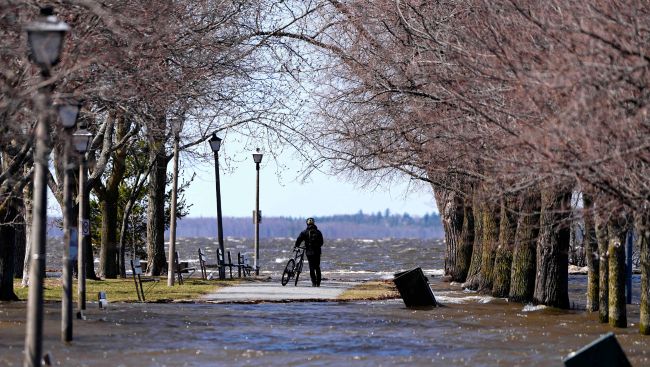
Floods are the most common and costly natural disasters in Canada, causing close to $3 billion in annual property damage, said a 2022 report by Canada's task force on flood insurance and relocation.
Climate change and continued development in flood-prone areas are driving those costs higher. The vast majority of Canada's cities are located, at least partially, in flood zones.
The task force's report said 90 per cent of all losses came from the top 10 per cent highest-risk homes, and the top one per cent represented more than a third of all losses.
Yet, many Canadians appear to be unaware of their flood risk, an issue some researchers say is compounded by the patchwork of information held by different levels of government. A 2020 University of Waterloo survey found just six per cent of Canadians in flood-prone areas knew about the dangers they faced.
Ottawa committed $15.3 million in the 2023 budget to create a publicly accessible online portal for flood risk information.
A consistent, countrywide flood risk tool could boost awareness, Milne says. She supported its release but was also skeptical about whether the tool on its own would move the needle on flood resilience.
People who learn about their flood risk and take action, such as by renovating their homes, were often already likely to do so, she said. Meanwhile, flood insurance is increasingly "something for the rich," she said, if it's accessible at all.
About 10 per cent of households can't get flood insurance, the Insurance Bureau of Canada estimates, though some experts suggest the number is likely higher. For those who can, flood insurance can add thousands of dollars to premiums each year.
Minister Olszewski said last month she couldn't promise the government would deliver on a national flood insurance program in the near future, despite a Trudeau-era pledge to bring it in by 2025.
Milne, the flood risk researcher, said she was surprised and disheartened by the decision to make the tool optional, especially on the heels of the minister's comments about the insurance program.
"I think people would want to see it and so I think it's a real shame if they can't access that information," said Milne.
The tool faced more questions on Monday after it came under scrutiny of the auditor general. The AG's report said the tool fails to consider how climate change will impact future flood patterns, a serious omission if it is supposed to help guide long-term decision making.
As climate change, driven by the burning of fossil fuels, leads to more intense rainfall and sea-level rise, floods are getting more severe and frequent in Canada. Flood damage costs could increase 10-fold by the end of the century, the Canadian Climate Institute estimates.
Olszewski said the maps underlying the tool will be updated to take new information into account.
Monday's audit, however, suggested the system is proprietary, and Public Safety Canada cannot update or adjust the information to reflect changing conditions.
The minister's office said that will change going forward.
"Public Safety Canada is actively working with a consortium of Canadian researchers through a project funded by the Natural Sciences and Engineering Research Council to develop a long-term model which will be open, more flexible, and easier to update as climate science continues to evolve," it said in a statement on Tuesday.
Picture Courtesy: THE CANADIAN PRESS/Justin Tang