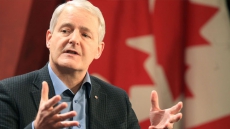
HALIFAX — The outgoing head of the navy says Canada is vulnerable and needs to work even more closely with the United States to improve the maritime security of North America.
Vice-Admiral Mark Norman, commander of the Royal Canadian Navy, said the government should look at investing in sensors to improve maritime surveillance and the information-sharing relationship between Canada and the U.S.
Norman, who will hand over the navy to Rear-Admiral Ron Lloyd on June 23, said the sensors could take a variety of forms, such as an underwater sensor network or land-based radar.
"At the moment we're vulnerable," said Norman during an exclusive interview recently with The Canadian Press onboard HMCS Windsor as it sailed roughly 57 metres below sea level off the coast of Halifax.
"There are a number of threats and the question is: Are we prepared to simply accept the threats and the implications of them? Or do we want to do something about it? Do we want to know what's going on?"
Those threats could include drug trafficking in the Caribbean, illegal migration, or "potential military threats in a circumstance that perhaps people don't like to think about," said Norman.
He said Canada has been "fairly lucky."
"We've been able to avoid any real situations that either have embarrassed the country ... or have actually threatened the security of Canadians," said Norman, who starts his new role as second in command of the Canadian Forces on Aug 5.
"But that doesn't mean that the potential for those things happening isn't real... As senior military officers, our responsibility is to provide advice beyond just being lucky. You don't base strategy or policy on, 'We've been lucky so far'."
Norman says such sensors would bolster what he called "maritime domain awareness" under the NORAD agreement. Established in 1958, NORAD is the joint U.S-Canada command providing aerospace warning, air sovereignty and defence for North America.
Norman's comments come as the Defence Department undertakes a review of the future of the Canadian Armed Forces.
Ken Hansen, a professor at the Centre for Foreign Policy Studies at Dalhousie University in Halifax, said working more closely with the United States is imperative because it's impossible to defend Canada on our own, given its size and population.
"If a serious threat was to develop, we would have absolutely no choice but to call on the Americans for help," said Hansen in a recent interview.
"That means that they have to trust that we're doing a reasonable job and not just, as Donald Trump says, freeloading."
Hansen also agreed with Norman about investing in sensors.
"You need intelligence and you need surveillance systems to get that intelligence and to shape and coordinate what we do and where and when," said Hansen. "You can build a trust relationship by being smart about where you put your resources."
Norman said investing in a sensor system is important, but it may not be seen as urgent in the context of the defence review currently underway.
"Do I see us having as a result of this defence policy review an explicit mention of improving the underwater sensor network in and around North America? Maybe, maybe not. We'll see what happens," said Norman.
"But it's a growing concern from a maritime defence perspective and it's something we need to think about going forward."