

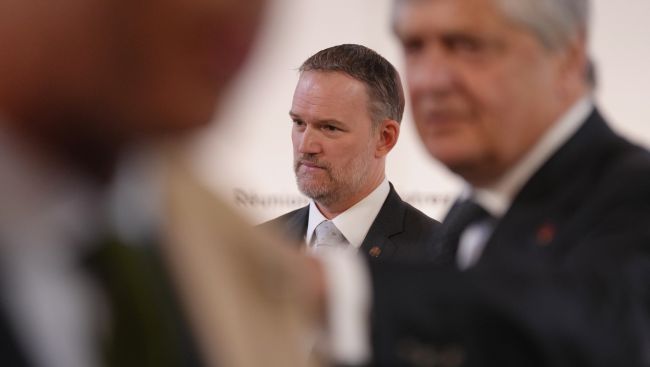
Prime Minister Mark Carney said Wednesday his Liberal government will soon introduce legislation on forced labour in supply chains after the Trump administration proposed a 10 per cent additional tariff on Canada and other countries following an investigation into the issue.
"Canada has a very strong legislative regime against forced labour in supply chains," Carney told reporters in Ottawa.
"We don't want any element of forced labour coming in goods and services, and we want to use our influence to eliminate this practice of forced labour and child labour."
The office of United States Trade Representative Jamieson Greer released a report late Tuesday saying Canada, Mexico, the United Kingdom and some other countries should be hit with the duties because they are not doing enough to enforce bans on forced labour.
It also proposes a 12.5 per cent duty on dozens of other countries which have partial or no bans on forced labour in supply chains.
"The failure of our most important trading partners to address the importation of goods made with forced labour is unacceptable," Greer said in a news release.
"This creates a dynamic where American workers are forced to compete globally on an unlevel playing field."
The new tariff would not apply to goods compliant under the Canada-U.S.-Mexico-Agreement on trade, known as CUSMA.
Carney said his government supports the "overall objective" of combating forced labour and the new legislation is expected in the coming weeks.
The investigations into forced labour under Section 301 of the Trade Act of 1974 were launched in March in an effort to shore up U.S. President Donald Trump's tariff policies.
They are meant to give Trump a legal basis to continue his worldwide tariff agenda after the U.S. Supreme Court struck down his favourite tool, which he used for his "Liberation Day" tariffs and fentanyl-related duties on Canada, Mexico and China.
In response to the top court's February ruling, Trump implemented a 10 per cent worldwide tariff using Section 122 of the 1974 Trade Act. But those duties expire after 150 days unless Congress votes to extend them.
The forced labour tariffs could be more durable but would require further public consultation before implementation. Greer is scheduled to hold hearings on the tariffs in July.
Canada already has legislation intended to curb forced labour in supply chains which requires annual reports to the federal government.
There are also rules in CUSMA that ban forced labour in supply chains, something Greer noted in the news release.
"Some trading partners have taken initial steps to prevent the importation of forced labour goods, including through (CUSMA) and commitments in Agreements on Reciprocal Trade," Greer said. "However, each of our trading partners must do more to ensure that trade does not perversely encourage and entrench forced labour globally."
The report said that although Canada's import prohibition "came into effect nearly six years ago, the number of enforcement actions Canada has taken to prevent the entry of forced labour goods is minimal."
It criticized the Canada Border Services Agency for not publishing statistics or information on its enforcement efforts and described Canada as a "dumping ground" for re-exports of forced labour products barred from the United States.
The new tariff threat came a few hours after Greer met with Canada-U.S. Trade Minister Dominic LeBlanc in Washington ahead of a review of the continental trade pact. Greer and LeBlanc also discussed Canada's commitment to fighting forced labour, the minister said.
In a social media post on Wednesday, LeBlanc said "we share the United States' objective of ensuring that goods produced with forced labour do not enter our supply chains, and we will be engaging constructively with them over the coming weeks."
Conservative finance critic Adam Chambers said Canada should do more to enforce the prohibition on forced labour in supply chains and "clearly the current laws are not working in the way that they should." Chambers said he would support legislation that addresses the issue.
"If the laws we currently have are not being enforced and not working, I think it's up to parliamentarians to decide whether we need to reframe and change the laws," he said.
Picture Courtesy: AP Photo/Aurelien Morissard, Pool


