The Canadian government told the Trump administration new legislation combating forced labour in supply chains should shield Canada from new tariffs.
In a written submission to the United States Trade Representative's office, the Government of Canada said it "remains committed to working closely with the United States to eradicate forced labour from global supply chains."
"In light of Canada's existing prohibition, complementary supply chain transparency measures, newly introduced standalone forced labour import legislation and continued commitment to Canada-U.S. co-operation, Canada respectfully submits that there is no basis for the imposition of additional Section 301 duties on Canadian goods," the government said in its Monday submission.
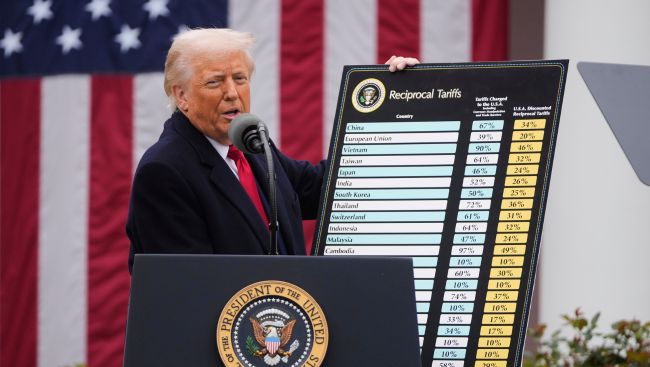
Ottawa's case was among more than 1,500 written submissions from nations and industry groups ahead of a three-day hearing in Washington this week on U.S. President Donald Trump's use of Section 301 of the Trade Act of 1974 to rebuild his global tariff wall around the United States.
United States Trade Representative Jamieson Greer announced in March that his office was launching trade investigations into 60 countries, including Canada.
Greer said Canada, Mexico, the United Kingdom and some other countries should be hit with 10 per cent duties because they are not doing enough to enforce bans on forced labour.
He also proposed a 12.5 per cent duty on dozens of other countries which have partial or no bans on forced labour in supply chains.
Canada already had legislation intended to curb forced labour in supply chains, which requires annual reports to the federal government. But the federal government tabled a bill last month to boost enforcement.
Bill C-35 would create a public list of products that have been linked to forced labour in specific regions, based on intelligence from embassies and other authorities. It would require importers to prove that specific products from listed regions were not made through slavery.
In separate submissions to the U.S. trade office, Canadian business and industry groups made the case that there are more effective paths to curbing the issue of forced labour than tariffs, particularly in the deeply integrated North American market.
"We urge USTR to assess Canada separately under Section 301 … suspend consideration of the proposed 10 per cent tariff while Canada's enforcement reforms are implemented and evaluated, and prioritize targeted bilateral enforcement co-operation over broad country-level measures," Canadian Chamber of Commerce Vice President Matthew Holmes wrote in his submission.
The Section 301 investigations did not come as a surprise. It was clear the United States would be looking at new avenues to impose duties after the U.S. Supreme Court struck down Trump's favourite tariff tool, which he used for his "Liberation Day" tariffs and fentanyl-related duties on Canada, Mexico and China, earlier this year.
In response to the top court's ruling, Trump implemented a 10 per cent worldwide tariff using Section 122 of the 1974 Trade Act. Those tariffs were always seen as temporary because they expire after 150 days — at the end of July — unless Congress votes to extend them.
The Canada-U.S.-Mexico Agreement on trade, also known as CUSMA, has shielded Canada from many of Trump's tariffs. The country is still being slammed by separate duties on industries like steel, aluminum, automobile and cabinetry.
Many Canadian submissions to the U.S. trade office made the case that CUSMA exemptions should remain in place no matter the outcome of the trade investigation.
Keith Currie, president of the Canadian Federation of Agriculture, wrote that there is "serious concern" the tariffs could expand to goods compliant with the continental trade pact, which would result in "serious and unintended consequences."
"Canada-U.S. agricultural trade is highly integrated and depends on predictable, timely cross‑border movement," Currie wrote.
"Even modest tariffs could disrupt supply chains, increase input costs, and reduce competitiveness, particularly as many agricultural products cross the border multiple times during processing. These impacts would place additional pressure on farmers and agri‑food businesses on both sides of the border."
The National Foreign Trade Council, an association of U.S. business enterprises, also called for CUSMA exemptions to be extended to any future tariffs, writing that "broad-based tariffs are a blunt, punitive measure that is unlikely to be an effective tool for eliminating forced labour."
"Moreover, a comprehensive tariff penalizes all goods from a country — including those from companies that have invested heavily to eliminate forced labour from their supply chains," it said.
Picture Courtesy: AP Photo/Mark Schiefelbein