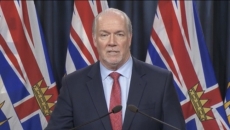
Prime Minister Justin Trudeau says Canada has signed a contract to receive up to 168,000 doses of Moderna's COVID-19 vaccine before the end of December.
The Moderna vaccine is still in the final stages of its review by Health Canada but Trudeau says deliveries could begin within 48 hours of the department's experts giving it the green light.
WATCH LIVE – I’m giving an update on vaccines and what we’re doing to protect you and your family: https://t.co/h0PIWYYlq9
— Justin Trudeau (@JustinTrudeau) December 15, 2020
Canada has contracted to receive two million doses from Moderna by the end of March, and 40 million by the end of 2021. But initially the first doses weren't going to arrive until January.
Now they will start arriving within two days of the vaccine's authorization by Health Canada. The Moderna vaccine's less stringent storage requirements will allow remote communities and northern territories to start receiving vaccine for the first time.
Health Canada approved the vaccine from Pfizer-BioNTech Dec. 9 and injections began in Ontario and Quebec Monday morning, with most provinces on track to deliver their first vaccinations by the end of the week. There are 30,000 doses arriving this week, and Trudeau said 200,000 more will arrive next week.
Because the Pfizer-BioNTech vaccine must be stored at ultralow temperatures — between -60 C and -80 C until shortly before injection — it was initially limited to 14 delivery sites in the 10 provinces. Trudeau said by next week there will be 70 sites.
Moderna's vaccine is stored in regular freezers at about -20 C, which makes it easier to ship and store. Trudeau said the territories and remote communities, which asked not to receive the Pfizer-BioNTech vaccine because of the cold-chain complexities, will be prioritized for the Moderna vaccine.
In all there should be 417,000 vaccine doses in Canada before Dec. 31, which will be distributed to provinces and territories based on population share, but the territories will get all of their doses from Moderna.
"This is the good news we all needed," Trudeau said. "This pandemic will end. We will get through this. But for now, we need to be incredibly careful."
Dr. Supriya Sharma, the chief medical adviser at Health Canada, told The Canadian Press the department's review of Moderna's vaccine is in the final stages. She said the final clinical data from the Massachusetts-based biotech company were received Dec. 11, and the final data on the manufacturing process is expected before the end of the week.
"It does look promising and it does look positive," said Sharma.
She said she will know better when the manufacturing data comes in how much longer it could be until a decision is made.
Both Pfizer's and Moderna's vaccines require two doses — 21 days apart for Pfizer's and 28 days apart for Moderna's. Sharma said with the Pfizer vaccine, a recipient's immune system generates some protection after the first dose, with maximum immunity in place seven days after the second dose.
Pfizer is shipping its doses to Canada from its manufacturing facility in Belgium but Canada has contracted FedEx to bring over the Moderna vaccine from Europe. Health-logistics firm Innomar will use its network of cold-storage facilities to receive the Moderna doses and repackage them for deliveries to the provinces and territories.
Maj.-Gen. Dany Fortin, the vice-president of logistics at the Public Health Agency of Canada, said a dry-run of the Moderna delivery is taking place Tuesday.
Six million doses of Pfizer-BioNTech and Moderna's vaccines are expected by the end of March, enough to vaccinate about three million people. The priority for the first doses are residents and workers in long-term care homes, front-line health workers at high-risk for exposure to COVID-19, people over the age of 80 living independently, and adults in remote Indigenous communities.
The vaccine program will be expanded to others in April, when more doses start arriving. There are also two other vaccines, from AstraZeneca and Johnson & Johnson, under review by Health Canada. Sharma said AstraZeneca's review team is determining if it will request further trials, after the drugmaker discovered some of the patients in the Phase 3 trial didn't receive the full doses of its vaccine.
Johnson & Johnson submitted its application Nov. 30, so that review is in the very early stages, said Sharma.
The Pfizer-BioNTech vaccine was authorized for use on people over the age of 16, who are not allergic to any of the ingredients. However pregnant or breastfeeding women and people with compromised immune systems are warned to talk to their doctor before getting it.
Canada's vaccine advisory panel Wednesday recommended more testing before COVID-19 vaccines are routinely offered to pregnant or breastfeeding women, kids under 16, or patients with compromised immune systems.
The National Advisory Committee on Immunization is encouraging vaccine-makers to expand clinical trials to include more study of their products in those groups.
But the committee's experts also say if there is evidence the benefits of getting the vaccine outweigh the potential risks of COVID-19, it could be offered to pregnant women, kids as young as 12, or people who are immunosuppressed, with informed consent.
The only COVID-19 vaccine authorized in Canada so far is from Pfizer-BioNTech for people as young as 16, but people who are immunocompromised, pregnant, trying to become pregnant, or breastfeeding are advised to talk to their doctors before getting it.
Pregnant women were not specifically included in Pfizer's clinical trials but almost two dozen women who got the vaccine later became pregnant and reported no complications.
Pfizer tested the vaccine on a small sample of children between 12 and 15 years old in the fall, with no safety concerns reported, and intends to expand trials to children as young as five next year.