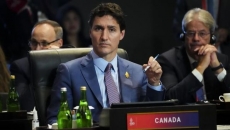
OTTAWA - Prime Minister Justin Trudeau says Canada is donating another $220 million to the COVAX global vaccine sharing alliance.
The funds will bring Canada's total monetary donation to COVAX to about $700 million for the purchase, delivery and distribution of COVID-19 vaccines for lower-income nations.
"Our collective aim must be to increase access to COVID-19 vaccines and other medical countermeasures, so that every country has what it needs to protect its people from this virus," Trudeau said Friday, during a virtual COVAX summit.
COVAX raised another US$1.7 billion from countries like Canada at the event.
The cash is intended to help Canada make good on its commitment to donate at least 200 million doses by the end of the year.
We’ll continue to demonstrate our commitment to COVAX – by providing financial support, by improving vaccine donation management, and by delivering the equivalent of more than 100 million doses of COVID-19 vaccines. More here: https://t.co/A2zIaHtjt4
— Justin Trudeau (@JustinTrudeau) April 8, 2022
This latest contribution will be targeted at helping recipient countries prepare to receive and distribute the vaccines on offer.
Last month International Development Minister Harjit Sajjan travelled to Senegal and Ghana to meet with local officials overseeing their vaccine programs. He said the issue with vaccine donations is no longer about supply.
Instead it's limitations on vaccine distribution within recipient countries, including the peripheral supplies like syringes, and high levels of vaccine hesitancy, particularly among younger people. He said his discussions on that trip were useful to helping target Canada's aid where it is needed most.
"The main challenge right now for us is not about supply," he said. "It's about actually getting all the other tools in place."
Justin McAuley, Canadian spokesman for the global anti-poverty agency ONE Campaign, said the new funds are helpful. For the first year of COVID-19 vaccines, supply was the main constraint in wealthy and low-income countries alike.
McAuley said now COVAX is not wanting for doses. Its own procurement agreements with vaccine makers are starting to bear fruit, and the wealthy countries like Canada that snapped up all the early doses of vaccines have vaccinated most of their populations and have many excess doses available.
"But some countries don't have the fridges, syringes and health-care workers needed to get doses in arms," said McAuley. "So when we finance COVAX like we did today, that is going to make sure that the logistical support is there so that our doses don't end up going bad in warehouses."
He said the financing can also help COVAX build public awareness campaigns to overcome apathy and hesitancy to getting vaccines.
But McAuley said Canada didn't start offering up a lot of doses to donate until it no longer had a use for them at home, and in many cases when their expiry dates were looming.
He said Canada needs to provide a stable, predictable supply of vaccine donations so countries that need them can prepare to receive and get them into arms.
Earlier this year, John Nkengasong, director of the Africa Centres for Disease Control and Prevention, asked for a pause on donations because so many were being offered that countries couldn't keep up with the storage needs or get them to people quickly enough.
He said transporting vaccines and supplies like syringes to remote locations is still a challenge, there is a shortage of health-care workers who can give the shots and vaccine hesitancy is high.
Canada has fully vaccinated 82 per cent of its population and a third dose has been given to 48 per cent. As a group, the wealthiest countries in the world have fully vaccinated 74 per cent and boosted 38 per cent.
The poorest countries have fully vaccinated less than 12 per cent of the population, and only 15 per cent has even one dose.
Canada promised to donate 38 million doses from its own domestic supplies, and another 13 million from doses Canada bought for itself from COVAX but didn't need.
Thus far Canada has shipped 14.2 million doses to 19 countries via COVAX and another 762,000 directly to six countries through bilateral vaccine donation agreements.
It says another 87 million doses were purchased by COVAX with Canada's previous financial donations — but that is based on a formula for the cost per dose developed by the United Kingdom, and COVAX itself says it cannot confirm the exact number.