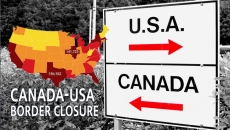
Canada and the United States won't be able to provide each other with much in the way of firefighting reinforcements this year as the two countries contend with one of the earliest and most severe wildfire seasons in recent memory.
Despite a long history of helping out, both need all hands on deck to battle rampant wildfires on either side of the border, says a Natural Resources Canada background memo obtained by The Canadian Press.
Both the Canadian Interagency Forest Fire Centre and its U.S. counterpart are at Level 5 of the "national preparedness" scale, the highest tier, "indicating a deficit of personnel in both countries," the memo says.
"Within that context, neither country has been able to share resources with each other."
Both will continue to be able to access other international resources if necessary, the memo notes — indeed, about 100 firefighters from Mexico recently arrived in B.C., joining a number of Canadian Armed Forces personnel — but the situation points to a challenge that's only going to get worse.
"There's two outlooks to think about: the first is the outlook for the rest of the summer, and the outlook for the rest of the summer is hot and dry," said James Johnston, a forest management and wildfire expert at Oregon State University.
"Then there's the outlook for summers to come, and that outlook is even hotter and drier."
Last year, Canada sent 529 front-line crew members, 62 supervisory teams and a number of aircraft to help the U.S. battle a slew of fires across hard-hit California, Oregon and much of the Pacific Northwest, the backgrounder noted.
This year, however, both countries have their hands full: in B.C. alone, where 269 active fires were reported Wednesday, experts are anticipating the worst summer in the province in more than 70 years. Across the Prairie provinces, more than 160 fires are burning in Alberta, Saskatchewan, Manitoba and northwest Ontario.
All told, Canada's currently active wildfires have consumed about 1.2 million hectares of territory, an area twice the size of Prince Edward Island.
In 14 different states across the U.S., meanwhile, about 21,000 firefighters are battling 96 fires, including 24 large blazes in Montana and 20 in Idaho.
"The demand from the 2021 fire season shows we both need more resources in the future," the Natural Resources memo says.
The situation is serious enough to have come up in a phone conversation Monday between Prime Minister Justin Trudeau and President Joe Biden, who agreed that it's beyond time to come up with a different approach.
In addition to their shared focus on mitigating climate change, the memo says the two countries are discussing a "co-ordinated investment program" to increase the pool of trained firefighters.
"Given that we are seeing longer, more intense fire seasons due to climate change and a resulting strain on resources, Canada and the U.S. are looking at ways to address these challenges in a co-ordinated way," it says.
Canada is also working on a "blueprint" for North American collaboration on the science surrounding wildfires, based on a proposal developed by Natural Resources Canada and the U.S. Forest Service in conjunction with experts from all three countries.
"Canada is continuing to look at ways to work collaboratively with the United States as well as other partner countries to develop innovative solutions, increasing global capacity to respond, and reducing the vulnerability from catastrophic wildfires."
Last week, California Gov. Gavin Newsom told Biden that the U.S. Forest Service, which is responsible for nearly 60 per cent of the forest lands in the state, took a "wait-and-see" approach to the massive Tamarack fire, which has been burning on both sides of the California-Nevada boundary.
"They waited, and what we saw is the fire took off," Newsom said.
"We need your help to change the culture in terms of the suppression strategies in this climate, literally and figuratively, to be more aggressive on these federal fires."
Indeed, said Johnston, one important step will be for the rest of the world to stop waiting for vast tracts of the continent to catch fire before thinking about how to deal with the problem.
"There simply isn't any easy solution," he said, noting that California spent nearly two per cent of its annual gross domestic product on dealing with wildfires.
Proactive strategies — using mechanical means and prescribed burns when conditions are less volatile to reduce the amount of raw fuel — will be a critical part of any successful plan.
"It's true that the only way to fight fire is with fire," Johnston said.
"We don't have a choice about whether to have fire, but we do have some choices about where and when."