WASHINGTON - The tax-credit scheme that President Joe Biden is proposing to encourage U.S. consumers to buy more electric vehicles might never be implemented in its current form, say veteran observers of both North America's auto sector and Canada-U.S. relations.
If they are, though, the tax incentives of up to US$12,500 on cars and trucks assembled stateside with union labour could mean the end of the road for Canada's automotive industry.
"We're at a really tentative moment," said Dimitry Anastakis, a professor of Canadian business history at the University of Toronto's Rotman School of Management.
Consider what would happen if the $83-billion U.S. auto market, which is rapidly abandoning the internal combustion engine, were suddenly confronted with the chance to save up to nearly 25 per cent on a $55,000 EV, so long as it was assembled on American soil by unionized workers.
It would amount to what the federal government in Ottawa calls a 34 per cent tariff on vehicles built in Canada. The imbalance would brand foreign-made cars with a scarlet letter and send auto manufacturers and their roughly 125,000 jobs scrambling over the border.
It's a worst-case scenario triggered by what Anastakis calls a "deintegration" of more than half a century of trilateral automaking, with companies abruptly pulling up stakes and cancelling plans they're already making to spend billions on their Canadian and Mexican operations.
"You'd see a removal and rescinding of all those announcements that have already been made for investments, and probably no future investment on passenger vehicles at all," he said, "which would obviously be the end of the industry as we know it."
But Anastakis and others are confident it won't come to that.
It doesn't make economic sense for anyone — not consumers, not manufacturers, whether foreign or domestic, and not even the government that's proposing it in the first place.
"The already-established manufacturers have a lot of money invested in Canada and Mexico, and they have a lot of benefit from an integrated industry," Anastakis said.
"There's all kinds of benefits to doing what they've been doing for the last 50 or 60 years — they make money off of this. There's a reason that the Big Three have done their production decisions in the way that they have, because they're trying to maximize (profits)."
It's long been a core principle of Canada-U.S. relations that the only way to effect change in D.C. is to frame Canada's priorities in terms of American self-interest. In other words: hurting us hurts you.
"Given the deep integration of our respective automotive industries, the proposal would have important repercussions in the U.S., affecting American production and jobs," Deputy Prime Minister Chrystia Freeland and Trade Minister Mary Ng wrote last week to key members of the U.S. Senate.
That letter laid out in stark terms that Canada would launch a barrage of targeted, retaliatory tariffs and suspend key portions of North America's new trade agreement if the provision, nestled deep in Biden's 2,135-page Build Back Better bill, wins the approval of Capitol Hill.
But we're not there yet.
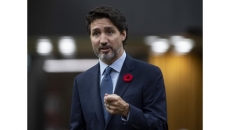
"There are solutions to this; this is not an intractable, unsolvable problem," Prime Minister Justin Trudeau said Thursday in an interview with The Canadian Press, though he would not speculate on what solutions might be on the table.
"Canadian supply chains and Canadian interconnectedness with the United States is such that it could end up being extremely unpleasant for American workers, for American politicians, for the American economy, to have to fall into this kind of disagreement, this discord, with Canada."
Canada offers a highly skilled, world-class manufacturing workforce with half a century's worth of institutional knowledge when it comes to building cars and trucks, not to mention the cost benefits of a country with an 80-cent dollar and public health care. Union leaders like Bob White, the founding president of the Canadian Auto Workers after it split from its American counterpart, exploited those advantages at every opportunity.
"Bob White used to say that every Canadian car that rolled off the line, you might as well slap $1,500 in cash on the hood of that car, because that was the difference in health care costs alone," Anastakis said.
"I cannot imagine that this is going to go through like this, because it's going to be so disruptive for the industry."
So why is it happening in the first place? Politics.
Biden is an old-school Democrat who remembers the glory days of the U.S. auto sector, not to mention the traditional base of his party: hardworking middle-class voters.
"He has this long-standing sort of blue-collar appeal that's always been part of his political persona," said Christopher Sands, director of the Canada Institute at Washington, D.C.'s Wilson Center.
"You get the sense from his campaign in 2020 that he thinks the blue-collar voters were essentially stolen from the Democratic party by Trump with a lot of nationalist language. And while he disagrees with Trump on a lot of things, he's trying to appeal to that same group and rally votes for the Democrats to get those voters back."
Like so much of what the Biden administration has done to shore up public support, it doesn't seem to be working.
The president's approval ratings have been plumbing new depths in recent months, despite a seemingly robust economy — COVID-19 notwithstanding — and two remarkable legislative victories in Congress: a $1.9-trillion pandemic relief bill and a $1.2-trillion infrastructure package.
Getting the $1.75-trillion Build Back Better bill passed, which now appears unlikely to happen before the new year, would complete a remarkable trifecta for a president who, despite being saddled with an evenly split Senate, has repeatedly demonstrated the consensus-building skills he honed during more than 40 years as a U.S. lawmaker.
Despite that, most political observers in the U.S. are predicting a Republican romp in next year's midterms. That could ultimately work in Canada's favour by forcing the president to tack more toward the centre.
"If you can just buy time, then maybe the political calculus changes," said Sands. "Canada doesn't want to burn its bridge for the future, and it doesn't want to jump in too hard on this particular fight because it might not actually come to fruition."
Even if the Senate does pass the bill, he added, a lot can change in the implementation process, when various federal agencies sit down to design the rules that will govern how the legislation's various statutes are to be rolled out. That could mean expanding the definition of "assembled in the U.S." to include North America, for instance, if the law as written doesn't provide consumers with enough choice.
Duncan Wood, a senior adviser to the Wilson Center's Mexico Institute, said he suspects the bill will eventually pass with some form of the tax-credit package still intact.
"And then I think that … we will see some kind of accommodation with the Mexicans and the Canadians," Wood said. "But I think it's going to be a long process."