Thursday, June 18, 2026
ADVT 
National

Carney, European leaders welcome reported Iran-U.S. ceasefire in joint statement

Darpan News Desk The Canadian Press, 08 Apr, 2026 09:42 AM
  • Carney, European leaders welcome reported Iran-U.S. ceasefire in joint statement

Prime Minister Mark Carney and nine European leaders issued a joint statement on Wednesday, welcoming the reported two-week ceasefire agreement between the United States and Iran.

The deal was announced Tuesday evening after President Donald Trump threatened in a social media post earlier that day that "a whole civilization" would "die" if a deal to reopen the Strait of Hormuz — a crucial shipping lane — was not reached.

Trump said on social media the U.S. and Iran will be talking about reconstruction, sanctions relief and resuming tanker traffic in the Strait of Hormuz — traffic that may be subject to Iranian tolls going forward.

Speaking to reporters on his way into his office in Ottawa Wednesday, Carney said it was a "good day."

"I think we should recognize the positive developments of the last few hours," Carney said, thanking Trump and Pakistan's Prime Minister Shehbaz Sharif, along with Iranian leaders.

"Canada joins our allies … in supporting these efforts, and that will include efforts to support the reopening of the Strait of Hormuz, which is important for re-establishing stability, lowering prices in commodities, prices at the pump even here in Canada, price of fertilizer for farmers, price of aluminum for manufacturers and others."

Carney said there is still much more to do to address "tricky issues" and said peace in the Middle East must include peace in Lebanon.

The statement from Carney and European leaders encouraged "quick progress towards a substantive negotiated settlement."

"This will be crucial to protect the civilian population of Iran and ensure security in the region. It can avert a severe global energy crisis," the statement said.

"We support these diplomatic efforts. To this end, we are in close contact with the United States and other partners."

Hours after the ceasefire deal was announced, Iran and Gulf Arab countries reported new attacks Wednesday.

It was not clear if the strikes would scuttle the deal, which U.S. Vice President JD Vance called “fragile.”

Even before the new attacks, much about the agreement was unclear as the sides presented vastly different versions of the terms.

Iran said the deal would allow it to formalize its new practice of charging ships for the right to pass through the Strait of Hormuz, a crucial transit lane for oil. But it was not clear Wednesday whether vessels would feel safe using the channel or whether ship traffic had resumed. It also was not clear whether any other country has agreed to this condition.

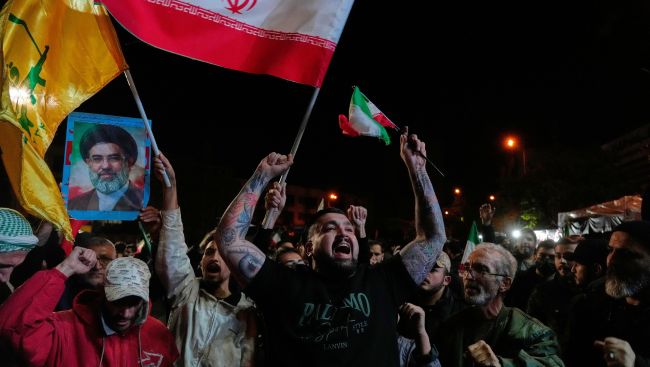
Pakistan — which helped to mediate the deal — and other countries said fighting would pause in Lebanon, where Israel has launched a ground invasion against the Iran-backed Hezbollah militant group. Israel said it would not, and strikes hit Beirut on Wednesday.

The fate of Iran’s missile and nuclear programs — the elimination of which were major objectives for the U.S. and Israel going into this war — also remained unclear. Trump said the U.S. would work with Iran to remove buried enriched uranium, though Iran did not confirm that.

Picture Courtesy: AP Photo/Vahid Salemi

MORE National ARTICLES

B.C. overdose deaths drop 30 per cent, but researchers point to 'emerging dangers'

B.C. overdose deaths drop 30 per cent, but researchers point to 'emerging dangers'
BC Coroners Service data show nearly half the people who died in January due to unregulated toxic drugs had the depressant bromazolam in their system, which researchers say highlights "emerging dangers" in the illicit drug supply even as deaths decline. The coroners service said Friday that 152 people died of toxic drug overdoses in January, marking four consecutive months that the toll was under 160.

B.C. overdose deaths drop 30 per cent, but researchers point to 'emerging dangers'

Reaction to Mark Carney being sworn in as prime minister

Reaction to Mark Carney being sworn in as prime minister
Mark Carney has been sworn in as Canada's new prime minister, succeeding Justin Trudeau. Here's how some leaders and politicians are reacting to his appointment.

Reaction to Mark Carney being sworn in as prime minister

Eby announces ending of provincial carbon tax, after Carney kills federal version

Eby announces ending of provincial carbon tax, after Carney kills federal version
Premier David Eby said at a news conference in Surrey that legislation is being prepared to repeal the consumer carbon tax during the current legislative session, with sittings scheduled to resume on March 31.

Eby announces ending of provincial carbon tax, after Carney kills federal version

Prime Minister Mark Carney's government terminates consumer carbon price

Prime Minister Mark Carney's government terminates consumer carbon price
Prime Minister Mark Carney's first move after taking office on Friday was to eliminate the consumer carbon price, undoing Justin Trudeau's signature climate policy. Carney addressed members of the media after the Friday afternoon cabinet meeting, saying the government is "focused on action."

Prime Minister Mark Carney's government terminates consumer carbon price

Canada’s International Student Cap: Universities Struggle, International Students Suffer 


Canada’s International Student Cap: Universities Struggle, International Students Suffer 

The recent cap on international student admissions in Canada has sent ripples through universities nationwide, disrupting enrollment patterns, financial planning, and student experiences. For institutions that have had student populations woven with a multicultural fabric for years, the impact has brought about significant challenges spanning across multiple areas.

Canada’s International Student Cap: Universities Struggle, International Students Suffer 


Is Diversity, Equity, and Inclusion at Risk? Navigating the Future of DEI in Canada 

Is Diversity, Equity, and Inclusion at Risk? Navigating the Future of DEI in Canada 
As corporate cutbacks and shifting public sentiment create uncertainty, many are asking: Is the momentum behind workplace diversity fading? Experts in workplace diversity and Canadian policy argue that, rather than disappearing, DEI is evolving, and its long-term sustainability will depend on how organizations choose to embed it into their core values. 

Is Diversity, Equity, and Inclusion at Risk? Navigating the Future of DEI in Canada