Canada will reach an even higher NATO spending target in part by developing its critical minerals and the infrastructure needed to get them to market, Prime Minister Mark Carney said as the annual leaders' summit of alliance members got underway in the Netherlands.
Carney is in The Hague for the NATO leaders' summit, and made the comments in a pre-summit interview with CNN's Christiane Amanpour that aired on Tuesday.
Leaders are debating how much to hike the NATO spending target, with NATO Secretary-General Mark Rutte proposing to more than double it from the current two per cent of GDP, to five per cent.
Carney said he expects leaders will agree to boost spending to 3.5 per cent of GDP in ten years.
Rutte's proposal is to hike spending to 3.5 per cent of annual GDP on core defence needs — like jets and other weapons — and another 1.5 per cent on defence-adjacent areas like infrastructure, cybersecurity and industry.
Carney said five per cent of Canada's GDP would amount to about $150 billion per year. NATO said last year Canada spent $41 billion on defence.
The prime minister said Canada will reach the target in part by developing deposits of critical minerals and that some of the work will be done in partnership with the European Union, EU member states, the U.K. and other countries.
"Some of the spending for that counts towards that five per cent. In fact, a lot of it will count toward that five per cent because of infrastructure spending — it's ports and railroads and other ways to get these minerals out," Carney said.
"So that's something that benefits the Canadian economy but is also part of our NATO, our new NATO responsibilities."
Critical minerals refers to a series of metals and mineral deposits including lithium, cadmium and nickel, which are key elements for modern technology in everything from laptops and cellphones to high end defence systems.
NATO released a list of 12 critical minerals last year that are a must for defence. They include aluminum, which NATO described as "pivotal" to producing lightweight planes and missiles, graphite, used in the production of tanks, and cobalt, essential in the production of jet engines, submarines and jet engines.
Canada has some of the worlds largest deposits of critical minerals.
Foreign Affairs Minister Anita Anand was at The Hague with Carney on Tuesday, where she told reporters that Canada is committed to increasing its defence spending but has questions about the "timeline" for hitting the new NATO spending target.
When asked if her government accepts the new spending benchmark, Anand said Canada has consistently supported NATO's spending targets.
"The question, really, is the timeline,” she told reporters in The Hague.
She added some allies have proposed a 2029 deadline for meeting the target.
“We’d like to see steps along the way where there can be a re-examination of whether this is the right approach, augmenting at this rate in terms of domestic spend," said Anand.
In a call back to reporters in Ottawa Tuesday, Anand said it would be "imprudent" to discuss Canada's position publicly before the NATO leaders discuss it at the table. She said questions remain about how much flexibility NATO members will be given as they pursue the five per cent target.
All 32 NATO member states have to agree on a new spending target — and no member state is spending anywhere close to five per cent. At 3.38 per cent, U.S. defence spending as a share of GDP was the highest in the alliance in 2024.
U.S. Secretary of Defence Pete Hegseth and Rutte have both said they expect alliance representatives at the summit to agree to the new five per cent target. But U.S. President Donald Trump has said the figure shouldn’t apply to the United States — only to its allies.
Trump shared on social media Tuesday screenshots of a text sent to him by Rutte. A spokesperson for NATO confirmed for The Canadian Press that the text was legitimate.
In the text, Rutte congratulated and thanked Trump for his "decisive action" in ordering airstrikes on Iranian sites linked to its nuclear program. He told the president he was "flying into another big success" in The Hague and that "we've got them all signed onto 5 per cent!"
"Europe is going to pay in a BIG way, as they should, and it will be your win," Rutte said.
Britain, France, the Netherlands and Germany have all committed to the five per cent goal. NATO nations closer to the borders of Ukraine, Russia and its ally Belarus have also pledged to do so.
But not everyone seems to be on board. Spanish Prime Minister Pedro Sánchez said Sunday that Spain reached a deal with NATO excluding it from the new spending target. Like Canada, Spain has long struggled to meet the two per cent target and has rejected the new proposal.
On Tuesday, Slovakia’s Prime Minister Robert Fico suggested that his country might be better off embracing neutrality. He also released a statement saying the new defence spending target would amount to almost a fifth of the country’s budget, which he called “absolutely absurd.”
Rutte warned Monday that no country can opt out of the target and that progress made toward the new target will be reviewed in four years.
NATO set the current two per cent target in 2014. This year, for the first time ever, all 32 member nations are expected to meet it. In 2014, when the current two per cent target was set, only three NATO members hit the mark — the U.S., the U.K. and Greece.
Canada's defence spending hasn't reached five per cent of GDP since the 1950s, and hasn't been above two per cent since 1990. NATO estimates that Canada spent $41 billion in 2024 on defence, or 1.37 per cent of GDP. In 2014, Canada spent $20.1 billion, or 1.01 per cent of GDP, on defence.
Ottawa said last year it would be able to hit two per cent by 2032, but Carney said earlier this month it will happen this year. In Brussels on Monday, he also announced that Canada had formally signed a new defence and security pact with the European Union that opens the door to defence procurement deals between Canada and European countries.
Anand said that new partnership will expand Canada’s defence industrial base.
The main talks in The Hague won't happen until Wednesday and leaders spent much of Tuesday in bilateral meetings.
Carney met with leaders from Latvia and the Netherlands. He also met with representatives of Nordic nations to discuss Arctic and transatlantic security.
The prime minister also had an audience with King Willem-Alexander and Queen Máxima of the Netherlands.
Lauren Speranza, a fellow at the Center for European Policy Analysis, said the NATO summit is coming at a “very precarious moment,” marked by uncertainty about the U.S. commitment to Europe, the grinding conflict between Russia and Ukraine and ongoing tensions over transatlantic trade.
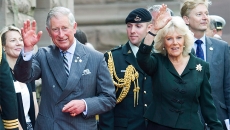
Picture Courtesy: THE CANADIAN PRESS/Sean Kilpatrick