

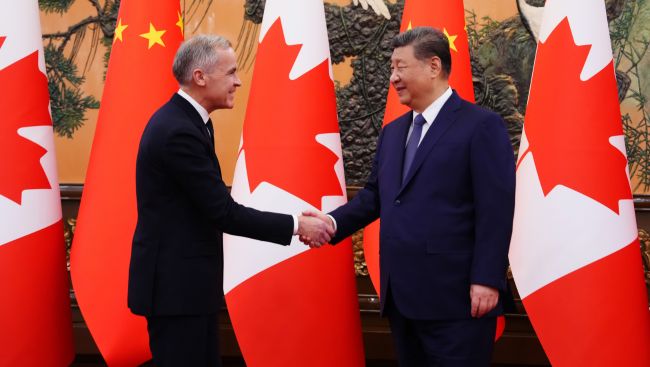
Prime Minister Mark Carney said that the electric vehicle deal with China is an "opportunity" for Ontario and autoworkers, despite criticism from Premier Doug Ford and the union representing Canadian autoworkers.
Speaking in Doha, Carney said there is interest in Chinese companies producing "affordable" electric vehicles in Canada.
"We've had direct conversations directly from the Chinese companies... with explicit interest and intention to partner with Canadian companies," Carney said at a Sunday news conference.
"We'll see what comes to pass. This is an opportunity for Ontario. It's an opportunity for Ontario workers, opportunity for Canada, done in a controlled way with a modest start."
The prime minister did not name any specific companies Canadian officials have had contact with.
Carney and Chinese President Xi Jinping signed an agreement Friday that will see Canada allow Chinese electric vehicles into the country at a 6.1 per cent tariff rate.
The deal includes an annual import quota of up to 49,000 Chinese EVs, and 50 per cent must have an import price of under $35,000 by 2030.
Canada joined the U.S. in putting a 100 per cent tariff on Chinese electric vehicles in 2024, with accusations of unfair subsidies and dumping vehicles in the North American market.
Ottawa does not see granting Chinese electric vehicles favourable tariffs under a new quota scheme as an economic threat to the domestic auto sector because it plays into a larger strategy of eventually making Chinese EVs domestically – maybe even the first to do so in North America.
That’s according to a senior government source who briefed reporters on the plan during the prime minister’s flight from Beijing to Doha and was granted anonymity to speak frankly about the decision.
Ford said in a social media statement Friday that this deal runs the risk of flooding the market with cheap, Chinese EVs without guaranteed Canadian investment.
"Worse, by lowering tariffs on Chinese electric vehicles this lopsided deal risks closing the door on Canadian automakers to the American market, our largest export destination, which would hurt our economy and lead to job losses," Ford said.
Lana Payne, Unifor president, said in a news release that this deal is a "self-inflicted wound" on an already hurting Canadian auto industry. She said that the U.K. and Brazil show that once China is allowed into an auto market, they quickly seize market share.
Michael Kovrig, a former Canadian diplomat in China who was one of two Canadians detained by Beijing for nearly three years and is now a senior adviser on Asia for the International Crisis Group, said that this deal is an example of "asymmetric coercion."
He said while that the Chinese canola tariffs were costing Canada billions, not many Canadians were buying made-in-China EVs.
"The big concern with letting Chinese electric vehicles into Canada is that it would help accelerate a process that China is already driving through massive industrial overproduction of de-industrializing Western democracies," Kovrig said in an interview with The Canadian Press.
"It's a problem for Germany, it's problem for Italy, the United Kingdom, France, you name it. They're all suffering from this because their manufacturers cannot compete with the level of economic subsidies and scale and just industrial density of China on these issues."
Carney described this deal as a trial stage for market entry and said Canada wants to be competitive in the auto market of the future.
"We don't want to competitive in the market of 2000, 2010. We want to compete in the future. That's what's going to get great jobs for Ontarians going forward," Carney said Sunday.
The prime minister says that any Chinese auto production in Canada would have to meet this country's labour standards.
Fen Osler Hampson, an international affairs professor at Carleton University, said the introduction of Chinese vehicles in the Canadian market will drive the cost of other EVs down in order to compete.
He said 49,000 EVs is "a lot of cars to sell."
"The Chinese are going to have to prove to wary and cautious Canadian consumers that this is a good product, that there's the infrastructure there to support it," Hampson said.
Hampson said he's driven a BYD, a popular Chinese vehicle, and he compared it to a "knockoff" Volvo.
In return for reducing auto tariffs, China plans to cut its tariff rate on canola seed from 84 per cent to 15 per cent March 1 and drop tariffs on canola meal, lobster, peas and crabs until at least the end of the year.
However, there was no mention of canola oil, which is subject to a 100 per cent tariff, and no change was made to the 25 per cent tariff on Canadian pork.
Canada's auto sector has felt the sting of American tariffs, as U.S. President Donald Trump has said that the U.S. doesn't need cars made in Canada.
However, Trump commended Carney for getting a deal with China.
“That’s what he should be doing and it’s a good thing for him to sign a trade deal. If you can get a deal with China, you should do that," Trump said Friday.
The senior source also confirmed Ottawa had notified the American government in advance of Ottawa’s new direction on autos, including United States Trade Representative Jamieson Greer.
Greer cautioned this week that “in the long run,” Canada will come to regret the deal.
Picture Courtesy: THE CANADIAN PRESS/Sean Kilpatrick


