

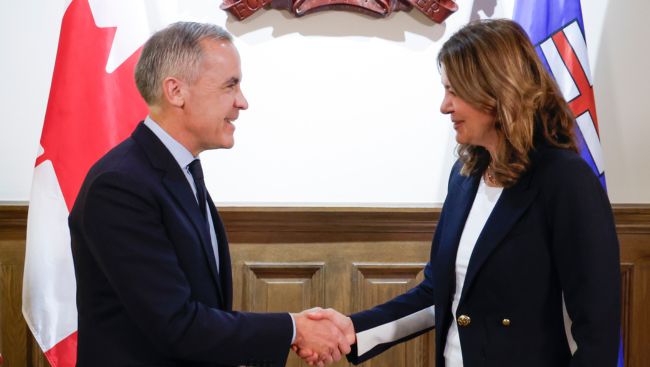
Prime Minister Mark Carney and Alberta Premier Danielle Smith have signed a memorandum of understanding that commits them to working toward building an oil pipeline to the West Coast — and opens the door to changes to the coastal tanker ban.
At a signing ceremony in Calgary on Thursday, the two agreed that Ottawa would enable the export of oil through a deepsea port to Asian markets and “if necessary” adjust the tanker ban to make that happen.
Ottawa's commitment is contingent on the pipeline being approved as a project of national interest, and on the project providing "opportunities for Indigenous co-ownership and shared economic benefits."
“This is a really great day for Albertans," Smith said ahead of the signing event.
"We have been working for some time on addressing the nine bad laws, as I like to call them, that have been impacting our investment climate here. I'm pleased that we've reached an agreement to substantially removing and revising those laws."
Those "bad laws" Smith cites include the clean electricity regulations and the federal emissions cap — both of which Alberta will be exempt from under the memorandum of understanding with Ottawa.
"It's a great day for Alberta and a great day for Canada," Carney said.
"In effect, it created an energy transition, but really sets the stage for an industrial transformation. At the core of the agreement, of course, is a priority to have a pipeline to Asia. That's going to make Canada stronger, more independent, more resilient, more sustainable."
The announcement comes after a group of First Nations in B.C. said that a new pipeline to the Pacific coast will never be built, and after B.C. Premier David Eby said lifting the tanker ban would threaten projects already in development in the region and consensus among coastal First Nations.
The memorandum of understanding between the federal and provincial governments says Ottawa and Alberta will engage with B.C. on the pipeline project and work with the province to advance its own economic interests through major projects.
The agreement pairs the pipeline project to the proposed Pathways Alliance carbon capture project and government officials say the two projects must be built in tandem.
The agreement says Ottawa and Alberta will with work with the Pathways Alliance partner companies — Canadian Natural Resources, Cenovus, ConocoPhillips Canada, Imperial and Suncor — to identify by April 1 new emissions-reduction projects to be rolled out starting in 2027.
The MOU says Ottawa and Alberta will sign an agreement by April 1 to mandate a 75 per cent cut in methane emissions by 2035 compared to 2014 levels.
That's a slight change from Ottawa’s most recent draft regulations — published two years ago — which called for a 75 per cent reduction by 2030 compared to 2012 levels. The latest federal budget committed to reinforced methane regulations.
Ottawa also has committed to suspending the clean electricity regulations, but only in Alberta.
The regulations, which are to come into effect in 2035, would set limits on emissions from power generation using fossil fuels. Alberta has long criticized the regulations, as its grid is predominantly powered by natural gas.
But the commitment to suspending the regulations in Alberta is contingent on the federal and provincial governments coming to a new carbon pricing agreement by April 1. Alberta has agreed to increase its industrial carbon price to $130 per tonne by April 1, putting it above the federal benchmark.
The carve-out on the clean electricity regulations is a significant win for Alberta, which is trying to attract investment for AI data centres but has struggled with meeting their electricity demands.
The agreement sets a goal of boosting Alberta's electricity generation to meet the needs of AI data centres, while Alberta commits to drafting with Ottawa a nuclear generation strategy by January 2027.
During a technical briefing Thursday, government officials said while Alberta’s commitment to a $130 per tonne carbon price is a “minimum” standard for the province, there are no guarantees it will increase on pace with the federal backstop price — which is set to rise to $170 per tonne by 2030.
Officials said those details still need to be negotiated, though the MOU signed Thursday cites “affordability” as one of the objectives.
Picture Courtesy: THE CANADIAN PRESS/Jeff McIntosh


