

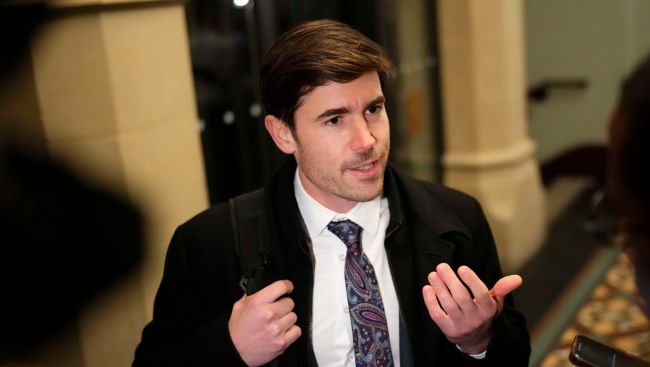
A British Columbia Liberal MP said Wednesday Prime Minister Mark Carney "will have to answer" questions on why he reversed a budget commitment on tax credits when he signed the Alberta energy deal.
The memorandum of understanding between Ottawa and Alberta extends federal tax credits for carbon capture to enhanced oil recovery, overturning a commitment the federal government made in the recent budget not to do so.
Speaking to reporters on his way into a Liberal caucus meeting, Liberal MP Patrick Weiler said Canada has a "a pretty clear stance" on moving away from inefficient fossil fuel subsidies and extending tax credits to enhanced oil recovery is a "step in the wrong direction."
"I think that's a really important thing that the prime minister will have to answer about," Weiler said.
Enhanced oil recovery is a carbon storage technology that captures carbon dioxide from industrial emitters and injects it underground at oilfields. That increases pressure and pushes more oil out of the rock, while the carbon dioxide is trapped underground.
Environmentalists see the extension of the tax credits to enhanced oil recovery as a direct subsidy of oil production, while the industry says tax measures are not subsidies.
The section of the budget addressing tax credits for carbon capture utilization and storage, often abbreviated as CCUS, said enhanced oil recovery would not be eligible for a federal tax credit.
But the deal with Alberta commits Canada to extending federal tax credits to encourage large-scale CCUS investments, including the Pathways Alliance project, as well as "enhanced oil recovery in order to provide the certainty needed to attract large additional sources of domestic and foreign capital."
Green Party Leader Elizabeth May said she had heard rumours that the government was going to reverse its budget commitment on enhanced oil recovery, which initially kept her from supporting the budget.
As The Canadian Press reported last week, then-cabinet minister Steven Guilbeault was dispatched to win May's vote for the budget last month, having received assurances from Carney's office that tax credits for enhanced oil recovery would not be in the budget or added to it afterwards.
May told The Canadian Press last week the flip-flop amounted to a "significant betrayal" and she now questions Carney's word going forward.
Patrick Bonin, the Bloc Québécois critic for environment and climate change, told The Canadian Press that the decision was "unfortunately" not surprising.
"Carney's word on the environment means nothing, we can't rely on him," Bonin said in French.
Bonin argued that Carney doesn't consider the environment and is only here to respond to oil companies' demands.
"It will probably be billions more in public money for oil companies, it's a testament to how Mr. Carney doesn't care about the environment," Bonin said in French. "Not only can people not trust him, but unfortunately there is no credibility when he talks about climate change."
Carney did not stop to take questions from reporters Wednesday, either before or after the caucus meeting or as he entered the House of Commons.
Neither Energy and Natural Resources Minister Tim Hodgson nor Environment Minister Julie Dabrusin would answer questions about the tax credit.
Hodgson told The Canadian Press the day the pipeline deal was signed that extending the tax credits to enhanced oil recovery was important to Alberta.
Finance Minister François-Philippe Champagne told reporters Wednesday he would get back with an answer on why the government contradicted the budget in the Alberta deal.
"I think what you've found in the budget is that there's a number of tax credits. I would say that we're probably, in the G7, the country which has offered the most competitive tax environment for clean technology when it comes to natural resources," he said.
"I would say that Canada is well positioned to be a responsible and also a sustainable producer of natural resources."
Not all Liberal MPs seemed concerned about the change of direction Wednesday.
Thunder Bay MP Marcus Powlowski said the government should have the flexibility to adjust the policy stances it presents in the budget.
Toronto Liberal MP Nathaniel Erskine-Smith, meanwhile, said enhanced oil recovery is an unproven method and he would have more to say about it soon.
Picture Courtesy: THE CANADIAN PRESS/Justin Tang


